You might think you know exactly where bees live, but you are likely stepping right over the largest colonies on earth.
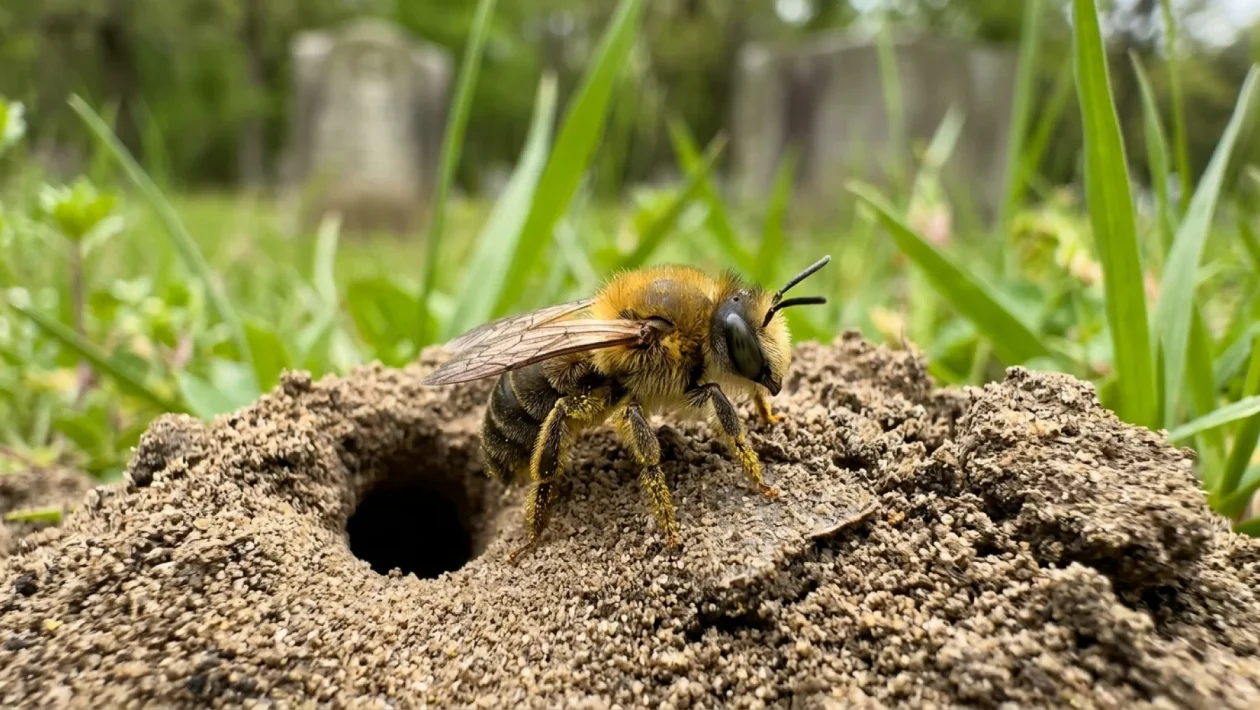
Right now, in May 2026, researchers are marveling at a staggering 5.5 million ground-nesting bees discovered thriving just inches beneath the soil of a quiet Ithaca, New York cemetery. It turns out, this massive, hidden underground workforce is the absolute secret weapon keeping our North American agriculture alive.
Ground-Nesting Bees: The Ultimate Independent Contractors
When most folks think of bees, they picture stacked wooden boxes and dripping honeycomb.
But here is a hard, surprising fact: a massive 75% of all bee species are solitary ground-nesting bees. They do not build giant hives, and they definitely do not answer to a queen.
Think of the Andrena regularis (the regular mining bee) as the ultimate independent contractor of the insect world. Every female digs her own underground chamber, stocks it with pollen, and raises her young entirely off the grid.
Without these fiercely independent pollinators, our favorite early-spring crops would completely tank. Next time you bite into a crisp apple from Loblaws or grab a quick fruit pastry at Tim Hortons, you owe a nod to these relentless subterranean workers.
Why 5.5 Million Pollinators Chose A Graveyard
So, why would millions of vital pollinators set up shop in a cemetery dating back to 1878?
It all comes down to prime real estate. These bees require perfectly undisturbed, sandy soil to build their intricate tunnels.
Cemeteries provide a rare sanctuary. They are peaceful, rarely tilled, and largely free of the harsh commercial pesticides you would find on industrial farmland. It is a quiet urban refuge that has allowed this single bee aggregation to quietly outnumber the human population of Manhattan by more than threefold!
“The research elevates the value of solitary ground-nesting bees and shows just how abundant these bees are, how important they are as crop pollinators, and that we need to be aware of these nest sites and preserve them.”
That brilliant insight from Cornell University entomology professor Bryan Danforth perfectly nails why we need to fundamentally rethink how we manage our green spaces across North America.
Hiding Underground In Plain Sight: Finding The Hidden Millions
Spotting a few million bees sounds easy until you realize they spend almost their entire lives completely out of view.
To actually count this hidden army, scientists at Cornell could not just walk around with a clipboard. They had to get creative with specialized mesh emergence traps.
Here is the exact step-by-step process of how this underground society springs to life every April and May:
- The Scout Phase: As soon as the spring soil hits 70 degrees, the male bees break through the surface first.
- The Waiting Game: The males aggressively patrol the nesting site, waiting for the females to emerge a few days later so they can mate immediately.
- The Dig: The fertilized females quickly tunnel back into the earth, creating fresh brood cells packed with pollen and nectar for the next generation.
- The Overwintering: The new larvae develop into adults completely underground, waiting patiently until the following spring’s apple bloom to emerge.
It is a highly synchronized, incredibly efficient lifecycle that has been happening under our boots for over a century.
| Ground-Nesting Bees | Standard Honeybees |
|---|---|
| Solitary and fiercely independent | Highly social, living in massive structured hives |
| Nest in sandy, undisturbed soil | Nest in man-made wooden boxes or tree cavities |
| Overwinter as full adults underground | Cluster together inside the hive to stay warm all winter |
| Rarely sting, incredibly docile | Will aggressively defend the communal hive |
Frequently Asked Questions
Do ground-nesting bees sting?
Almost never. Because they are solitary and do not have a communal hive or a queen to defend, they are incredibly docile. The cemetery superintendent in Ithaca actually walked right among them for 46 years without taking a single sting.
Should I mow my lawn if I see ground nests?
If you can, give them some space. These bees are only active above ground for a few short weeks in the spring. Leaving their nesting patches undisturbed ensures they can properly pollinate your local neighborhood ecosystem.
Are there predators that attack these underground bees?
Yes. Nomad or “cuckoo” bees are notorious brood parasites. They sneak into the underground nests, lay their own eggs, and their hatching larvae eventually consume the host’s carefully stored pollen.
🤝 Share your thoughts in the comments below if you have ever spotted these tiny dirt volcanoes in your own backyard!
💡 Remember, a perfectly manicured lawn might look nice, but leaving a little patch of sandy dirt untouched could literally feed millions of essential pollinators.
📱 Send this article to that one neighbor who is absolutely obsessed with keeping their garden pristine.
👇 Good luck out there, and keep your eyes focused on the dirt the next time you take a walk through the neighborhood.