The Dirty Truth About House Keys
You handle your house keys multiple times a day. They constantly travel from unwashed hands to dirty pockets, countertops, and public surfaces.
This endless contact makes them a major, yet often ignored, carrier of bacteria and microscopic grime.
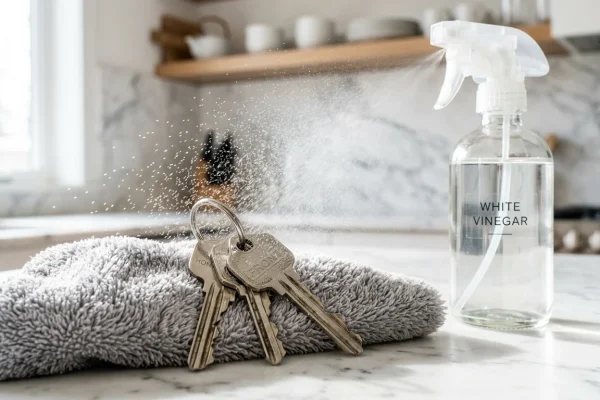
A set of metal keys resting on a surface, ready to be sanitized with vinegar.
The Science Behind Acetic Acid
To combat this contamination, cleaning professionals rely on a cheap and highly effective household staple: white vinegar. The secret lies entirely in its chemical makeup.
White vinegar contains acetic acid, a compound widely recognized for its powerful antibacterial and antifungal properties. Research published in the Journal of Food Protection and the International Journal of Environmental Health Research confirms its effectiveness.
These studies demonstrate that acetic acid significantly reduces common bacteria on frequently touched surfaces. It destroys microorganisms completely without relying on harsh, synthetic chemicals.
A mixture of white vinegar and salt used as a highly effective natural household cleaner.
Removing Grease and Restoring Shine
Vinegar does much more than simply sanitize metal. It effortlessly breaks down the invisible layers of sweat, natural skin oils, and grease that bind to keys over time.
The liquid neutralizes lingering odors and prevents dust from sticking to the surface. It also restores a clean, polished shine to dull metal keys.
Because it evaporates cleanly and leaves zero toxic residue behind, it remains perfectly safe for items you touch daily.
Baking soda and vinegar combining to create a powerful, natural cleaning reaction.
The 15-Minute Disinfection Routine
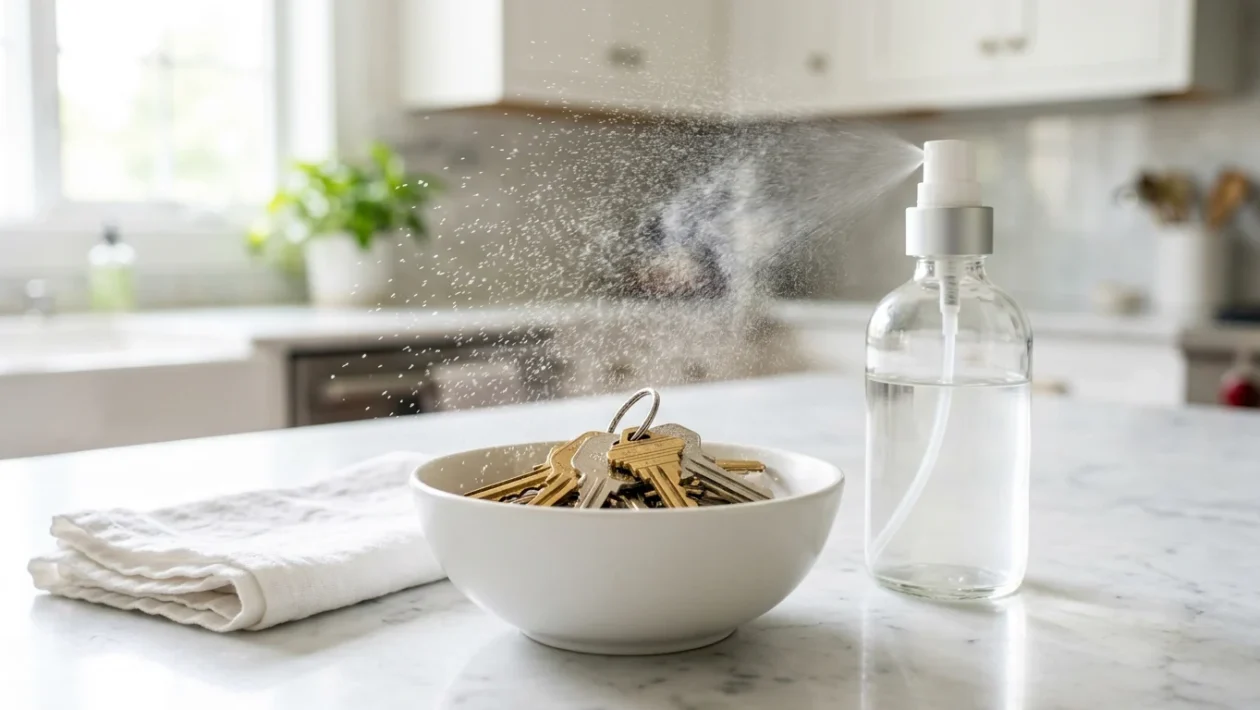
Sanitizing your keys requires minimal effort. Start by placing them on a clean cloth or inside a small bowl.
Spray the metal generously with white vinegar until fully coated. Let the acid sit and work for 5 to 10 minutes.
If you have never cleaned your keys before, extend the soaking time to a full 15 minutes. Afterward, scrub the keys gently with an old toothbrush to dislodge any stubborn dirt trapped inside the grooves.
Finally, dry the metal thoroughly with a clean rag to prevent moisture buildup and rust. Repeat this simple routine once or twice a week to maintain optimal hygiene.