
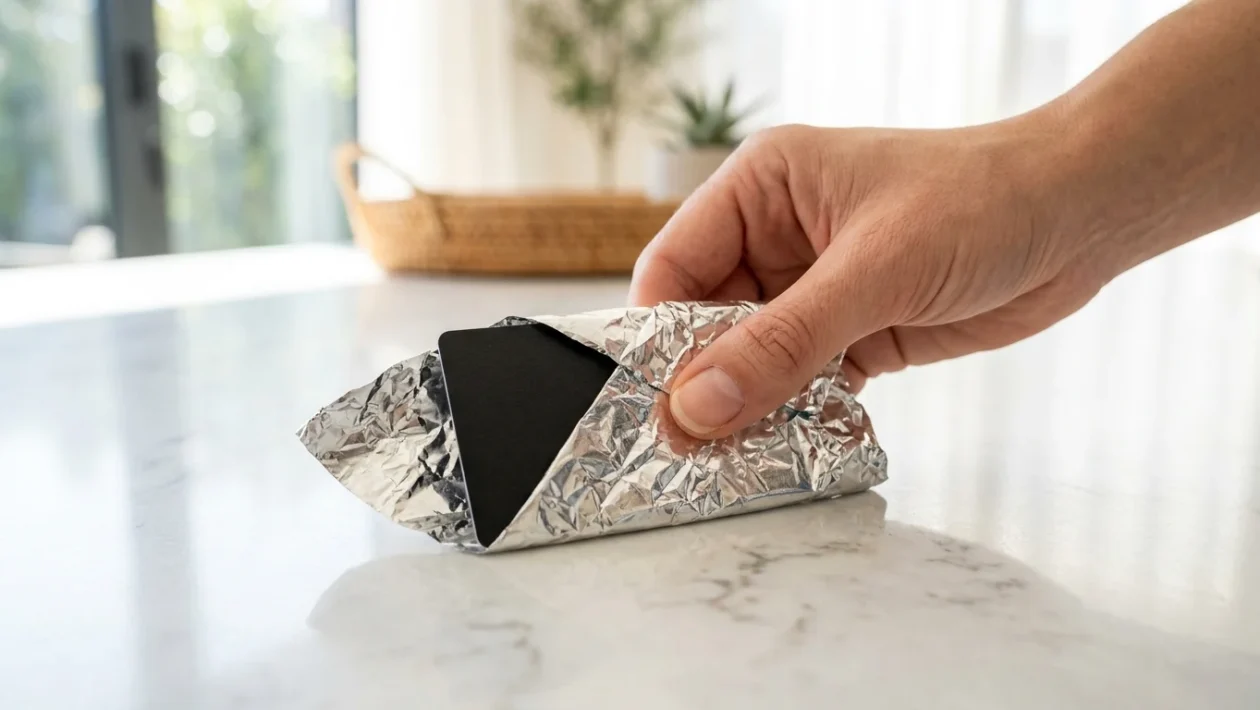
Contactless data theft is no longer a sci-fi movie trope. It happens quietly in everyday life, prompting consumers to adopt a seemingly primitive but highly effective defense: wrapping credit cards in aluminum foil.
While it might look odd, this zero-cost trick relies on solid physics to protect your personal finances without requiring a specialized wallet.
The Mechanics of Wireless Skimming
Most modern credit cards are equipped with RFID or NFC technology for quick “tap-to-pay” transactions. This convenience comes with a hidden vulnerability known as wireless skimming.
Thieves armed with concealed radio-frequency readers can capture your card’s signal and extract sensitive data without ever touching your wallet.
This type of fraud thrives in crowded environments like public transit systems, busy airports, and shopping malls. Criminals simply brush past their victims, activating their hidden scanners to clone data in mere seconds.
The Faraday Cage Effect
The foil trick relies on the scientific principle of the Faraday cage, a structure that completely blocks electromagnetic fields. Because aluminum is a conductive material, it acts as a physical barrier that stops radio waves from entering or escaping.
When you wrap your card in foil, you disrupt the specific 13.56 MHz frequency utilized by most contactless payment systems. This renders external readers completely blind to your card’s data.
It provides the exact same utility as premium RFID-blocking wallets, just without the retail markup.
How to Execute the Strategy Properly
The method only works if applied correctly. A sloppy wrapping job will still leave your card vulnerable to high-powered scanners. To maximize protection, follow these basic rules:
- Complete coverage: Ensure the entire card is wrapped with no exposed edges.
- Use enough layers: A double wrap provides significantly stronger electromagnetic blockage than a single sheet.
- Check material integrity: Replace the foil immediately if you notice any tears, punctures, or extreme wear.
- Be gentle: Do not press the foil down too aggressively, as this can physically damage the card’s internal microchip.
While this DIY shield is highly effective against local skimming, it shouldn’t be your only line of defense. Setting up real-time transaction alerts, monitoring your bank statements closely, and utilizing your bank’s official app remain essential steps for comprehensive fraud protection.

