Picture this: your partner is in active labour, you’re flying down the Trans-Canada Highway, and the baby isn’t waiting for the next exit. Thanks to rampant rural hospital closures, roadside births are no longer just a wild movie trope—they are a terrifying reality for Canadian parents right now. Today, we’re breaking down exactly why our healthcare system is forcing families onto the asphalt and, more importantly, how to take control and deliver safely if you’re ever caught in this nightmare.
Roadside Births: The Terrifying Reality For Rural Parents
Nobody expects to welcome their child next to highway marker 242. But for New Brunswick parents Mariah Jackson and Fernando Gonzalez, that was exactly how their baby boy, Liam, entered the world this spring. Living just seven minutes from their local hospital, they thought they had plenty of time.
Instead, they found themselves pulled over in sheer panic. When Fernando delivered his son, the baby was blue and unresponsive in his hands. It was a heart-stopping 10 minutes before paramedics finally arrived on the scene.
This isn’t an isolated fluke. Ambulance New Brunswick has already responded to 10 pregnancy-related highway calls just this year. When you’re miles from help, you have to be the first responder.
Surviving Rural Hospital Closures: Why Your Local Ward Is Locked
If you live outside a major city, you know the drill. You check the news to see if your local ER or obstetrics unit is even open. The Upper River Valley Hospital in Waterville has suspended its labour and delivery services multiple times a year since 2021.
When those doors lock, expectant mothers are diverted to Fredericton—over an hour away. That massive distance is a ticking time bomb for moms who experience fast labours. While the provincial government claims they’ve recruited five permanent physicians and 15 nurses for the 2025-26 fiscal year, local politicians are bluntly warning that someone is going to die if the system isn’t fixed immediately.
“What we’re seeing is that, when you do close units, it increases stress for women, families and also increases the risk to those moms that have to travel that long distance. If you do not have a dedicated maternal-neonatal transport system, there is no guarantee transport will be available in a timely fashion.” — Dr. Lynn Murphy-Kaulbeck, President of the Society of Obstetricians and Gynaecologists of Canada
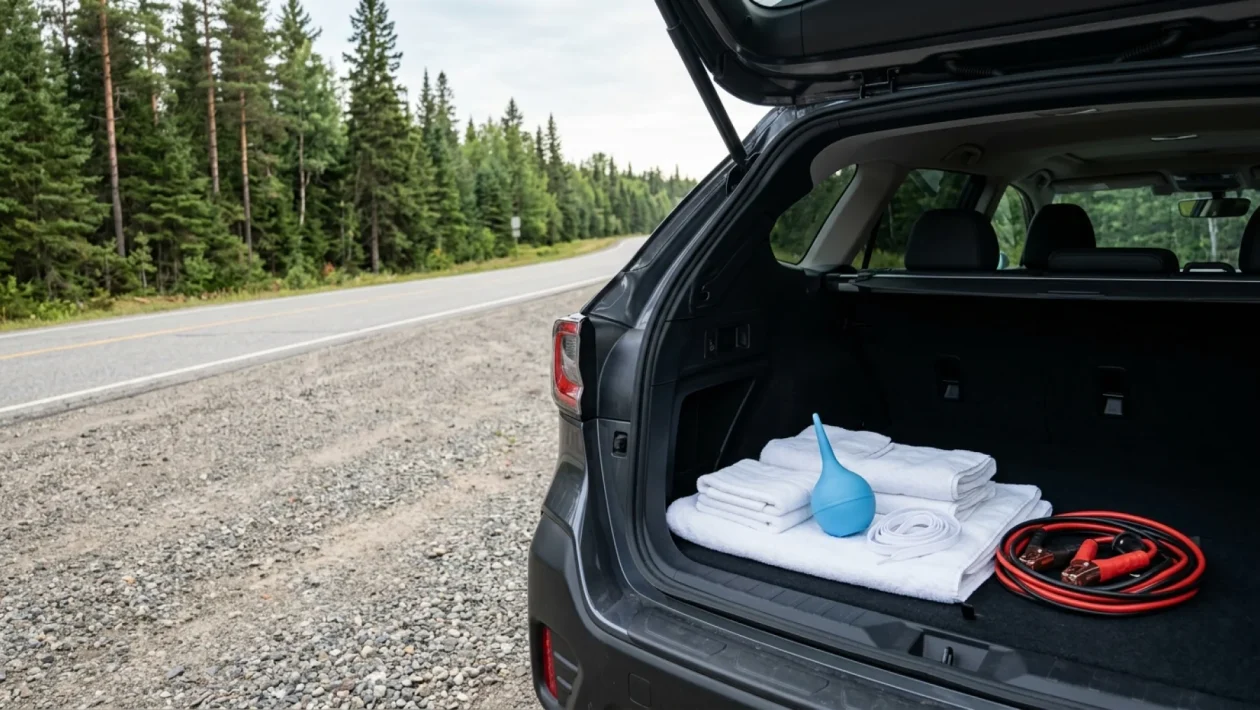
Until a dedicated transport system is built, you need to treat your family vehicle like a backup delivery ward. Here is what you should keep packed in the trunk, right next to your booster cables from Canadian Tire.
| Emergency Kit Item | Practical Purpose |
|---|---|
| Clean Towels & Blankets | Drying the baby and retaining critical body heat immediately after birth. |
| Bulb Syringe | Clearing amniotic fluid from the newborn’s mouth and nose so they can breathe. |
| Clean Shoelace or String | Tying off the umbilical cord (do NOT cut it yourself unless explicitly instructed by 911). |
| Heavy-Duty Garbage Bags | Protecting your car seats and keeping the makeshift delivery area sanitary. |
Emergency Highway Deliveries: Step-By-Step Action Plan
If you are driving your Ford F-150 or family SUV down the highway and realize the baby is coming right now, panic is your worst enemy. You need to channel your inner handyman, stay grounded, and follow a clear process.
- Pull over safely: Get as far off the highway shoulder as possible, ideally past blind curves. Turn on your four-way flashers immediately.
- Call 911 on speakerphone: Get dispatch on the line right away. They will walk you through the entire process and dispatch paramedics to your exact GPS location.
- Prep the space: Recline the passenger seat fully. Lay down your garbage bags first, followed by clean towels to create a makeshift sterile zone.
- Support the delivery: As the baby crowns, do not pull. Gently support the baby’s head and body as they emerge naturally.
- Clear the airway and warm the baby: Use a towel to wipe the baby’s mouth and nose. Place the baby directly on the mother’s bare chest for skin-to-skin contact, then cover them both with dry blankets to prevent hypothermia.
Frequently Asked Questions
Should I cut the umbilical cord myself on the side of the road?
Absolutely not. Unless the 911 dispatcher gives you direct orders to do so because of a severe medical complication, leave the cord intact. Keep the baby warm on the mother’s chest and wait for the paramedics to handle the clamping and cutting with sterile medical equipment.
What if my local hospital suspends services right before my due date?
If you are 35 weeks or more into your pregnancy, hospital staff are supposed to contact you directly if a diversion is confirmed. However, don’t wait for the phone to ring. Work with your doctor to create a rock-solid secondary birth plan, map out the route to the alternate hospital, and always keep your gas tank full.
Is the government doing anything to stop these roadside births?
Health officials are currently scrambling to recruit more locum physicians and permanent staff to rural hospitals. However, medical experts are pushing hard for a specialized maternal-neonatal ambulance system that doesn’t compete with regular 911 calls.
🤝 You are your family’s first line of defense. While we all hope the healthcare system fixes these rural closures, knowing how to handle an emergency highway birth gives you ultimate peace of mind.
💡 Preparation beats panic every single time. Pack that emergency kit, talk to your partner about the “what-ifs,” and make sure your vehicle is always ready for an unexpected detour.
📱 Good luck out there, and stay safe on the roads. If you’ve experienced a crazy hospital diversion or a roadside emergency, share your thoughts with your community—we need to keep talking about this.
👇 Drop a comment below or forward this guide to an expecting parent who lives out in the country. It just might save a life!