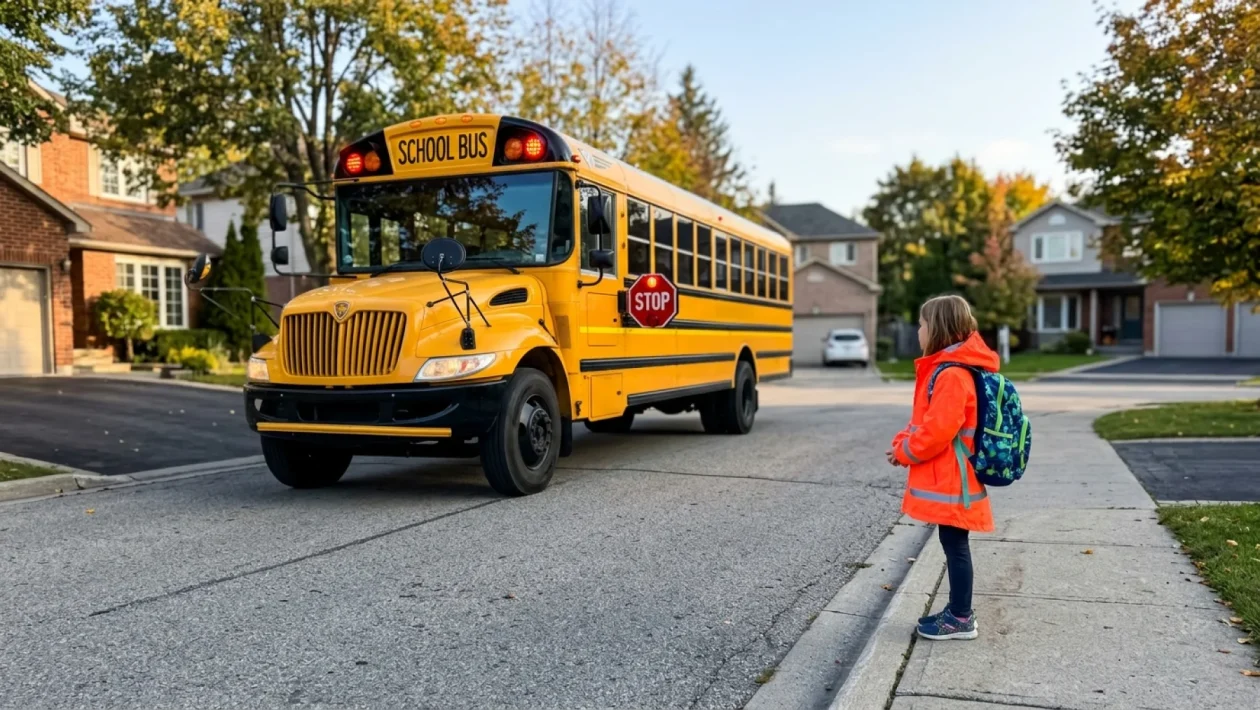
Every morning, we send our kids out the door, expecting the big yellow bus to deliver them safely to the classroom. But a terrifying incident this May in P.E.I. proved that our daily routines can shatter in seconds. A student was seriously injured while simply trying to board their bus on Route 2 near Dunstaffnage, prompting a massive RCMP response and a full highway shutdown. It is a gut-wrenching wake-up call for every parent and driver on the road. We need to stop relying on blind luck and start taking concrete steps to secure our school zones.
School Bus Safety
When we talk about school bus safety, we usually picture seatbelts and padded seats. But the reality is much harsher. According to Transport Canada, while school buses are statistically 16 times safer than family cars, the absolute most dangerous time for a student is before they even step foot on the stairs. The danger zone is entirely outside the vehicle.
You can buy your kids the brightest, high-visibility spring rain jackets from MEC, but reflective gear is only half the battle. If drivers are distracted or kids are standing in the driver’s blind spots, high-end gear will not stop a moving vehicle.
We have to shift our mindset. Safety is not just the responsibility of the bus driver or the school board. It is a shared contract between pedestrians, parents, and every single commuter rushing to grab their morning coffee at Tim Hortons before work.
How to Protect Our Kids
If you want to keep your kids safe, you have to drill the right habits into them before they ever leave the driveway. Kids are easily distracted, especially on a crisp spring morning when they are joking around with friends. It is our job to build reliable, automatic routines.
Here is the exact pre-boarding drill you need to practice with your children:
- The 10-Foot Rule: Teach your kids to stand at least three giant steps (about 10 feet) back from the curb while waiting.
- Wait for the Signal: Never approach the bus until it comes to a complete, dead stop and the driver opens the door or gives a clear hand signal.
- Look Before You Leap: Even with the flashing red lights on, kids must look left, right, and left again before crossing the road to board.
- Stay Visible: If a child drops something near the bus, they must leave it. Never bend down in front of the bus where the driver cannot see them.
To put this into perspective, let’s break down the most critical areas around the bus. Memorize this breakdown so you know exactly where the risks lie.
| Bus Perimeter Zone | Risk Level & Action Required |
|---|---|
| Directly in front (0-10 feet) | Extreme Danger. The driver has zero visibility. Never walk here. |
| Right side (door side) | High Risk. Wait exactly 10 feet back until the door fully opens. |
| Directly behind the bus | Extreme Danger. Complete blind spot. Stay away entirely. |
After the Tragic P.E.I. Crash
The Thursday morning incident on Route 2 is still being investigated, but it highlights a terrifying reality about our rural and suburban highways. The Public Schools Branch immediately deployed support staff, but the emotional toll on the students who witnessed the event will last much longer.
As drivers, we are the ones commanding thousands of pounds of steel. When you see amber lights flashing on a bus, it is not a signal to speed up and pass before the red lights come on. It is a warning to hit the brakes immediately.
“The majority of close calls and injuries around school buses come down to a deadly mix of driver impatience and a lack of situational awareness. Ten saved seconds on your morning commute is never worth a child’s life.”
The RCMP shutting down a highway in both directions is a massive operational undertaking. But it is also a stark reminder that when metal meets flesh, there are no minor accidents. We owe it to the kids of P.E.I., and across the entire country, to do better.
Frequently Asked Questions
When exactly do I have to stop for a school bus?
In all Canadian provinces, you must come to a complete stop when a school bus has its upper red lights flashing and the stop arm extended. This applies to traffic in both directions unless you are on a divided highway with a physical median.
What is the “danger zone” around a bus?
The danger zone is the 10-foot perimeter completely surrounding the school bus. This is where the driver’s blind spots are largest and where kids are most likely to be struck by the bus itself or a passing vehicle.
How can I make my child more visible at the bus stop?
Equip them with backpacks that have reflective stripping, avoid dressing them in dark colors during early morning hours, and attach a small LED safety light to their jacket zipper for dark or foggy spring mornings.
🤝 Share your thoughts with your kids tonight at the dinner table. Having a simple five-minute conversation about road rules can literally save a life.
💡 Make it a habit to check your own driving speed the second you enter a school zone. We all get rushed, but nothing is more important than getting everyone home safely.
📱 If you see dangerous driving around a school bus, do not hesitate to report the license plate to your local RCMP detachment. Community vigilance is our best defense.
👇 Good luck out there on the roads, stay alert, and let’s make sure an incident like this never happens in our neighborhoods again.