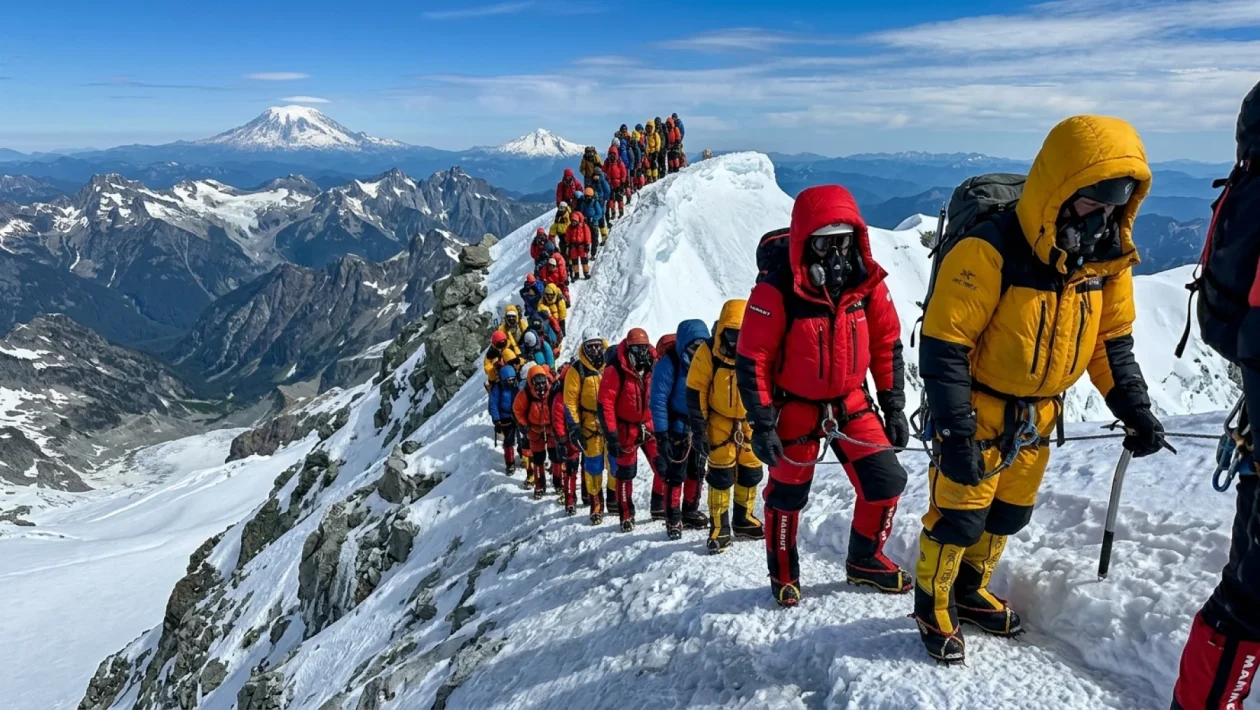
Imagine paying $80,000 to stand in a frozen lineup at 29,000 feet while your supplemental oxygen slowly bleeds dry. That is the harsh, unspoken reality of modern high-altitude mountaineering. We are looking at a historic bottleneck where a staggering 274 climbers scaled the world’s highest peak in a single 24-hour window. If you think scaling a mountain is just about putting one foot in front of the other, you are dead wrong. Today, the biggest threat on the mountain is not the avalanche risk—it is the person standing right in front of you.
Everest Overcrowding: The Reality of the “Death Zone” Lineup
We need to talk about Everest overcrowding and what it actually does to the human body. When you cross the 8,000-metre mark, you enter what alpinists flatly call the “Death Zone.”
Up there, your body is literally dying by the minute. Human beings simply were not built to digest the razor-thin air found at cruising altitude for a commercial airliner.
Yet, as of May 2026, the summit ridges look more like the queue for a downtown Toronto nightclub than a pristine alpine wilderness. Waiting for hours clipped into a single fixed rope means frostbite creeps into your extremities while severe exhaustion takes over your brain.
Why 274 Climbers Summited in One Day
You might be wondering how we ended up with a literal traffic jam in the clouds. The answer comes down to weather windows colliding with aggressive commercialization.
Every spring season, the jet stream shifts, offering a fleeting few days where the winds drop low enough for a summit push. When the meteorologists call the window, every single commercial expedition leaves Base Camp at the exact same time.
This creates a massive funnel effect on the Hillary Step and the final summit ridge. It is a terrifying numbers game. Statistically, pushing a record 274 people to the top simultaneously stretches the mountain’s fragile safety infrastructure to the absolute brink.
How to Survive High-Altitude Traffic Jams
So, how do the pros handle a frozen standstill when turning back is simply not an option? You have to treat the waiting game as a highly calculated survival scenario.
It is not just about having the grit to push forward. It is about flawless thermal management and strict oxygen conservation.
Here is the proven survival protocol for outlasting a massive bottleneck:
- Regulate your flow: The moment you stop moving, dial down your oxygen regulator to conserve your tank, but never shut it off completely.
- Keep the blood pumping: You cannot walk, so you must aggressively wiggle your toes and clench your fists inside your mitts to keep circulation moving.
- Trust elite gear: This is where your investment pays off. You want proven North American kit like a custom down suit from Arc’teryx or heavy-duty expedition layers from MEC to trap every ounce of body heat.
- Maintain mental focus: Do not let the panic of the crowd infect you. Focus on deep, rhythmic breathing and continuously monitor the climber ahead of you for signs of altitude sickness.
Dealing with these extremes separates the casual tourists from the real mountaineers.
“The mountain doesn’t care how much you paid to be there. When you’re stuck on a ridge behind forty other climbers, your survival depends entirely on your patience, your gear, and how flawlessly you manage your oxygen.”
If you are entirely rethinking the Himalayan crowds, Canada offers world-class, brutal alternatives. Let us compare the heavily trafficked Everest to Canada’s own Mount Logan.
| Factor | Everest vs. Mount Logan |
|---|---|
| Crowd Level | 270+ per day vs. Completely isolated |
| Price Tag | $80,000+ CAD vs. Under $10,000 CAD |
Frequently Asked Questions
Is it safe to climb with so many people on the mountain?
Safety is highly compromised during a bottleneck. More people means significantly slower moving times, which dramatically increases the risk of oxygen depletion and severe frostbite while waiting.
Why don’t climbers just pass each other?
At 29,000 feet, you are clipped into a single safety rope on a ridge that is often only a few feet wide. Unclipping to pass an exhausted climber over a 10,000-foot sheer drop is essentially a death wish.
Will climbing permits be capped in the future?
Local authorities frequently discuss tightening permit regulations. However, the massive economic boost from mountain tourism makes strict caps a highly complex political issue.
🤝 Look, getting to the top of the world is an incredible feat, but the modern reality of Everest overcrowding demands a serious reality check. It is not just about physical fitness anymore; it is about surviving the crowds.
💡 Whether you are aiming for the high Himalayas or tackling rugged, isolated peaks right here in the Canadian Rockies, the golden rule remains exactly the same: respect the mountain and always prep for the worst.
📱 If you found this breakdown helpful, send it to your regular hiking buddy or that friend who is obsessed with high-altitude climbing documentaries.
👇 Drop a comment below and share your thoughts—would you brave the frozen line at 29,000 feet, or are you sticking to the quiet backcountry trails?