Step outside across North America right now, and the heavy, acrid stench of burning timber hits you like a brick wall. The skies from the Great Lakes to the East Coast have turned into a hazardous haze this July 2026, trapping millions under a dome of dangerous air. You cannot simply tough it out or wait for a breeze to clear the neighborhood.
I have covered extreme environments for years, and I can tell you firsthand that breathing in pulverized ash requires serious defense mechanisms. Wildfire smoke protection is not about panic; it is about practical, calculated steps to keep your family’s respiratory system out of the danger zone. Below, I am going to show you exactly how to lock down your home, filter your air, and navigate the outdoors safely until the skies clear.
Wildfire Smoke Protection: Understanding the Invisible Threat
You might think the real danger is the smoke you can actually see, but your eyes are lying to you. The true enemy is entirely invisible to the naked eye.
Wildfires churn out a massive cocktail of gases and fine particulate matter, officially known as PM2.5. Here is a hard, uncomfortable fact: PM2.5 particles are roughly 30 times smaller than a single strand of human hair.
Because they are so incredibly tiny, they bypass your body’s natural defense systems entirely. They do not just irritate your throat; they lodge deep within your lung tissue and slip directly into your bloodstream, causing immediate cardiovascular strain.
“The biggest mistake homeowners make is trusting their noses. By the time you smell the campfire scent indoors, millions of microscopic particulates have already breached your living space, triggering long-term cellular inflammation.” — Dr. Sarah Jenks, Environmental Health Authority
Defending Your Lungs with Bulletproof Indoor Air
Your home is your castle, but right now, it needs to function like a submarine. When the outdoor air quality index (AQI) hits hazardous levels, your priority is establishing a dedicated clean room.
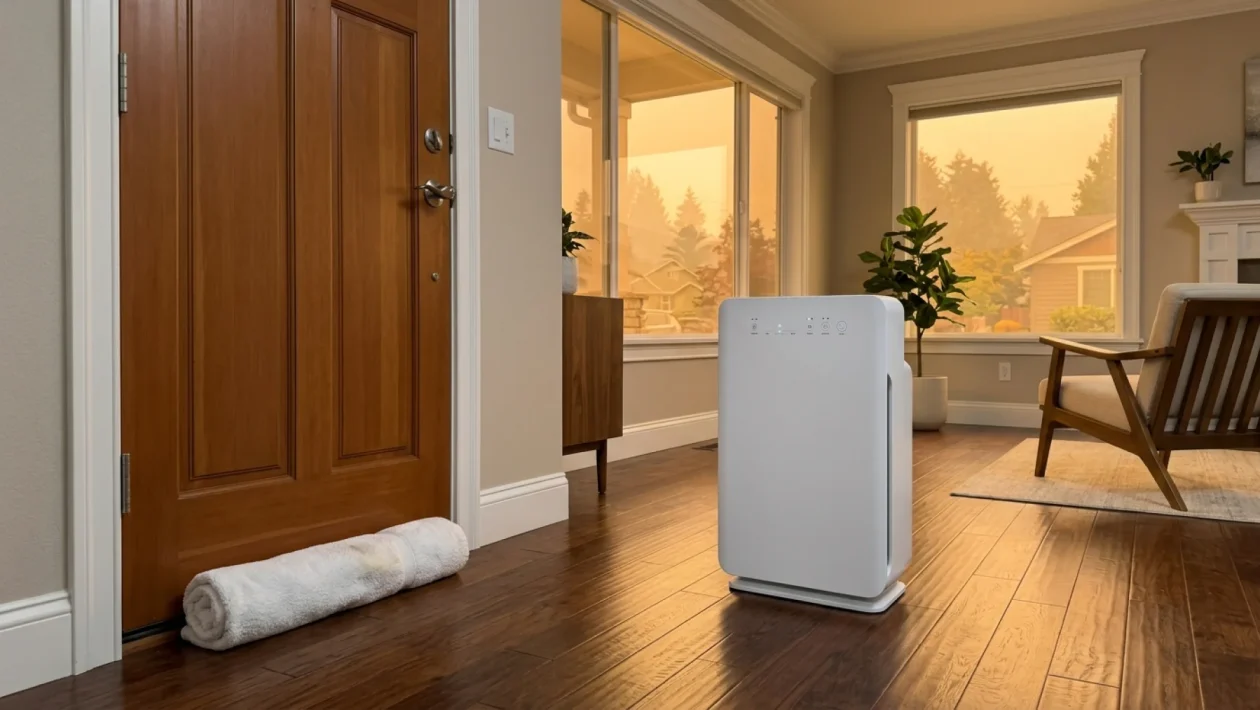
You need to mechanically scrub the air. I always rely on a trusted Honeywell True HEPA purifier to do the heavy lifting in my main living space. If you are on a budget or purifiers are sold out everywhere, you can build your own air scrubber in minutes.
Here is my foolproof method for locking down your indoor environment:
- Seal the perimeter: Close all windows and use rolled-up damp towels at the base of exterior doors to block drafty gaps.
- Kill the intake: Turn off any window air conditioning units that pull fresh air from the outside, and set your central HVAC system to “recirculate.”
- Run the scrubber: Place your HEPA purifier in the center of your primary living space and run it continuously on its highest setting.
- Minimize indoor pollution: Stop vacuuming, do not burn candles, and avoid frying food on the stove, as these activities drastically spike indoor particulate levels.
Navigating the Danger When Skies Turn Toxic
Sometimes staying indoors just is not an option. You have to work, grab groceries, or check on a neighbor. When the skies turn toxic, your outdoor strategy must be flawless.
Ditch the cloth masks and those flimsy blue surgical masks; they are practically useless against wildfire smoke. You need a tight-fitting seal over your nose and mouth. Slapping on a genuine 3M N95 respirator is the only proven way to filter out 95% of those airborne toxins.
To keep things simple, here is a quick breakdown of your primary defense options when the air turns sour:
| Protection Method | Effectiveness Against Smoke |
|---|---|
| N95 / KN95 Respirator | Excellent (Filters 95% of PM2.5 particles) |
| Standard Surgical Mask | Poor (Offers zero seal against fine ash) |
| True HEPA Purifier | Excellent (Safest option for long-term indoor use) |
| DIY Box Fan Filter | Good (Great emergency indoor alternative) |
Frequently Asked Questions About Smoke Safety
How long do these hazardous smoke conditions usually last?
It depends entirely on shifting weather patterns and high-pressure systems. As we are seeing this summer, a stagnant pressure system can trap toxic air close to the ground for days or even weeks. Always check your local AQI daily before planning activities.
Can I exercise outdoors if the smoke looks a little lighter today?
Absolutely not. Vigorous exercise forces you to breathe deeper and faster, pulling PM2.5 particles further into your lung tissue. If the AQI is above 100, move your workout to the basement or the living room.
Are my pets safe outside in the smoke?
Your dog or cat is actually more vulnerable to respiratory distress than you are, due to their smaller lung capacities. Keep bathroom breaks incredibly brief and avoid any outdoor play until the weather service gives the all-clear.
🤝 Share your thoughts: Have you built a DIY air filter or found a clever way to keep the smoke out of your home? I want to hear about your setups in the comments below.
💡 Stay vigilant: Mother Nature is not messing around this season. Check your window seals, stock up on the right respirators, and do not take clean air for granted.
📱 Keep your guard up: Download a reliable air quality app to your phone today. Good luck, stay safe, and breathe easy out there!