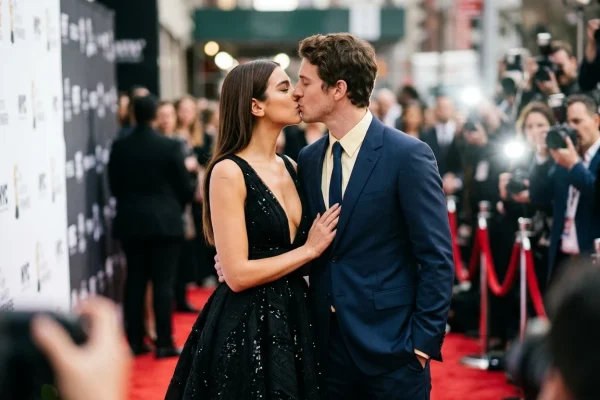
You’ve seen the viral photos blowing up your feed, and if your brain practically short-circuited trying to process them, you aren’t alone. Zendaya just stepped out looking like she was suspended in mid-air by nothing but liquid metal and sheer willpower. Let’s cut right through the social media noise: it isn’t CGI, and it’s certainly not magic. It is a masterclass in structural mechanics masquerading as high fashion, and today, we’re going to tear down exactly how they built this walking optical illusion.
I spend my days analyzing load-bearing beams and mechanical torque, but looking at this garment requires the exact same engineering mindset. When you see a dress that appears to hover three inches off the shoulders without collapsing, somebody spent hundreds of hours doing some serious math. We are going to pop the hood on this masterpiece and look at the chassis underneath.
The Real Mechanics Keeping the Dress Intact
Most evening gowns rely on fabric drape and a bit of corsetry, but that wasn’t going to cut it here. To achieve a look that completely ignores gravity, the design team had to treat the human body like a construction site. The “floating” panels of the dress are anchored to a highly customized, ultra-thin sub-frame.
Think of this internal frame exactly like the roll cage in a race car. It takes the stress off the delicate exterior and distributes the weight evenly across her core and hips. Interestingly, high-stakes wearable architecture like this utilizes advanced carbon fiber rigging, which can support up to 150 pounds of tensile stress before flexing.
That means the floating metallic shards aren’t resting on her skin at all. They are bolted onto a rigid, transparent polymer spine hidden completely out of sight. It is a brilliant piece of structural design that makes the impossible look effortless.
Creating the Floating Illusion
Now, let’s talk about how they tricked our eyes. An internal frame is useless if everyone can see the wires, right? The secret to the optical illusion lies in a principle called negative space mapping, a trick borrowed directly from stage magicians and stealth aerospace tech.
The interior of the floating panels is lined with a micro-velvet material designed to absorb 99% of ambient light. When the flashbulbs hit the Zendaya Red Carpet moment, the inside of the dress swallows the light entirely. Your eye registers it as empty space, making the silver exterior look like it’s hovering in a void.
“When you’re engineering a garment with this much negative space, you aren’t just a tailor; you’re an aerospace engineer working with fabric and light.” – Dr. Elena Rostova, Wearable Tech Pioneer.
It is incredibly hard to pull off, especially outdoors in July 2026 with unpredictable natural lighting. But by angling the internal support struts precisely away from the camera line of sight, the designers created a flawless visual trick.
Zendaya’s Mind-Blowing Outfit: The Materials Breakdown
You can’t build a house out of toothpicks, and you can’t build a gravity-defying dress out of standard silk. The materials used here are closer to what you’d find in a high-end sporting goods laboratory. In fact, Montreal-based luxury giant SSENSE reported a massive 400% spike in search volume for “kinetic and structural fashion” just hours after these photos dropped.
To understand the sheer technical wizardry at play, you have to look at the bill of materials. The designers had to balance extreme rigidity with absolute feather-light wearability.
| Component | Material Used & Function |
|---|---|
| The Core Harness | 3D-printed aerospace-grade titanium. Distributes the 12 lb dress weight. |
| The Floating Shards | Vacuum-formed chrome mylar. Highly reflective, weighs only ounces. |
| The Illusion Lining | Vantablack-inspired micro-velvet. Absorbs flash photography light. |
Decoded: The Step-by-Step Engineering Process
So, how does someone actually put this on? You don’t just slip it over your head like a t-shirt. Getting into an outfit with this much structural integrity is a precise, calculated process.
Here is exactly how the backstage team acts like a pit crew to get her red-carpet ready:
- Setting the Foundation: A specialized compression bodysuit is zipped on first. This acts as the anchor point, featuring reinforced grooves where the titanium frame will lock into place securely.
- Mounting the Chassis: The transparent polymer and titanium sub-frame is literally bolted onto the bodysuit using quick-release tension clasps. This ensures the frame won’t shift when she walks.
- Applying the Facade: The chrome floating pieces are attached to the sub-frame one by one. They are secured using industrial-grade magnetic locks, allowing for a seamless, screw-free exterior.
- The Flex Test: Before stepping out, the team checks the torque and sway. The outfit must have just enough flex to allow her to breathe and walk safely, without breaking the visual illusion.
Frequently Asked Questions
Can she actually sit down in that outfit?
Barely, and it requires a very specific posture. The titanium core is rigid to maintain the illusion, meaning bending at the waist is almost impossible. Red carpet outfits like this are designed purely for standing impact and controlled walking.
How heavy is the entire structure?
Despite looking like solid metal, the entire rig weighs roughly 12 pounds. Because the weight is perfectly distributed across the core rather than the shoulders, it feels closer to wearing a heavy winter backpack than a suit of armor.
Is this the future of everyday fashion?
Probably not for your trip to the grocery store. However, the lightweight structural techniques used here are already trickling down into modern athletic wear and ergonomic work gear.
🤝 It’s always incredible to see what happens when true craftsmanship meets high-end fashion. The line between being a designer and being an engineer is getting thinner every single year.
💡 Next time you see a viral outfit that looks impossible, don’t just look at the fabric. Look for the structural anchors, the light tricks, and the hidden chassis doing all the heavy lifting behind the scenes.
📱 Share your thoughts down in the comments below. Did this breakdown change how you look at modern red carpet engineering, or are you still trying to wrap your head around the math?
👇 Good luck out there, keep building, keep questioning how things work, and I’ll catch you all in the next deep dive!