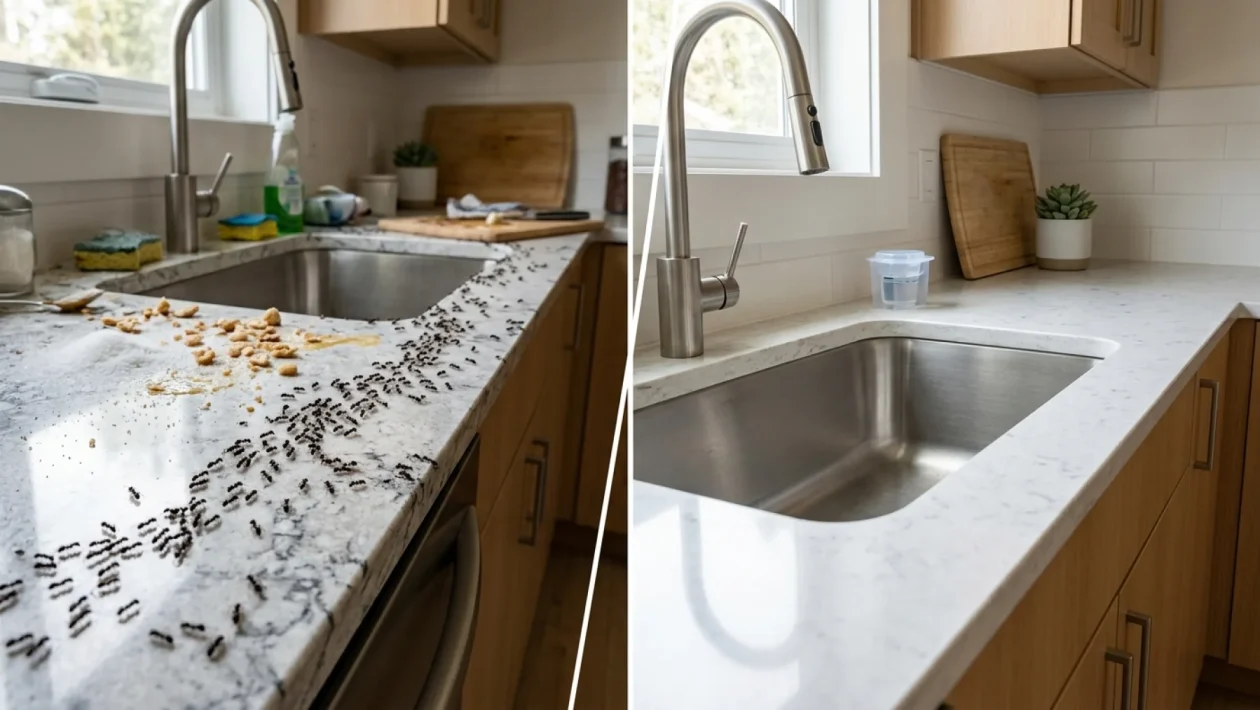
You walk into the kitchen for a midnight glass of water, flip on the light, and there it is—a moving black highway marching right across your countertops. Your home has been breached, and swatting them with a rolled-up magazine will not fix the underlying issue. True ant pest control is not about killing the bugs you see; it is about destroying the ones you do not. Today, we are going to tear down the exact methods pros use to track the scouts, assassinate the queen, and seal up your home so tight that even a microbe could not sneak in.
Ant Pest Control: Understanding the Root Cause of the Problem
Ants do not invade your home by accident or out of spite. They are highly efficient foragers on a relentless, biological mission for carbohydrates, proteins, and moisture.
Here is a staggering fact: a single mature carpenter ant colony can house upwards of 50,000 workers. When you see five or six ants wandering near your sink, they are merely the expendable scouts testing your perimeter defenses.
If they find a single crumb, they leave an invisible pheromone trail that signals the rest of the army to follow. Effective ant pest control requires you to stop reacting to the scouts and start using their own biology against them.
The Handyman’s Blueprint: Professional Strategies Anyone Can Use
When faced with a sudden invasion, the rookie mistake is to grab a can of aerosol spray and obliterate the visible trail. You might win the battle for the afternoon, but you will absolutely lose the war.
“If you spray the scout ants, you are just killing the messengers. You need to provide a Trojan horse for them to carry back to the queen,” says Dr. Aaron Smith, a veteran structural entomologist.
To truly win, you need to swap the harsh contact sprays for slow-acting baits. Let us look at why baiting is the ultimate handyman approach for long-term success.
| Eradication Method | Result & Effectiveness |
|---|---|
| Aerosol Contact Sprays | Kills instantly, leaves toxic residue, colony survives and relocates. |
| Liquid Borax Baits | Slow kill, workers share with the queen, entire colony collapses. |
Banish House Invasions: Stopping the March at Your Threshold
Now it is time to roll up your sleeves and execute a tactical strike. As of July 2026, modern baiting systems are more effective than ever, but you have to use them with precision.
Brands like Terro liquid ant baits are a staple in North American garages for a reason—they work by leveraging a simple, highly effective borax and sugar syrup mixture. Here is how to execute the eviction flawlessly.
- Identify the hot zones: Follow the ants to see exactly where they are entering the room, usually near baseboards, plumbing pipes, or window sills.
- Place the bait: Set your liquid bait stations directly in the path of their established pheromone trail, avoiding any cross-contamination with household cleaners.
- Do not interfere: Let them swarm the bait! It will look terrible for 48 hours, but you must let them feast and carry the poison back home.
- Wait for the collapse: Within three to five days, the trail will completely dry up as the colony starves from the inside out.
Reclaim Your Kitchen: Sealing Entry Points and Preventing Returns
Once the colony is dead, you have to ensure a new one does not take its place next season. The final, critical step of ant pest control is physically fortifying your perimeter.
Grab a tube of high-quality exterior silicone sealant, like DAP, load up your caulking gun, and inspect the outside of your foundation. Focus heavily on where pipes, electrical wires, and dryer vents penetrate the siding.
Seal every hairline crack and crevice you can find to shut the door on future pests. Indoors, wipe down your countertops with a mixture of warm water and white vinegar to permanently neutralize any lingering pheromone trails.
Frequently Asked Questions
How long does it take for ant bait to wipe out a colony?
Patience is heavily rewarded here. A robust baiting strategy usually takes between three to seven days to completely collapse a colony, depending entirely on the size of the nest.
Will DIY vinegar sprays actually kill ants?
Vinegar is an excellent household cleaner that destroys the chemical trails ants use to navigate, but it will not kill the nest. It should be used as a preventative maintenance tool, not a primary eradication method.
🤝 Share your thoughts in the comments below if you have ever battled a stubborn ant colony and come out on top.
💡 Remember this rule: Never spray the scouts if you truly want to eliminate the queen and protect your property long-term.
📱 Save this guide on your phone for the next time those six-legged invaders try to breach your kitchen counters.
👇 Good luck with your DIY pest control, and always keep that caulking gun handy!