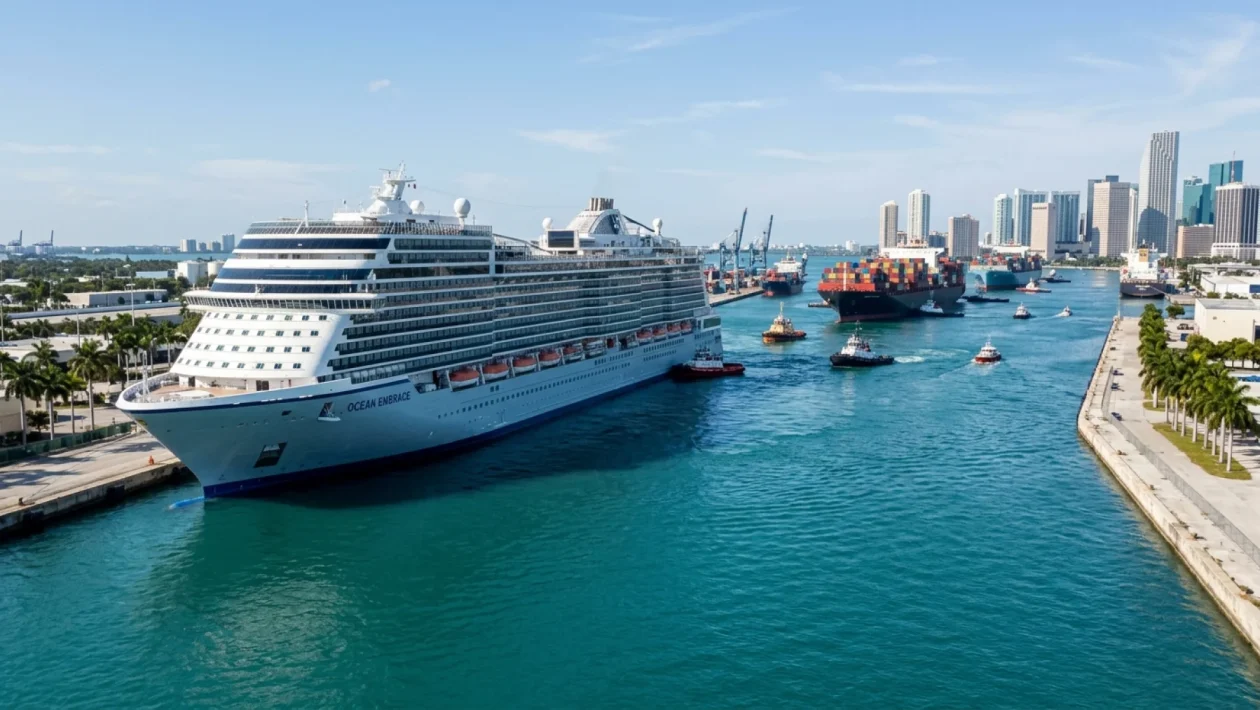
Imagine dropping thousands of dollars on a dream Caribbean getaway, only to spend your first night floating completely powerless in North America’s busiest shipping channel. That is exactly the nightmare thousands of vacationers woke up to this July 2026, when a colossal Royal Caribbean vessel suffered a catastrophic total power failure. The Miami cruise stranded in the main channel did not just ruin vacations; it created a massive logistical bottleneck that brought millions of dollars of maritime traffic to a grinding halt. If you have ever wondered what happens when a billion-dollar floating city just dies in the water, the reality is far messier than you think.
I have spent years wrenching on heavy diesel machinery and reporting on marine infrastructure, and I can tell you that ships this size do not just shut down for no reason. When the lights go out on a modern leviathan, it is a masterclass in mechanical domino effects. Let us break down exactly what went wrong, how the port scrambled to fix it, and what it was like for the people trapped inside a steel baking tin.
Miami Cruise Stranded: The Mechanics of a Total Blackout
Modern cruise ships are essentially massive, self-contained power plants. They rely on redundant diesel-electric systems designed to keep everything from the massive propulsion pods to the soft-serve ice cream machines humming. But redundancies only work if the main switchboard communicates properly.
When the main bus tie failed on this Royal Caribbean ship, the safety systems instantly triggered a hard shutdown to prevent a massive electrical fire. It is exactly like blowing the main fuse in your house, except this house weighs 200,000 tons and is drifting dangerously close to a concrete breakwater.
To put the scale into perspective, the power generated by one of these ships is enough to light up a small city. When it dies, you are left with a vessel that makes our massive BC Ferries look like bathtub toys, dead in the water and completely at the mercy of the ocean currents.
How a Royal Caribbean Blackout Blocked the Channel
The Port of Miami is a tightly choreographed dance of cargo freighters, luxury yachts, and cruise liners. There is zero margin for error in the main channel. When this ship lost thrust, it drifted slightly sideways, essentially throwing up a massive steel roadblock.
A staggering statistic makes this even crazier: while the global maritime industry sees about a dozen major propulsion failures a year, a total blackout inside a primary port channel is considered a one-in-a-million logistical nightmare. Cargo ships carrying perishable goods had to drop anchor offshore, bleeding money by the hour.
“When a vessel of this magnitude loses its main switchboard, you aren’t just steering a heavy boat. You are trying to parallel park a skyscraper with no brakes and no steering wheel.” — Capt. Marcus Vance, Maritime Logistics Authority
Port Panic: The Extraction Process
You cannot just hook a tow rope to a dead cruise ship with your Ford F-150 and pull it to the dock. Moving a stranded leviathan out of a narrow channel requires extreme precision and serious brute force.
Here is exactly how the Coast Guard and port authorities cleared the bottleneck:
- Drop the Anchors: Emergency backup generators provide just enough juice to deploy the anchors, stopping the drift and preventing a catastrophic collision with the port walls.
- Deploy Heavy-Duty Tugs: Four specialized harbor tugboats, each boasting over 5,000 horsepower, are lashed to the massive hull to act as the ship’s new engines and steering.
- Coordinate a Dead-Ship Tow: Harbor pilots board the vessel to manually coordinate the tugs via radio, inching the massive steel wall back to a secure berth at a painstakingly slow one knot per hour.
Life Inside a Dead Ship in July
While the tugboats fought the currents outside, the situation inside the ship was rapidly deteriorating. Summer in Miami is unforgiving, and without the main engines, the air conditioning stopped completely.
Within an hour, the internal temperature of the windowless interior cabins skyrocketed. Emergency lighting cast an eerie glow over the promenades, but the real issue was the plumbing. Modern marine toilets rely on vacuum suction powered by the main electrical grid. No power means no flushing.
Here is a quick look at how a ship’s systems degrade during a blackout:
| Ship System | Blackout Status |
|---|---|
| Air Conditioning | Fails immediately. Cabins become saunas within 45 minutes. |
| Plumbing & Toilets | Vacuum pumps fail. Bathrooms become completely unusable. |
| Food Service | Walk-in freezers hold temp, but cooking ranges go dead. Cold sandwiches only. |
Frequently Asked Questions
Why couldn’t they just restart the engines?
Restarting a marine diesel-electric plant is not like jump-starting a car. Engineers must manually reset massive breakers, purge fuel lines, and slowly bring generators online to prevent a devastating power surge that could fry the ship’s entire computer network.
Do passengers get a full refund for a stranded ship?
Generally, yes. When a cruise is delayed by a catastrophic mechanical failure resulting in a missed itinerary or severe discomfort, cruise lines typically issue full refunds alongside future cruise credits to manage the public relations fallout.
Are the emergency backup generators enough to keep the ship safe?
Yes, but barely. By international maritime law, backup generators are only designed to power emergency lighting, communication radios, and critical bilge pumps. They do not have the output to run the massive hotel load or the propulsion pods.
Final Thoughts on the Miami Incident
🤝 Share your thoughts in the comments below! Have you ever been stuck on a cruise ship or ferry when the engines gave out, or did you narrowly avoid this Miami mess?
💡 The truth is, modern marine engineering is incredibly safe, but when you mix complex electrical grids with saltwater and high summer temperatures, Mother Nature occasionally wins the round.
📱 If you found this breakdown helpful, be sure to send it to that friend who is always bragging about their upcoming cruise vacation. It never hurts to know what goes on below the deck.
👇 Good luck on your next adventure, stay cool out there, and always pack a backup battery for your phone just in case the ship goes dark!