By July 2026, you would think we had collectively learned our lesson about approaching massive wild animals with a smartphone. Yet, another Yellowstone bison video is burning up the internet today, providing a stark reality check. A tourist got way too close for a selfie and was promptly launched eight feet into the summer air. If you are packing up the SUV for a national park road trip this season, consider this your ultimate wake-up call. I am going to break down exactly what went wrong and how to make sure your family vacation does not end with an emergency helicopter ride.
Yellowstone Bison Video: Breaking Down the Viral Encounter
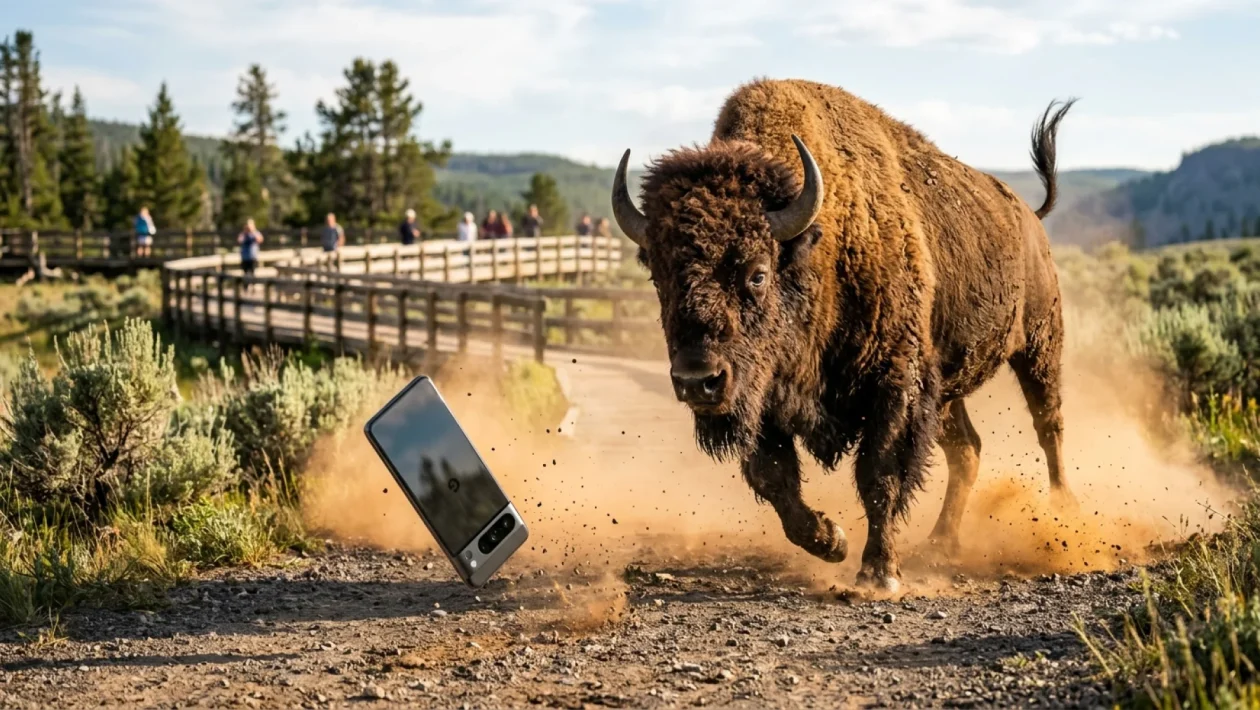
The footage is tough to watch but impossible to ignore. In the now-infamous Yellowstone bison video, a visitor abandons the safety of the boardwalk to get a close-up of a grazing bull. The animal looks docile at first, chewing cud like an overgrown, fluffy dairy cow.
But that calm demeanor is a complete illusion. Within seconds, the bison’s tail raises, it pivots with terrifying speed, and a massive headbutt sends the man flying. It is a brutal reminder that our national parks are untamed ecosystems, not roadside petting zoos.
As a guy who spends half the year hiking the Rockies and hauling gear in my trusty MEC pack, I see this reckless behavior constantly. People let the majestic scenery lull them into a dangerous, false sense of security.
Tourist Tossed 8 Feet: Why You Cannot Outrun 2,000 Pounds of Muscle
Let’s talk about the sheer physics of getting tossed 8 feet by a wild bovine. Bison are the largest land mammals in North America, built like elite offensive linemen but equipped with horns.
Here is a hard fact that should make anyone think twice: A mature male bison can weigh over 2,000 pounds and sprint at speeds reaching 35 miles per hour. That is roughly three times faster than you can run on your absolute best day.
When that much mass connects with a human body, it is literally like getting hit by a compact car. The tourist in the video learned the hard way that explosive agility is not strictly a trait reserved for predators.
“Bison injure more people in Yellowstone than any other animal. When they feel threatened, their fight-or-flight response leans heavily toward fight, and they close the distance in a blink.” — Sarah Jenkins, Senior Wildlife Biologist.
Shows Exactly What Not To Do: Your Wilderness Survival Playbook
Watching someone get gored is sobering, but it is also a masterclass in what to avoid. Surviving a wildlife encounter is not about fighting back; it is entirely about preventative spatial awareness.
Whether you are sipping coffee out of your Yeti mug at a scenic pull-off or hiking deep into the backcountry, keeping your distance is non-negotiable. If you accidentally find yourself too close to a bison, here is exactly how to handle it.
- Read the body language: Look for immediate warning signs. A raised tail, pawing at the dirt, or sudden bluff charges mean the animal is highly agitated.
- Do not run immediately: Running triggers a chase response. Slowly and calmly back away while keeping your eyes on the animal.
- Find a large barrier: If the bison charges, quickly put a sturdy tree, a large boulder, or a vehicle between you and the animal.
- Protect your head: If contact is unavoidable and you go down, curl into a tight ball and protect your neck and head with your hands.
The Safe Distance Breakdown
Every national park clearly posts distance regulations, but in the heat of the moment, it can be tough to judge. Use this quick reference guide to keep yourself firmly in the safe zone.
| Distance from Animal | Safety Status & Action Required |
|---|---|
| Less than 25 yards (75 feet) | Extreme Danger. You are in the strike zone. Back away slowly immediately. |
| 25 to 50 yards | Warning Zone. Too close for comfort. Keep moving away and do not stop for photos. |
| More than 50 yards | Safe Viewing. Relax and use a zoom lens or binoculars to enjoy the wildlife safely. |
Frequently Asked Questions
Can you outrun a charging bison?
Absolutely not. Bison can easily outpace a human, covering rough, uneven terrain at 35 mph. Your only defense is maintaining distance from the start or finding immediate cover behind a solid object.
Why do bison attack unprovoked?
Bison rarely attack without reason, but their definition of being “provoked” is much more sensitive than ours. Simply stepping into their personal space or accidentally blocking their path is enough to trigger a defensive strike.
What should I do if a bison blocks the hiking trail?
Patience is your best tool. Wait quietly for the bison to move off the trail organically. If it does not move, you must take a wide, off-trail detour to maintain at least a 25-yard safety buffer.
🤝 Respecting the wild is the absolute baseline of any outdoor adventure. We step into their living room the moment we cross into these parks, and it is our job to play by their rules.
💡 The next time you see a Yellowstone bison video, do not just shake your head at the screen. Use it as a harsh, real-world reminder to give nature the massive amount of space it deserves.
📱 Share this survival guide with anyone you know heading out on a camping trip or road trip this summer.
👇 Drop a comment below and let me know about your closest wildlife encounter—safely from a distance, I hope!