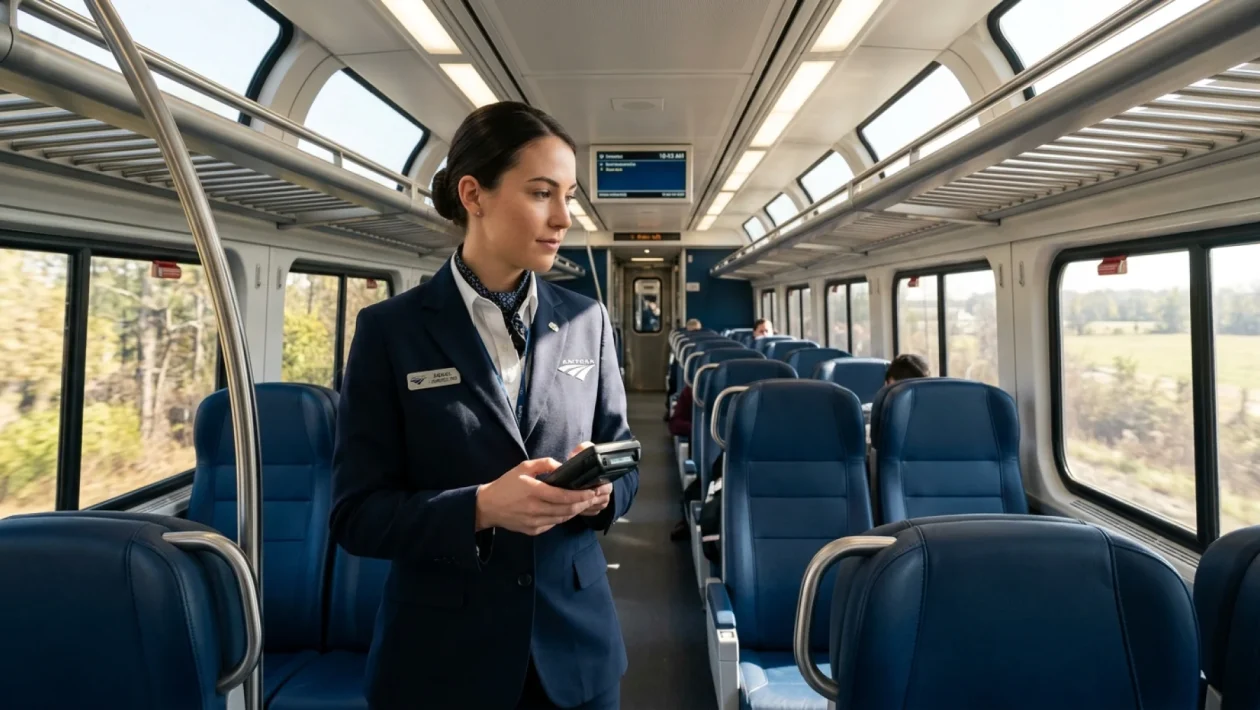
Pulling in €4,770 (roughly $7,000 CAD) a month for a part-time, four-day-a-week gig sounds like the absolute dream. But before you start polishing your resume and looking at one-way flights to Switzerland, let’s look under the hood of what that paycheck actually demands. The train attendant salary might look fantastic on paper, but the real cost involves making life-and-death safety calls, managing escalating passenger aggression, and carrying a massive amount of unseen stress on your shoulders.
We are going to break down the actual day-to-day grind of a modern railway worker. By the time we’re done, you’ll know exactly why that seemingly massive part-time wage barely covers the sheer amount of responsibility riding on their shoulders.
Train Attendant Salary Reality (The €4,770 Part-Time Paycheck)
Let’s talk hard numbers. Cheyenne Wüthrich is a 27-year-old customer companion working for the Swiss Federal Railways (SBB). For an 80-percent workload, she brings home about 4,400 Swiss Francs (roughly €4,770) gross per month.
Annually, that clocks in around €61,700—and that is strictly her base pay. Whenever she works nights, Sundays, or holidays, the overtime and premium bumps kick in. When you compare that to a typical conductor job at VIA Rail here in Canada, the European compensation package looks incredibly robust.
Yet, Cheyenne admits that while the pay is fair, the heavy risks and massive responsibilities make her feel like it should be higher. She isn’t living a life of luxury, either. To make her wages stretch in an expensive economy, she shops for second-hand clothing and budgets carefully for months before making any large purchases.
| Compensation Factor | The SBB Reality (80% Workload) |
|---|---|
| Monthly Base Pay | €4,770 (approx. 4,400 CHF) |
| Annual Gross Pay | €61,700 (approx. 57,000 CHF) |
| Shift Premiums | Extra pay for nights, Sundays & holidays |
| Lifestyle Output | Frugal living, second-hand shopping required |
Stopping High-Speed Rails (The Burden Of Total Responsibility)
Here is where the job stops being about punching tickets and starts being about crisis management. A train attendant has the ultimate authority to decide if a multi-million-dollar machine actually moves. They are the eyes and ears of the entire operation.
Just last spring, Cheyenne made a massive judgment call that proves this point perfectly. While stopped in Bellinzona, the train’s critical cooling system completely failed. With carriages packed full of elderly passengers and young families, she had to make a rapid-fire safety assessment.
Realizing the sheer danger of dragging a sweltering, unventilated metal tube through the massive Gotthard Tunnel, she officially halted the train. No movement. No compromise. Here is exactly how an experienced rail worker handles that kind of high-stakes mechanical failure:
- Assess the Vulnerability: Quickly scan the passenger demographic to identify high-risk individuals (infants, elderly, medically fragile).
- Evaluate the Environment: Determine the severity of the mechanical failure—in this case, zero airflow in an enclosed, crowded space.
- Project the Route: Analyze the upcoming track for hazard zones, like the incredibly long and enclosed Gotthard Tunnel.
- Execute the Stoppage: Communicate directly with the engineer and dispatch to officially ground the train until a safe transfer is arranged.
Dodging Aggressive Riders (The Rising Threat In The Aisles)
Dealing with the public is never easy, but the hostility on public transit has reached a boiling point. The modern train attendant salary is essentially hazard pay at this point. Ticket checks frequently escalate into aggressive, and sometimes physical, altercations.
The intensity of these incidents is ramping up across the board. Because of the rising threat level, SBB now mandates that night trains are staffed by a minimum of two attendants walking the aisles together. It’s no longer just about customer service; it’s about having someone watch your back while you do your job.
“People look at transit workers and just see a uniform, forgetting that these folks are often acting as first responders, mechanics, and security guards all at once. The emotional toll of de-escalating angry commuters daily is staggering.”
This stress is causing massive shifts in the industry worldwide. Just look at Germany’s Deutsche Bahn (DB). By the end of 2025, DB saw its workforce plummet by a shocking 13.2 percent, dropping to just 8,717 full-time employees. Whether it’s internal reorganization or sheer burnout, keeping good people on the tracks is becoming a monumental challenge.
Frequently Asked Questions
Do train attendants get paid for travel expenses?
Most major rail companies provide their staff with comprehensive travel passes for free transit on their networks. However, meals and overnight hotel stays during long-haul shifts are usually covered by a strict per-diem allowance, not a blank check.
Is it dangerous to work on night trains?
It carries significantly higher risks due to intoxicated passengers, reduced lighting, and fewer stops. That is exactly why most modern European and North American rail services now enforce a strict “buddy system” for all late-night ticket checks.
Do you need a degree to become a train attendant?
No university degree is required, but the training is brutal. You must pass rigorous safety exams, psychological evaluations, and extensive emergency protocol drills before you ever step foot on a passenger carriage.
🤝 Look, there is no denying that working the rails is a tough way to make a living. Whether you are navigating the Swiss Alps or the Canadian Rockies, the people keeping those massive engines moving deserve every single dime they earn.
💡 The next time you board a train, take a second to look at the crew. They aren’t just there to scan your digital boarding pass; they are the highly trained professionals keeping you out of harm’s way when things go sideways.
📱 I’d love to hear your take on this. Do you think the current compensation matches the sheer amount of responsibility these workers carry every single shift?
👇 Drop a comment below and share your thoughts. Good luck out there, stay safe on your daily commute, and I will catch you in the next breakdown!