Your thermostat is flashing an error code, the July 2026 power grid is stressed to the breaking point, and every portable AC unit at Canadian Tire and Home Depot is suddenly on a two-month backorder. We have all been there, frantically refreshing inventory pages while our living rooms turn into brick ovens. But while we are fighting over the last window unit in town, a completely different approach to urban cooling is going viral overseas.
Instead of pumping cold air into a sealed box, engineers are figuring out how to air-condition the entire outdoors. They are doing it with an incredibly simple, low-power concept, and it is time we took notes.
Roof Misting Systems
Let’s talk about the hardware first. When you hear the words “misting system,” you probably picture those sputtering patio fans at your local pub that just end up making your fries soggy.
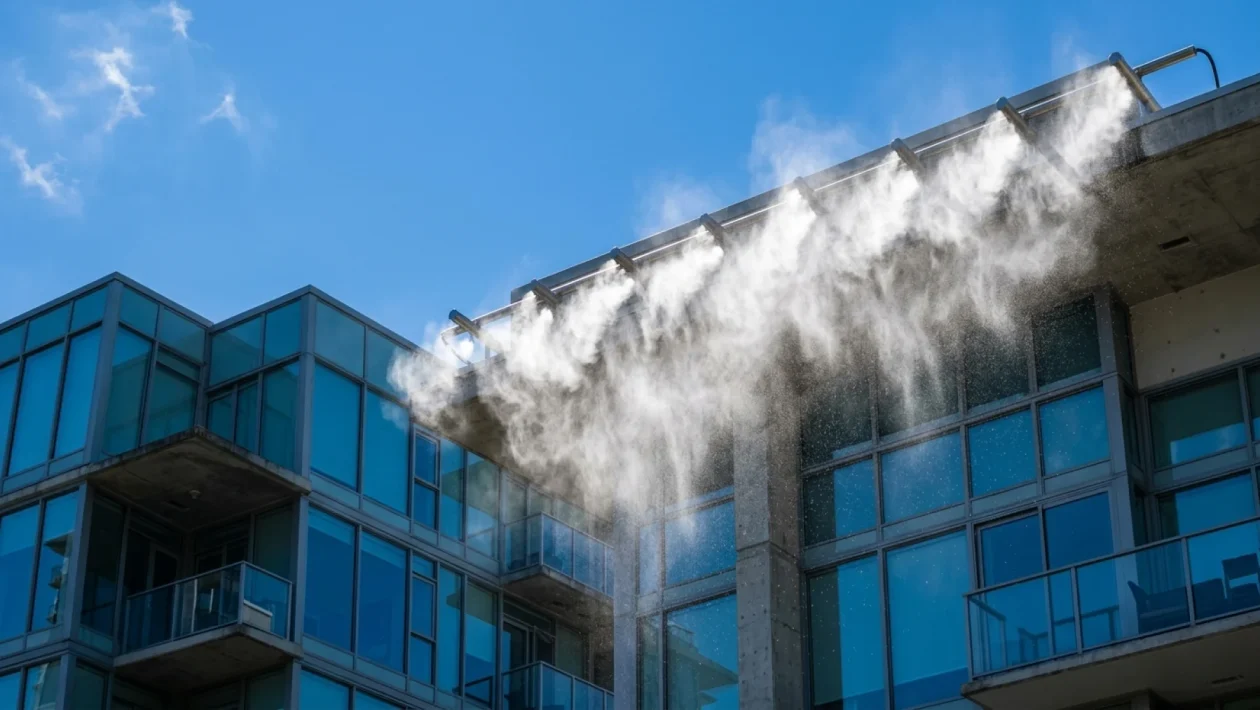
This is not that. We are looking at industrial-grade water atomizers mounted on the very top edges of residential buildings.
These Roof Misting Systems use high-pressure hardware to turn liquid into a microscopic vapor. Here is exactly how the setup transforms a blazing afternoon into a manageable day:
- Pressurization: Heavy-duty commercial pumps push stored water through rooftop plumbing lines at immense pressure.
- Atomization: Specialized alloy nozzles shear the water into droplets so fine they resemble a thick, rolling cloud.
- Flash Evaporation: The microscopic droplets absorb the surrounding heat and evaporate instantly, long before they ever touch the pavement.
The Chinese High-Rise Technology
Right now, the city of Yuncheng in China is basically serving as a massive, real-world testing ground for this concept. Videos of their high-rises spewing rolling clouds of mist down the sides of concrete buildings are racking up millions of views.
It looks a bit like a sci-fi movie, but the engineering is incredibly practical. Instead of relying on power-hungry refrigerant compressors, this method leans heavily on basic fluid dynamics to do the heavy lifting.
The global interest makes perfect sense right now. Just last week, online search queries for emergency AC units exploded from 118,000 to nearly 2.5 million in a matter of days. We are desperate for alternatives that do not spike our hydro bills.
“We cannot just keep building louder, hungrier air conditioners to fight urban heat islands; eventually, we have to cool the actual concrete absorbing that heat in the first place,” notes urban climate researcher Dr. Aris Vlahos.
Dropping Neighborhood Temperatures By 8 Degrees
Here is the payload: under the right conditions, this evaporative cooling effect drops local outdoor temperatures by a massive 5 to 8 degrees Celsius. That is roughly a 9 to 14-degree Fahrenheit drop.
That is the tangible difference between a dangerous summer heatwave and a perfectly standard afternoon. But there is a catch—it does not work flawlessly everywhere.
Evaporative cooling thrives in dry heat. If the air is already thick, humid, and soupy, the water cannot evaporate quickly enough, and the cooling effect plummets. Plus, there is the water consumption issue to consider.
Pumping treated municipal drinking water onto a roof just to spray it into the sky is not exactly a bulletproof sustainability plan. To make this viable in North America, we would absolutely need to integrate smart rainwater harvesting.
Let’s look at how this rooftop tech stacks up against our traditional chilling methods.
| Feature | Roof Misting Systems |
|---|---|
| Power Draw | Extremely Low (Pumps only) |
| Cooling Zone | Exterior (Streets, yards & facades) |
| Main Drawback | Heavy water dependency |
Frequently Asked Questions
Will this cool down my hot apartment?
Not directly, no. This system targets the exterior environment to stop heat from baking into the concrete and radiating inward. You will still want that window AC unit for your bedroom to sleep comfortably.
Does it make the streets wet and slippery?
No. The nozzles atomize the water so finely that it undergoes flash evaporation. It absorbs ambient heat and turns into a gas long before it ever reaches the ground level.
Could we build this in North America?
Absolutely, but it makes the most sense in dry, arid regions. Cities in the desert Southwest or the dry Canadian prairies would see massive benefits, whereas highly humid coastal cities would struggle to get the same temperature drop.
Final Thoughts
🤝 Wrapping this up, we have to start thinking outside the box—or in this case, outside the house—when it comes to beating the relentless summer heat.
💡 While a rooftop cloud generator will not replace your trusty basement fan today, it proves that smarter, community-wide engineering is right on the horizon.
📱 Share your thoughts with your neighbors the next time you are sweating out a heatwave on the patio. Would you chip in for a neighborhood misting system?
👇 Good luck staying cool out there, and keep those AC filters clean until the neighborhood tech catches up to the thermometer!