Imagine trying to fly a brick at the speed of a commercial airliner. That is exactly the aerodynamic nightmare most First-Person View (FPV) pilots face when chasing absolute top speed. But an Australian aerospace engineer just cracked the code, pushing a custom-built rig past the limits of what we thought battery-powered flight could do.
They didn’t just tweak a factory motor; they completely reinvented how air moves over a propeller. Let’s lift the hood and tear down the exact mechanics behind the fastest drone design on the planet.
Fastest Drone Design: Breaking Down the Build
If you have ever messed around with off-the-shelf FPV kits, you know that hitting even 150 km/h feels like you are wrestling a hurricane. The drag coefficient usually tears the chassis apart. Enter Ben Biggs and his co-pilot Aidan from the YouTube channel Drone Pro Hub.
As we roll through the spring of 2026, their latest creation—fittingly dubbed the “Blackbird”—has officially clocked in at an eye-watering 730 km/h (roughly 453 mph) in unofficial testing. That completely shatters the previous 659 km/h benchmark set by the team at Bell Textron, the same North American aerospace titan known for military helicopters.
When you are competing against corporate engineering giants with massive R&D budgets, you have to get creative. The Drone Pro Hub guys didn’t just add bigger motors; they re-engineered the very physics of their thrust.
Custom Carbon Fiber Rotors: The Sawtooth Secret
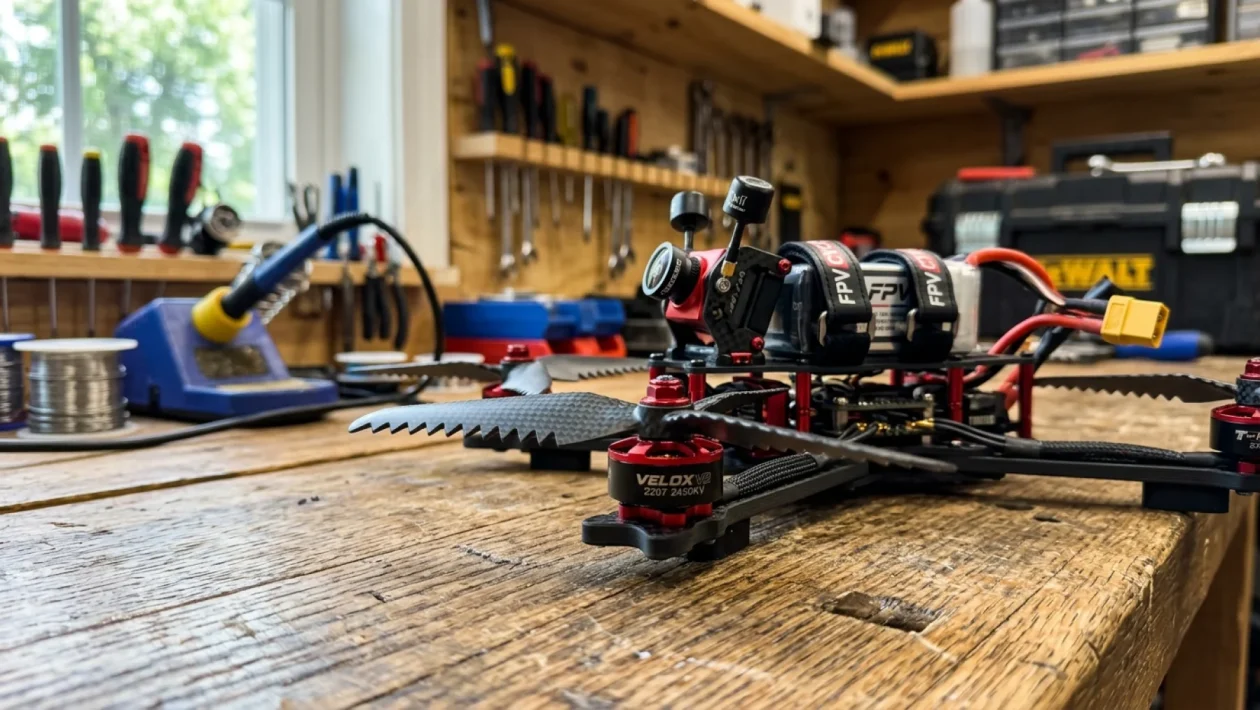
The real magic of this build lives right on the spinning edges. Biggs completely threw out standard propeller geometry and hand-laid his own custom carbon fiber rotors. At first glance, they look like standard high-performance props, but they hide two massive mechanical advantages.
First, they feature a brutally steep angle of attack. Second, and most importantly, the leading edges of the blades are serrated. Instead of a smooth, razor-sharp edge, they look like the teeth of a handsaw.
This isn’t just for aggressive looks. It is a brilliant play on fluid dynamics that solves the biggest issue with steep blade angles: aerodynamic stalling. Here is exactly how this sawtooth design works under pressure:
- The serrated edge aggressively slices into the oncoming air as the motor spools up to maximum RPM.
- These “teeth” intentionally generate micro-vortices, which are essentially tiny, controlled tornadoes of air across the blade.
- These mini-whirlpools force the airflow to stay glued to the surface of the propeller, stabilizing the boundary layer.
- The drone maintains massive thrust and avoids a mid-air stall, even at angles that would cause a normal prop to lose all its bite.
Hitting 730 KM/H: Surviving the Test Flight
Getting these concepts to work on a workbench is one thing, but pushing them through the sky is another beast entirely. The test flights were an absolute masterclass in risk management.
During their first high-speed pass, the Blackbird suffered a catastrophic failure. At 633 km/h, the remote control link completely severed. At speeds approaching Mach 0.6, there is no hitting the brakes. The drone flew blind for several kilometers before finally smashing into the earth.
But they rebuilt, recalibrated, and tried again. On their final successful run, they caught a massive 54.7 km/h tailwind, pushing the drone’s ground speed to that historic 730 km/h mark. Even flying directly into the headwind, it maintained a blistering 639 km/h.
Demolishing Aviation Records: What’s Next?
Right now, the drone racing community is buzzing, and for good reason. While the Guinness World Records team still needs to officially homologate the run, the raw telemetry data speaks for itself.
This project proves that independent, garage-style engineering can still outpace massive aerospace conglomerates if the fundamental science is sound. It is a reminder that obsessing over the tiny details—like the texture of a propeller edge—pays massive dividends.
“When you push past the 600 km/h threshold, you aren’t just fighting mechanical drag anymore; you are battling fluid dynamics that actively want to rip your chassis out of the sky. Innovation at the boundary layer is the only way forward.”
| Drone Model | Top Recorded Speed |
|---|---|
| Bell “Peregreen V4” (Previous Record) | 659 km/h |
| Biggs “Blackbird” (New Benchmark) | 730 km/h |
Frequently Asked Questions
Is this 730 km/h speed officially a Guinness World Record?
Not yet. While the onboard GPS and radar telemetry clocked the drone at nearly 730 km/h, the team is currently preparing all the required documentation to have the record officially homologated by the Guinness committee.
Can I buy these sawtooth FPV propellers for my own drone?
At the moment, no. These carbon fiber rotors are entirely handmade prototypes specifically tuned for the Blackbird’s weight and motor torque. However, given their success, it wouldn’t be surprising to see commercial manufacturers like DJI or Nazgul adopting similar micro-vortex tech in the coming years.
How long does the battery last at those extreme speeds?
At wide-open throttle pulling maximum amperage, a standard high-discharge LiPo battery will be completely drained in under 60 seconds. These flights are intense, straight-line sprints, not endurance marathons.
🤝 It is truly incredible what a couple of dedicated guys in a workshop can pull off when they stop playing by the traditional rules of aerodynamics.
💡 Whether you are wrenching on a weekend project in the garage or just love seeing the limits of technology pushed to the absolute brink, builds like the Blackbird should definitely inspire you.
📱 I’d love to hear your take! Drop a comment below and share your thoughts on whether you think someone will crack the 800 km/h barrier before the end of the year.
👇 Good luck on your next build, keep those rotors spinning, and I will see you in the next breakdown!