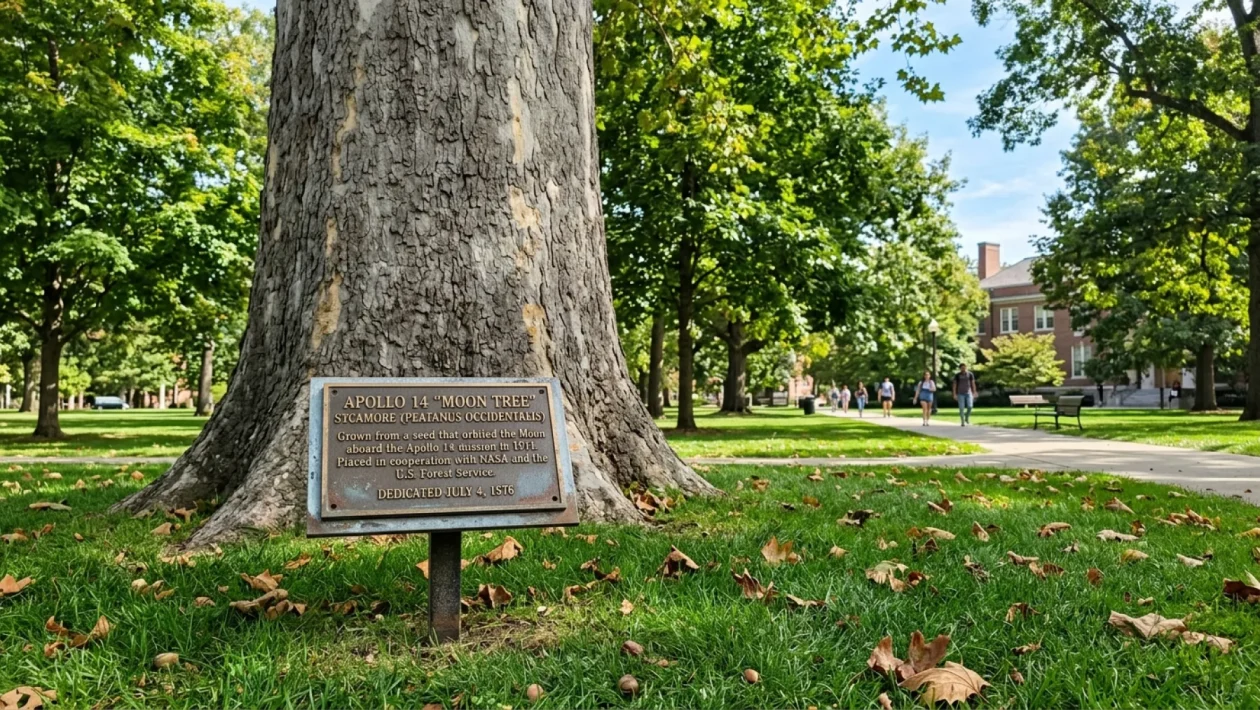
You probably leaned against a piece of literal space history this morning without even realizing it. No glowing alien bark, no sci-fi force fields—just ordinary wood, leaves, and a completely wild backstory. Back in 1971, NASA sent hundreds of tree seeds on a round-trip ticket around the Moon, and today, those exact seedlings are towering over our sidewalks, courthouse lawns, and schoolyards. I am going to show you exactly how these galactic giants ended up right in our backyards, and the secret to finding one in your own neighborhood.
Moon Trees Are Hiding In Plain Sight
If you are looking for twisted branches or silver leaves, you are out of luck. Moon Trees look exactly like their earthbound cousins. A loblolly pine that went to space drops the same annoying needles on your driveway as the one that never left the county.
That is the absolute beauty of this project. You could easily be sitting on a bench, drinking your morning Tim Hortons double-double, directly in the shade of a sycamore that has traveled further into the cosmos than most human beings ever will.
Because space did not mutate them, they blend perfectly into our local landscapes. It takes a sharp eye to notice the only thing setting them apart: a modest, often weathered little plaque at the base of the trunk.
| Trait | The Moon Tree Reality |
|---|---|
| Physical Appearance | Identical to normal, Earth-grown trees. |
| Growth Rate | Average. No mutant growth spurts or stunting. |
| Identification | Only verified through rare, easily missed historic plaques. |
How Apollo 14 Seeds Went To Deep Space
This whole crazy endeavor started with a guy named Stuart Roosa. Before he was the command module pilot for Apollo 14, Roosa was a U.S. Forest Service smokejumper—a tough-as-nails wildland firefighter who parachuted into blazing forests.
When Roosa got tapped for the lunar mission, the Forest Service asked him to take a piece of his old life with him. He packed a metal canister full of sycamore, sweetgum, redwood, and Douglas fir seeds into his personal kit. While Alan Shepard and Edgar Mitchell were down kicking up dust on the lunar surface, Roosa and his seeds stayed in the Kitty Hawk module, orbiting the Moon.
But the journey back was almost a disaster. After splashdown, the bags burst open during decontamination.
Here is a crazy hard fact for you: nearly 500 of those delicate seeds were accidentally exposed to the absolute, crushing vacuum of a decontamination chamber—and they still managed to germinate. They are incredibly tough.
Here is the exact blueprint of how a forest went galactic:
- The Selection: Forest Service geneticists carefully picked prime seeds from five rugged American tree species.
- The Lunar Orbit: The seeds were sealed in Roosa’s kit, surviving the violent vibrations of a Saturn V rocket launch and the freezing void of space.
- The Recovery: After the vacuum chamber mishap on Earth, experts carefully sorted and germinated the surviving seeds in specialized nurseries.
- The Planting: Grab a sturdy spade from Lee Valley Tools! The viable saplings were shipped out and planted in normal soil to see how they would fare.
Secretly Taking Over Parks And Campuses
By the time 1975 and 1976 rolled around, the saplings were ready for dirt. They were shipped off and planted as living monuments for the U.S. Bicentennial. They went to state capitols, universities, and even overseas.
But here is where it gets incredibly relatable for anyone who has ever tried to organize a community project: nobody kept a master list. Campuses remodeled, landscapers accidentally tossed old plaques, and people simply forgot. The trees successfully infiltrated our infrastructure, becoming quiet, towering ghosts of the Apollo era.
“The Moon Trees do not announce themselves. They do not look lunar. They look terrestrial, rooted, seasonal and ordinary, which is exactly why the story works.”
Now, the legacy is getting a massive reboot. With NASA’s current Artemis program, they have fired up the tradition again. Artemis I took a whole new batch of seeds into deep space.
And with last month’s historic Artemis II mission in April 2026—where our very own Canadian astronaut Jeremy Hansen finally orbited the Moon—the connection between space exploration and our own backyard dirt has never felt more real.
Frequently Asked Questions
Can I buy a Moon Tree for my own yard?
Unfortunately, you cannot just pick one up at your local garden center. The original trees are strictly tracked historical monuments, and the new Artemis generation seedlings are being exclusively awarded to schools, museums, and public organizations.
Are the seeds radioactive or dangerous?
Not at all. The seeds were exposed to cosmic radiation, but they do not retain any radioactivity. They are completely safe, genetically normal, and healthy.
How can I find out if there is a Moon Tree near me?
NASA maintains a running online archive trying to track the survivors. It is essentially a crowd-sourced treasure map. If you spot a suspicious plaque under a massive pine at your local courthouse, it might just be on their list!
🤝 It is pretty incredible to think that our biggest achievements in modern science are currently providing shade for squirrels and park benches.
💡 The next time you are out for a walk, take a second to read that dirty bronze plaque at the base of the old oak or fir in your local square.
📱 You might just be standing face-to-bark with a veteran of the space race.
👇 Good luck tree hunting, and be sure to share your thoughts if you ever stumble across one of these living legends!