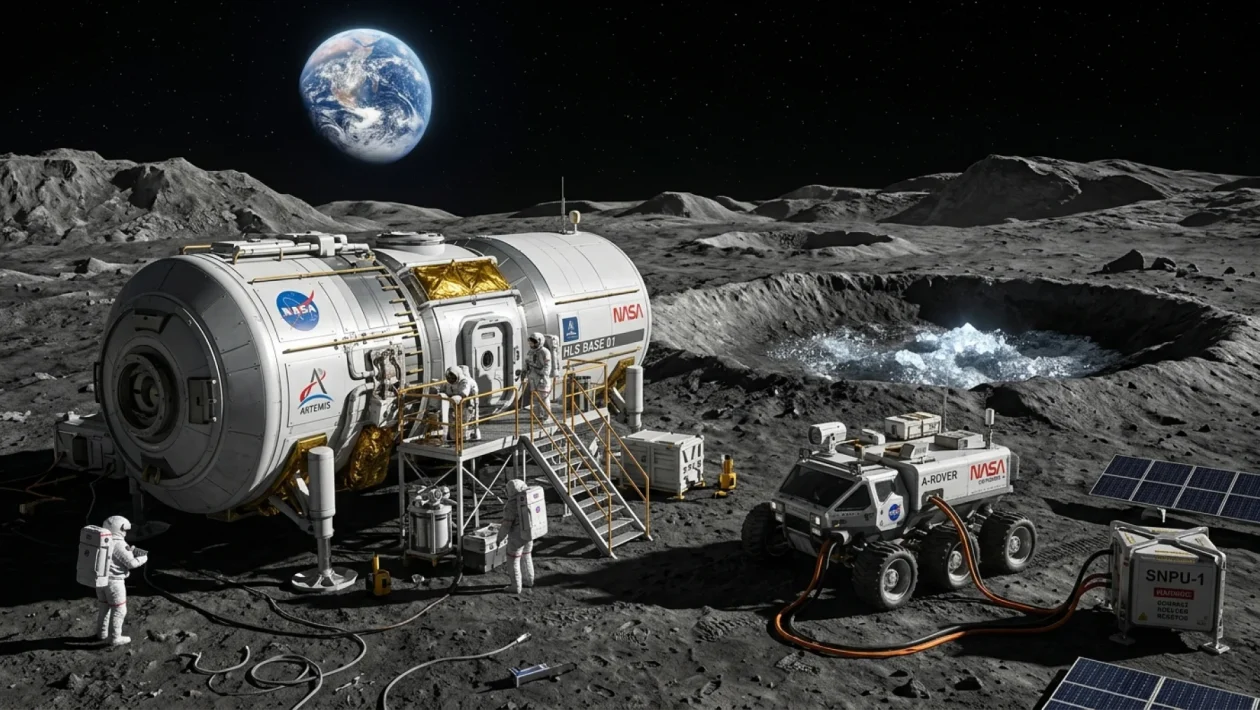
We are skipping the orbital waiting room and heading straight for the dirt. NASA has officially benched its massive “Gateway” space station plans to fast-track a permanent NASA Lunar Base right at the Moon’s South Pole. The goal? Drastically cut costs, accelerate the Artemis program, and get actual habitats on the ground. If you’ve been wondering when science fiction becomes a high-stakes construction project, the timeline is officially set—and the heavy lifting starts this year.
Conquering the South Pole
Building a custom home in a brutal Canadian winter is tough, but building one in a vacuum where temperatures swing by 300 degrees is a whole different ballgame. Yet, that is exactly the engineering marvel unfolding right now.
NASA realized that building a space station around the Moon before landing on it was just slowing us down. Now, the strategy is direct, dirty, and focused entirely on the lunar surface.
The South Pole isn’t just a random spot; it is prime real estate. It holds deep, permanently shadowed craters packed with water ice. That ice is the absolute holy grail of space exploration—it means drinking water, breathable oxygen, and rocket fuel right in our backyard.
The 3-Phase Blueprint
You don’t just drop a condo on the Moon. It requires a meticulous, heavily tested rollout. Here is the exact step-by-step roadmap NASA is executing over the next decade to build the NASA Lunar Base:
- Phase 1 (2026–2029) – The Robotic Invasion: This spring kicks off a massive wave of 25 missions and 21 automated landings. We’ll see landers like Blue Origin’s Blue Moon Mark 1 Endurance hit the dirt later this autumn. They are testing automated rovers, extreme-weather tech from North American aerospace giants like MDA Space, and surface drones without risking human lives.
- Phase 2 (2029) – Breaking Ground: This is when the heavy machinery arrives. NASA will deploy advanced surface nuclear reactors, the very first habitable modules, and heavy-duty communication networks. Think of it as pouring the foundation and running the primary power lines.
- Phase 3 (The 2030s) – The Permanent Outpost: The infrastructure expands into a fully functional base. Astronauts will start regular, long-term rotations. At this point, it is no longer a survival experiment; it is a fully operational off-world research facility.
What It Costs
Let’s talk freight. Moving lumber across town is expensive enough, so imagine shooting it 384,000 kilometers into the void.
The sheer volume of cargo required to keep this lunar outpost alive is staggering. Once the permanent base is running in Phase 3, it will require an astonishing 38 tons of materials shipped annually just for basic maintenance and expansion.
Here is a quick look at the brutal logistics of getting this massive project off the ground:
| Mission Phase | Logistical Payload & Effort |
|---|---|
| Phase 1 (2026-2029) | 25 missions, 21 landings (Rovers, Drones, Comms) |
| Phase 2 (2029+) | 60 tons of core infrastructure spread across 24 missions |
| Phase 3 (Ongoing) | 38 tons of maintenance material required annually |
It is a masterclass in extreme supply chain management where every single ounce matters.
“Every mission, with or without astronauts, will be an opportunity to learn. We will return to the lunar surface, build the infrastructure needed to stay, and develop the skills required to live and work in one of the harshest environments imaginable.” — Jared Isaacman, NASA Administrator
Frequently Asked Questions
Why did NASA pivot away from the Gateway station?
They severely downgraded its priority to stop burning time and money. Pushing directly for a surface base speeds up the entire Artemis program, slashes operational overhead, and gets actual habitats built significantly faster.
Will there be a human crew on the 2026 Blue Moon flight?
No. The Blue Moon Mark 1 Endurance launching later this year is strictly an uncrewed test flight. It is designed to verify autonomous navigation and precision landing systems. If it nails the landing, a crewed Mark 2 version will follow around 2028.
The Next Frontier
🤝 We are literally watching the foundation of humanity’s next great frontier being poured in real-time. By the end of this decade, looking up at the Moon will mean looking at an active construction site.
💡 The engineering challenges ahead are brutal, but the payoff—from mastering deep-space survival to creating massive off-world economies—is unimaginable.
📱 What do you think about this aggressive new timeline? Are we moving too fast, or is it about time we set up shop permanently on the lunar dirt?
👇 Share your thoughts in the comments below, and good luck to the thousands of engineers working overtime this spring to make it happen!