Your engine sputters, the dashboard lights up like a Christmas tree, and you are suddenly losing speed in the middle of a 100 km/h traffic flow. Breakdowns on major corridors are terrifying, but the real danger begins the moment the vehicle stops moving. Just this past week in May 2026, a pedestrian suffered life-threatening injuries on Highway 417 near Bronson Avenue after a late-night multi-vehicle collision left them exposed in the eastbound lanes. The brutal reality of 400-series highways is that stepping out of your disabled vehicle turns you from a stranded driver into an immediate casualty risk.
I have spent years covering traffic safety and roadside emergencies across Canada, and the post-collision reports always tell the same story. Panic breeds fatal mistakes. Whether you catch a flat tire, run out of gas, or get clipped by a transport truck, surviving the aftermath requires cold, calculated action. You need to know exactly how to secure your immediate environment, alert the authorities, and ride out the wait until heavy tow trucks or the Ontario Provincial Police (OPP) arrive.
Surviving a Highway 417 Breakdown
Driving on Highway 417—or any major North American arterial road—means sharing the asphalt with 80,000-pound transport trucks moving at high speeds. When your vehicle fails, the physical forces at play are heavily stacked against you. According to traffic safety data, while pedestrians account for roughly 15% of all road fatalities, a person struck by a vehicle on a major highway faces a fatality rate exceeding 85%.
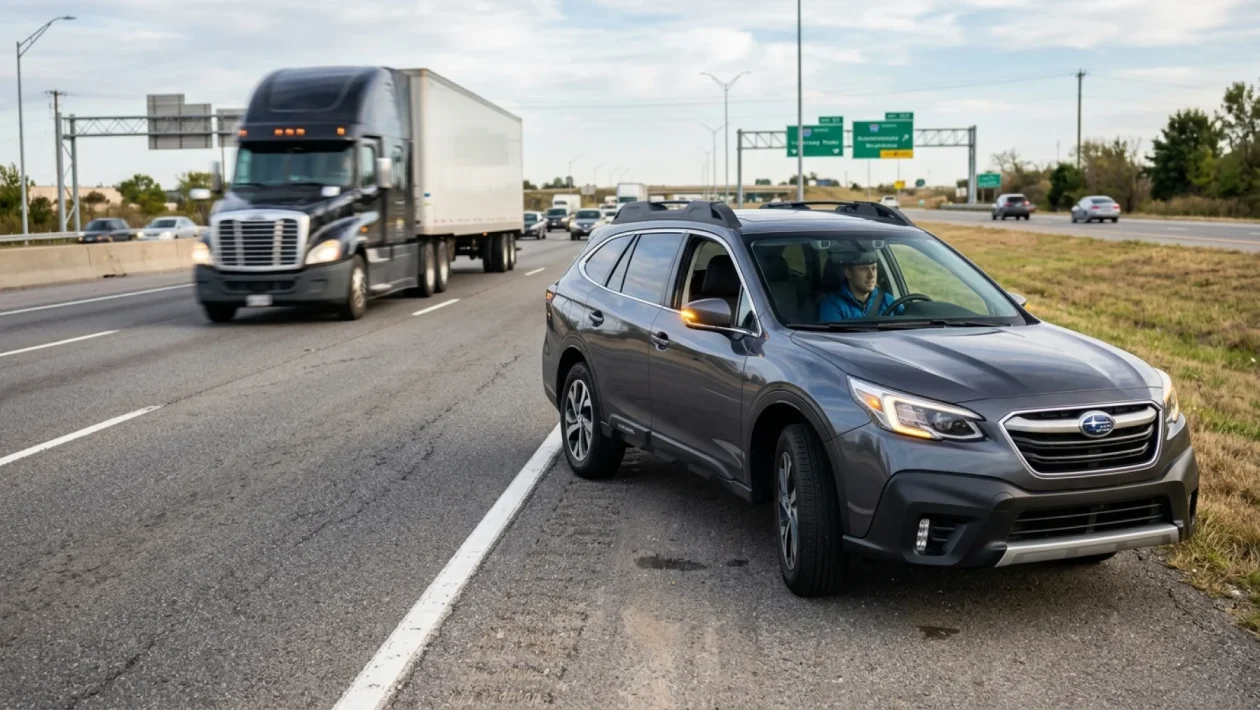
The shoulder of a highway is not a safe zone; it is merely a designated emergency buffer. A stalled car acts as a sitting duck for distracted drivers who inadvertently drift toward flashing lights—a phenomenon known as target fixation. If you exit your vehicle to inspect a flat tire on the traffic side, you are putting your life in the hands of strangers barreling past you just inches away.
Before you even think about popping the trunk to grab a jack, you need to assess the flow of traffic. Your primary objective is to make your vehicle as visible as humanly possible while treating the cabin of your car as a reinforced steel bunker.
The Exact CAA-Approved Protocol
When the worst happens, you cannot rely on instinct. You need a proven, step-by-step strategy. The Canadian Automobile Association (CAA) and local law enforcement champion a specific sequence of actions designed to minimize your physical exposure to moving traffic.
Memorize this protocol and run through it the second your vehicle loses power:
- Coast to the right shoulder immediately: Do not brake hard. Use your remaining momentum to merge as far to the right as the pavement allows, keeping your wheels turned away from the active lanes.
- Engage hazard lights instantly: Hit the four-way flashers before you even come to a complete stop to warn drivers behind you of your rapid deceleration.
- Lock the doors and buckle up: Once stopped, ensure your seatbelt remains fastened. If your stationary car is rear-ended, the seatbelt and airbags are your only defense against whiplash or ejection.
- Call for emergency extraction: Dial 911 if you are blocking a live lane of traffic or are in immediate danger. If you are safely on the shoulder, call CAA (*222 on your mobile) or a dedicated roadside assistance service.
If you absolutely must mark your vehicle with flares or reflective triangles—which you should ideally pick up at a Canadian Tire or local auto shop before hitting the road—only deploy them if you can exit the vehicle safely on the passenger side, away from the flow of traffic.
To Stay Alive
The single biggest mistake stranded motorists make is assuming they need to “get to safety” by crossing active lanes or walking down the shoulder to find an exit. Unless your vehicle is actively on fire or submerged in water, the safest place for you is inside the cabin.
“Your vehicle is a 4,000-pound steel roll cage engineered specifically to absorb high-velocity impacts. Your body is not. Stay in the car, keep your seatbelt on, and let the heavy rescue trucks do their job.” — OPP Traffic Safety Division
To put the decision-making process into perspective, here is a quick breakdown of how to handle the first five minutes of being stranded:
| Action | Survival Impact |
|---|---|
| Staying buckled inside the vehicle | High Survival. Roll cage and airbags protect you from secondary impacts. |
| Exiting to inspect damage | Extreme Danger. High risk of target fixation from passing drivers. |
| Attempting to cross highway lanes | Fatal Risk. Human depth perception cannot accurately gauge vehicles moving at 120 km/h. |
| Calling 911 from the center median | High Risk. Medians offer zero structural protection from swerving trucks. |
Frequently Asked Questions
What if my car dies completely in a center lane?
Turn on your hazard lights immediately. Do not attempt to exit the vehicle and run across live lanes. Call 911 right away and inform the dispatcher that you are trapped in an active, high-speed lane. Keep your seatbelt fastened and brace yourself against the headrest.
Should I leave my car and stand behind the guardrail?
If you can safely exit your vehicle from the passenger side (the side facing away from traffic) and there is a physical barrier like a guardrail or concrete wall you can step entirely behind, yes. Wait well back from the road. If there is no barrier or the shoulder is too narrow, stay secured inside the car.
Does CAA or roadside assistance tow from active 400-series highways?
Yes, but protocol varies by severity. If you are blocking a live lane, police will often dispatch an emergency contract tow to immediately drag you off the highway to a safe staging area, where your regular roadside provider will then take over.
🤝 Look out for the people you care about. Highway breakdowns are incredibly stressful, but knowing the right protocol takes the panic out of the equation.
💡 Preparedness is your best insurance policy. Take five minutes today to check your trunk for a high-visibility vest, reflective triangles, and ensure your emergency roadside contact numbers are saved in your phone.
📱 Share this guide on your local community groups or send this to a friend who commutes daily. A quick read today could literally save their life on the highway tomorrow.
👇 Stay safe out there, keep your eyes on the road, and always respect the heavy machinery sharing the asphalt with you.