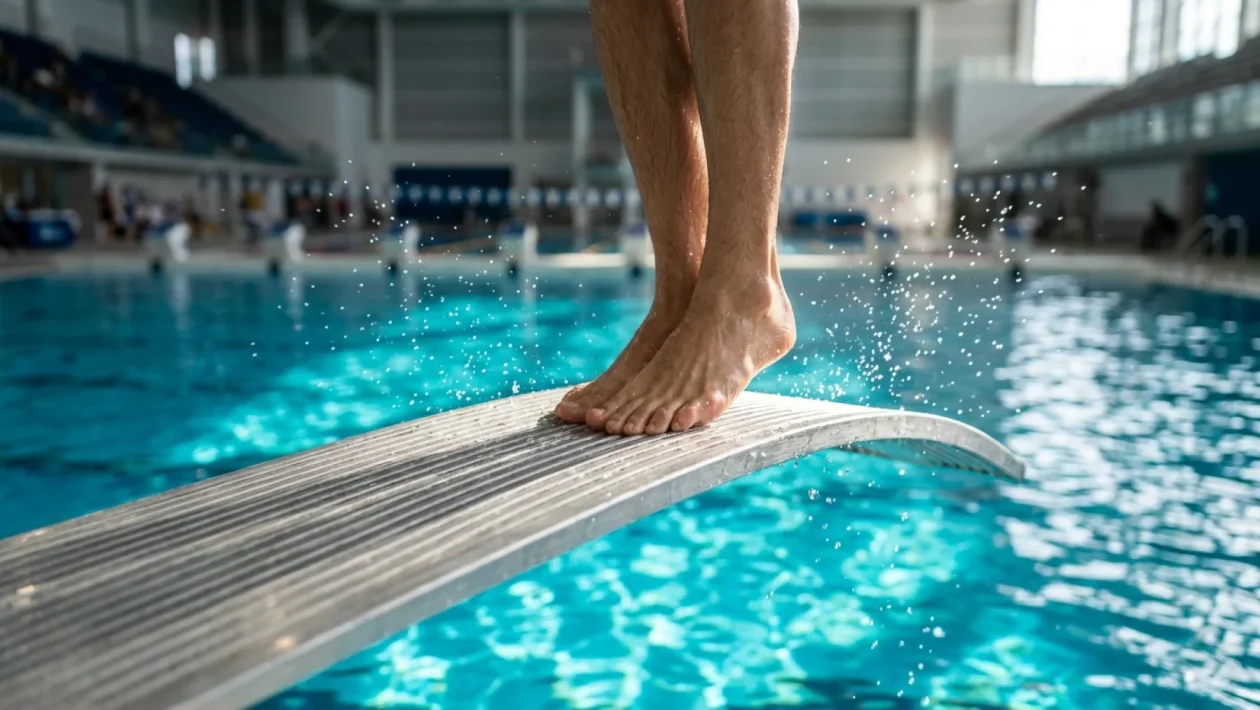
Standing on a slip-resistant plank of aircraft-grade aluminum, suspended exactly 39 inches above the water, isn’t just about bravery. It is a brutal, unforgiving exercise in raw physics.
When you watch the Women’s 1m springboard prelims on the CBC Sports broadcast this May 2026, you aren’t just watching athletes jump into a pool. You are watching kinetic energy transfer executed with millimeter precision.
If your hurdle is off by a fraction of an inch, your entry will be off by a foot. Let’s break down exactly how these athletes turn a piece of bending metal into a launchpad, and what actually separates the amateurs from the national contenders.
Mastering the 1m Springboard
The springboard itself is the primary tool of the trade, and treating it right is non-negotiable. Unlike platform diving where you drop from a solid surface, a 1m springboard is a dynamic partner that reacts to your exact body weight and downward force.
Elite boards, like the standard Maxiflex model, feature a ribbed aluminum surface and a movable fulcrum wheel. The fulcrum dictates the stiffness of the board.
Roll the fulcrum forward, and you get a tighter, faster snap for lighter divers. Roll it back, and the board becomes highly flexible, demanding a slower, more patient hurdle to generate maximum upward thrust.
Elite Mechanics Behind the Dives
Translating forward momentum into vertical height on a one-metre board requires absolute mechanical perfection. There is zero margin for error when you only have 39 inches of clearance.
Here is the exact mechanical sequence an elite diver uses to launch off the 1m springboard:
- The Approach and Press: The diver takes exactly three to four steps, pressing down onto the balls of their feet. This builds the initial forward momentum without shifting their center of gravity past their toes.
- The Hurdle: The diver drives one knee upward to a 90-degree angle while punching their arms toward the ceiling. They lift entirely off the board, entering a brief free-fall.
- The Landing and Compression: The diver lands on the very tip of the board with rigid legs, absorbing the shock. They force the board down into a deep bend, storing massive kinetic energy.
- The Ride and Kick-Out: As the board aggressively recoils upward, the diver “rides” it to the top before snapping their legs straight, launching their hips over their shoulders to initiate the rotation.
The National Diving Championships
The Summer Senior National Diving Championships are where Olympic dreams are either cemented or shattered. The pressure cooker environment tests not just technique, but pure mental endurance.
In the preliminary rounds, judges are ruthlessly dissecting every phase of the dive. They look for the height of the apex, the tightness of the tuck or pike, and the complete elimination of splash on entry.
| Scoring Phase | Judge’s Primary Focus |
|---|---|
| The Take-off | Elevation, balance, and controlled distance from the board. |
| The Flight | Aesthetic form, tight body compression, and proper limb extension. |
| The Entry | Vertical alignment, locked elbows, and the coveted “rip” entry (zero splash). |
Toronto Pan Am Sports Centre
Hosting this caliber of event requires a world-class facility, and the Toronto Pan Am Sports Centre (TPASC) is the undisputed crown jewel of Canadian aquatics. Built for high-performance athletes, the engineering behind this facility is staggering.
Here is a wild fact: The diving well at TPASC holds exactly 1.2 million gallons of water, continuously filtered and maintained at a highly precise 26.5°C. This specific temperature prevents the divers’ muscles from seizing up or cramping during the long waits between preliminary rounds.
Outfitted in high-compression suits from brands like Speedo Canada, athletes rely on these optimal environmental conditions to execute extreme rotational forces without fear of injury or fatigue.
“Diving off a one-metre board is like trying to thread a needle while being shot out of a cannon. The board gives you the power, but if your core alignment is off by even a single degree at the apex, the water will punish you for it on the way down.”
Frequently Asked Questions
How deep is the diving pool at competitive facilities?
To safely accommodate the velocity of elite divers, the diving well at facilities like TPASC is exactly 5 metres (16.4 feet) deep. This provides ample deceleration space even for athletes generating massive speed from the 10-metre platform.
What is a “rip” entry?
A rip entry happens when a diver enters the water completely vertical with their hands clasped flat, punching a hole in the surface tension. It creates a vacuum effect that sucks the splash downward, resulting in a sound similar to ripping paper.
Why do divers shower or use hot tubs immediately after a dive?
Air temperatures in large aquatic centers can feel drafty when you are soaking wet. Divers immediately hit the hot tub or warm showers to keep their fast-twitch muscle fibers warm, loose, and primed for their next explosive jump.
🤝 Share this guide with the sports junkie or aspiring athlete in your life who appreciates the gritty mechanics behind Olympic-level competition.
💡 The next time you watch a diving broadcast, watch the bend of that aluminum board instead of just the splash. You will immediately spot who has mastered their weight transfer.
📱 Send this to a friend who thinks jumping off the local pool deck is the same as what these national contenders are pulling off. Let them see the real physics at play.
👇 Drop your thoughts below or tag your favorite local diver. Keep your core tight, your entries clean, and always respect the fulcrum.