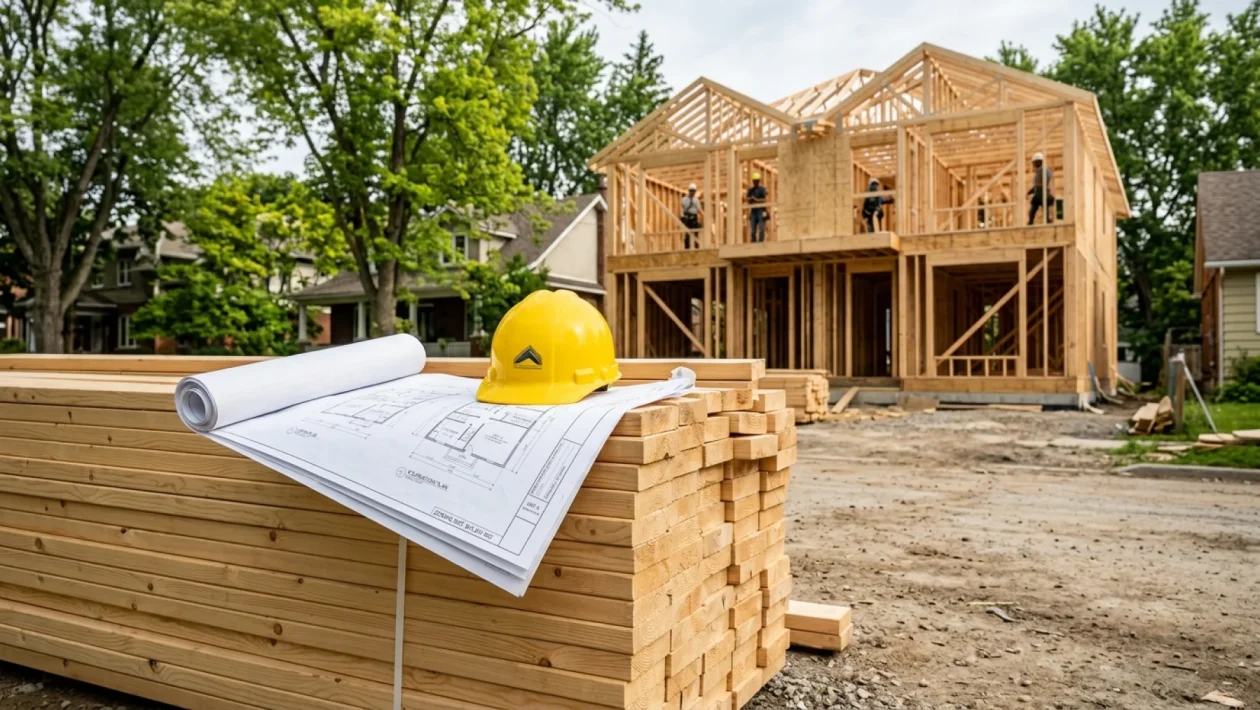
If you have ever tried to pull a building permit for anything more complex than a backyard shed, you know that municipal zoning codes are usually ancient documents designed to say “no.”
Charlottetown has been running its urban development on an official plan drafted back in 1999. Think about that for a second. We were still worried about Y2K the last time the city fundamentally agreed on how and where to grow. But the clock is officially ticking. The city has a hard deadline of October 2026 to pass a completely rewritten zoning and development bylaw. If they do not get it locked in before the municipal elections in November, the incoming council inherits a half-finished puzzle, and the housing gridlock drags on for another year.
Fast-Tracking the Four-Plex
The biggest friction point in this draft is density. Specifically, the move to allow four housing units “as-of-right” in certain areas.
If you are not familiar with city planning jargon, “as-of-right” is the magic phrase builders pray for. It means if your blueprints meet the basic technical requirements for height and setbacks, city staff can rubber-stamp the project. You don’t have to grovel before the planning board or face a firing squad of angry neighbors at a public council meeting. You just get your permit, order your Weyerhaeuser framing lumber, and get to work pouring the foundation.
Deputy Mayor Alanna Jankov has pitched this rewrite as bringing the city’s development processes into modern 2026 language. The explicit goal is to clear out the bureaucratic backlog and get accessory dwelling units—like garden suites and basement apartments—built much faster to address the chronic housing shortage.
The Sacred Downtown Boundary
Of course, you cannot talk about building taller in Charlottetown without someone bringing up the historic core.
The city is trying to pull off a delicate balancing act. The draft bylaw heavily pushes larger, multi-storey developments out to major arteries like University Avenue and St. Peter’s Road. The logic here is incredibly sound. Put the dense housing where the transit routes actually function, and leave the heritage character of “Lot 500” mostly alone.
Here is how the proposed changes actually break down on the ground:
- Building up the corridors: Allowing taller structures along University Avenue means more foot traffic for commercial spaces and actually justifies upgrading the city’s transit infrastructure. If you want to avoid endless suburban sprawl eating up the island, building up on major roads is the only mathematical solution.
- Mandatory bike storage: A surprisingly progressive addition forces developers of larger apartment buildings to include secure bicycle storage.
- Protecting the heritage aesthetic: The historic downtown gets a pass on the most aggressive density pushes for now, while a completely separate heritage preservation bylaw is drafted in the background to handle the architectural gatekeeping.
The Great Parking Delusion
You can map out all the bike storage and active transit lanes you want, but eventually, you hit the wall of maritime reality.
People here drive.
At the final public consultation this May, the divide was painfully obvious. You have urbanists cheering for density and transit, and then you have downtown residents pointing out that nobody wants to circle the block for twenty minutes trying to park their Honda Civic. Trying to solve a housing crisis while simultaneously guaranteeing convenient street parking is a mathematical impossibility. You simply have to sacrifice one to get the other.
“Look, everybody says they want more housing until a triplex gets proposed next door,” one local contractor mentioned outside the open house. “Adding more parking spaces is a nice thought, but we all just want to drive our own vehicles and park right outside where we’re going. It’s a difficult thing to solve when everybody wants the convenience but nobody wants the concrete.”
If the city pulls this off by October, it will be a massive victory for housing supply. The map will be redrawn, garden suites will start popping up in older neighborhoods without months of red tape, and developers will finally have a predictable playbook. But if the public pushback over parking spots and building heights spooks the current council, the whole zoning rewrite might just get punted to the next administration, leaving builders exactly where they started.