Imagine cruising over the Rockies, sipping a ginger ale, when suddenly a flight attendant sprints down the aisle looking dead serious. It is the ultimate nightmare scenario for any traveler. But for your flight crew, it is exactly what they train for. Just recently, pop superstar Katy Perry took to social media to publicly praise Air Canada for their lightning-fast response to a terrifying medical crisis on her flight. When the chips are down and the nearest hospital is five miles straight down, flight attendants are the ultimate first responders.
You are actually much safer in the sky than you might think. We are going to break down exactly how these high-altitude rescues work, why Katy Perry was so impressed, and the hidden logistics that keep us safe when things go sideways.
In-Flight Medical Emergencies: The Unseen Protocol
Most of us think flight attendants are just there to serve snacks and remind us to buckle up. In reality, they are highly trained safety professionals capable of handling massive stress. In-flight medical emergencies are surprisingly common.
Here is a wild statistic to chew on: according to aviation medical researchers, a mid-air medical event happens roughly once in every 600 flights. With tens of thousands of planes in the sky right now in May 2026, that means multiple emergencies are playing out globally as you read this.
Crews are trained to handle everything from minor fainting spells to full-blown cardiac arrests. They do not just wing it. They follow a strict, highly rehearsed protocol that turns a chaotic cabin into a mobile triage center.
How Air Canada Crew Aided Katy Perry
When an emergency struck on Katy Perry’s flight, the singer witnessed firsthand the incredible efficiency of Canadian aviation professionals. The crew didn’t panic. They immediately secured the area, assessed the passenger in distress, and initiated their life-saving procedures without skipping a beat.
Airlines like Air Canada and WestJet invest heavily in rigorous annual medical training for their crews. Perry’s public shoutout highlights a reality that usually goes unnoticed behind the curtain: these men and women are absolute heroes in a crisis.
“People forget that an airplane is essentially a pressurized metal tube hurtling through the stratosphere. When a medical crisis hits, our flight attendants become the eyes and hands for doctors on the ground. Their ability to stay cool under pressure is what saves lives.” — Captain Mark Reynolds, Commercial Aviation Veteran
What Really Happens At 30,000 Feet
So, what actually goes down when someone presses the call button in distress? The process is a masterclass in crisis management. If you have ever wondered what happens behind the scenes, here is the exact sequence of events.
- The Initial Assessment: The closest flight attendant secures the scene and checks the passenger’s vital signs, determining if it is a minor issue or a life-threatening emergency.
- The P.A. Call: We have all heard it in the movies: “Is there a doctor on board?” The crew pages the cabin for any traveling medical professionals, nurses, or off-duty paramedics.
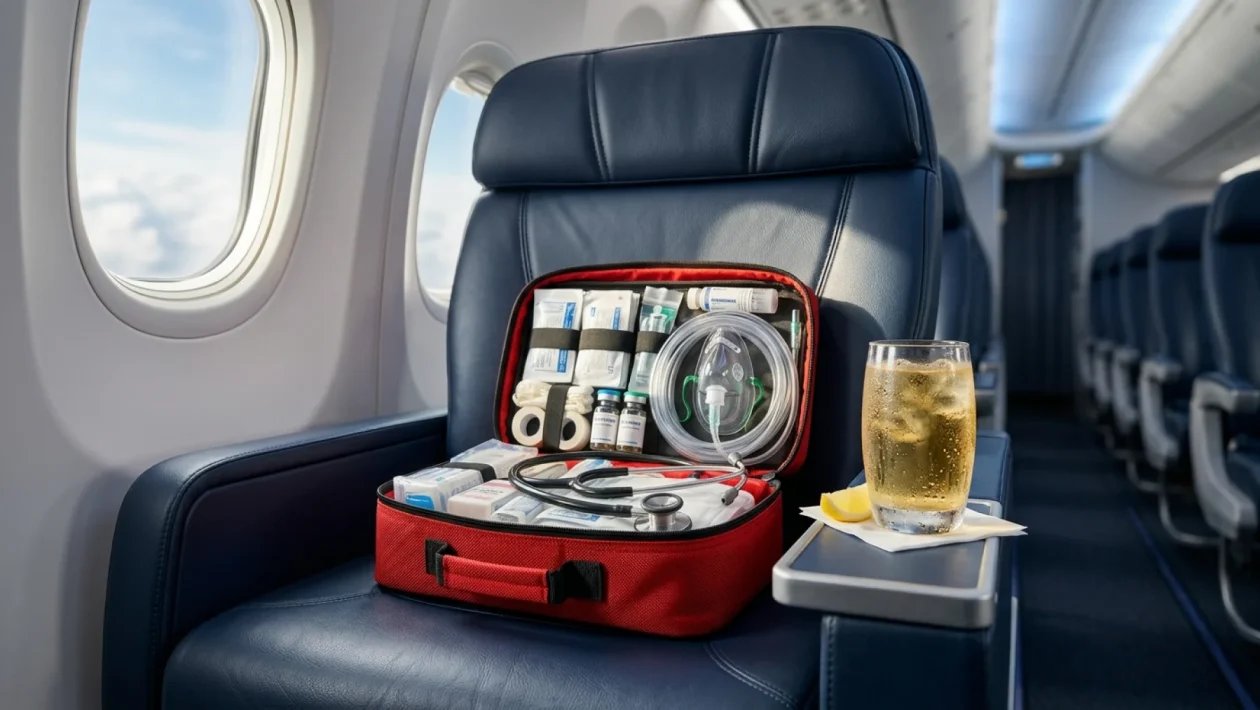
- Accessing the Vault: The crew unlocks the Enhanced Emergency Medical Kit (EMK). This isn’t your standard drugstore first aid kit; it is packed with serious hardware.
- The Satellite Lifeline: The pilots contact a dedicated ground-based medical support team (like MedAire) via satellite radio. ER doctors on the ground talk the crew through the crisis in real-time.
- The Diversion Decision: The pilot, the ground doctors, and the airline’s dispatch team calculate if they need to perform an emergency landing at the nearest suitable airport.
Speaking of the medical kit, the gear hidden on your flight is incredibly advanced. Here is a quick look at what is stored onboard compared to a basic kit.
| Standard First Aid Kit (Minor) | Enhanced Medical Kit (EMK – Locked) |
|---|---|
| Bandages and gauze pads | Automated External Defibrillator (AED) |
| Antiseptic wipes and burn gel | IV fluids, needles, and catheters |
| Over-the-counter painkillers | Epinephrine, Nitroglycerin, and Atropine |
Frequently Asked Questions
Do planes always land during a medical emergency?
Not always! In fact, most in-flight medical events are resolved without needing to divert the plane. A diversion is a massive logistical undertaking, so pilots rely on ground-based doctors to determine if an immediate landing is truly a life-or-death necessity.
Can volunteer doctors be sued for helping on a flight?
Generally, no. In North America, “Good Samaritan” laws extend to the skies, protecting medical professionals who volunteer to help during an in-flight crisis from civil liability, provided they act in good faith.
Do airlines charge you if they have to divert for your medical emergency?
No, the airline absorbs the cost of the diversion. However, once you are on the ground and handed over to local paramedics, your personal travel or health insurance will need to cover the ensuing hospital bills.
The Final Word on Flying Safe
🤝 It is incredibly reassuring to know that airlines are fully equipped to handle worst-case scenarios. Next time you board a flight, give a little nod of respect to your flight attendants.
💡 They are the real deal, balancing a tray of coffees in one hand and knowing how to operate a defibrillator with the other. Katy Perry definitely got it right when she gave them their well-deserved flowers.
📱 I would love to hear your thoughts! Have you ever been on a flight when a medical emergency happened?
👇 Drop your story in the comments below, share this article with your favorite travel buddy, and safe travels out there!