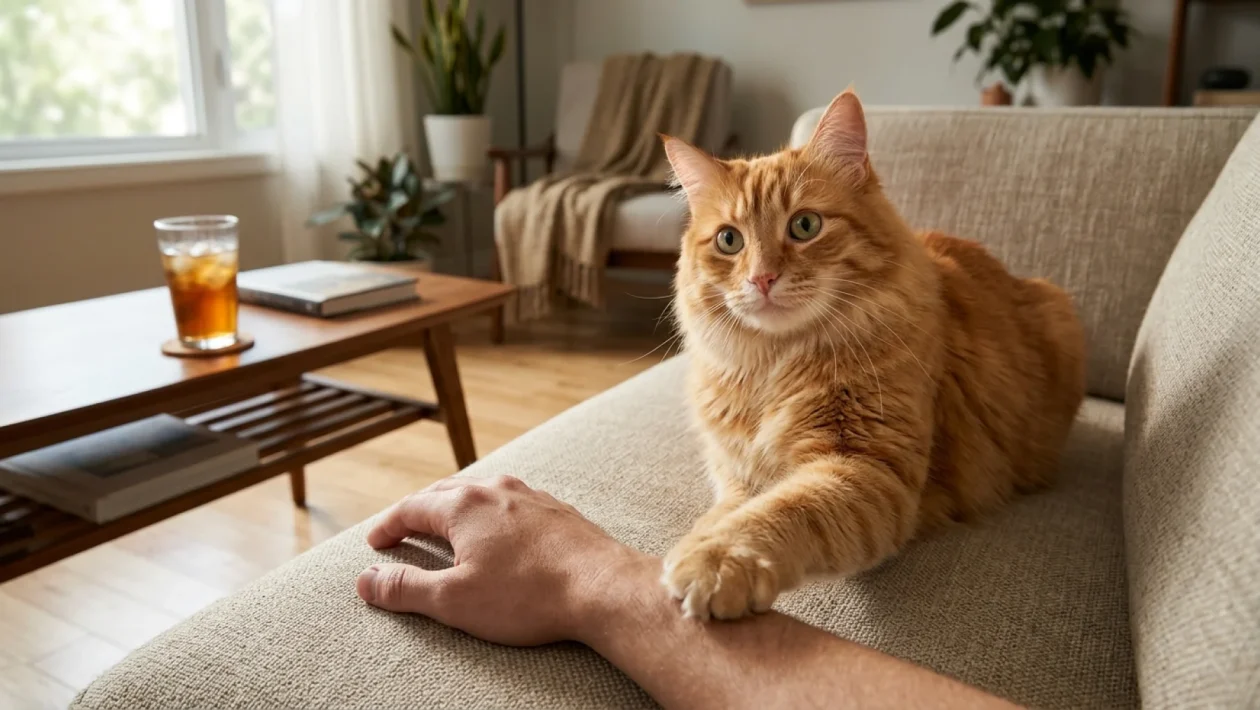
You are finally settling into the couch with a cold drink this July weekend, ready to watch the Blue Jays game, and out of nowhere—bap. A soft, velvety paw taps your arm. You ignore it. Bap. Bap. Bap. Suddenly, your cat is relentlessly jabbing your cheek like a tiny, furry boxer. If you have ever wondered why your cat insists on using you as a speed bag, you aren’t alone.
We are going to break down exactly why your fuzzy roommate is aggressively petting you back. Better yet, we will decode their silent demands so you can finally regain control of your personal space.
Cat Paw Tapping: The Silent Feline Demand
Cats are absolute masters of getting exactly what they want. While a dog might aggressively drop a slobbery tennis ball in your lap, cats use a much more refined, calculated approach. Cat paw tapping is a highly learned behavior. Think of it like the check-engine light on your truck—it is a clear, physical signal that requires your immediate attention.
Feline behavioral studies show a fascinating hard fact: nearly 70% of adult house cats reserve this specific tactile communication strictly for humans. They almost never tap other felines this way. If you have been buying them those premium treats from Pet Valu, and they suddenly start swatting your leg, they have learned that this exact physical contact yields a high return on investment.
You reacted once, and now, it is hardwired into their predatory little brains.
Decoding Why Your Feline Smacks You at 3 AM
We have all been there. It is 3:00 AM on a Tuesday, and you are jolted awake by a gentle, yet persistent, paw directly to your eyelid. Why do they do this when we are dead asleep?
It usually comes down to biological clocks and immediate, non-negotiable needs. Cats are crepuscular, meaning they are most active at dawn and dusk. When they want an early breakfast or just feel incredibly bored in the middle of the night, a verbal meow might not wake a heavy sleeper.
But a direct paw to the face? That gets results every single time.
And What They Really Want: Uncovering the Hidden Meanings
Context is absolutely everything when it comes to understanding your cat. If you want to know what they are asking for, you have to read the room. Are they stretching a paw out toward a feather wand? They want you to initiate playtime.
Are they softly touching your hand while you sit quietly scrolling on your phone? That is a pure, unadulterated request for affection and a major sign of trust. To make it easy, here is a quick breakdown of what your cat is trying to say based on the situation:
| The Situation | What the Tap Means |
|---|---|
| Sitting near the empty food bowl | “Service is terrible here. Feed me.” |
| Reaching toward your hand on the sofa | “I am granting you permission to pet me.” |
| Smacking your face in bed | “Wake up, I am bored or hungry.” |
If you want to stop being a human punching bag, you need to understand how your own reactions fuel the fire.
“Cats do not waste energy on behaviors that fail. If your cat is tapping you relentlessly, it means you have accidentally trained them to do it by rewarding the action with food, pets, or even just eye contact.”
Here is exactly how you should handle relentless pawing if it is driving you up the wall:
- Assess the environment: Check the clock and the food bowl before you react to the tap.
- Ignore bad timing completely: If it is 3 AM, do not engage. No talking, no petting, just play dead.
- Reward the good timing: When they tap you gently on the sofa for affection, reward them immediately with a scratch behind the ears.
Frequently Asked Questions
Is it normal for my cat to use claws when tapping?
Usually, a communicative tap is completely clawless. If they are digging their claws in, they are likely overstimulated, frustrated, or trying to initiate rough play. Redirect that energy to a toy immediately.
How do I stop my cat from waking me up with paw taps?
Consistency is your best tool. Ignore the behavior completely at night—do not even look at them. Also, ensure they have a heavy, interactive play session right before you go to bed to burn off that midnight energy.
Does tapping ever mean my cat is in pain?
Rarely. Paw tapping is almost universally an attention-seeking behavior. However, if the tapping is accompanied by unusual vocalizations, hiding, or a sudden change in litter box habits, a trip to the vet is in order.
🤝 Understanding your cat does not require a Ph.D. in animal psychology. It just takes a little bit of observation, recognizing their patterns, and a whole lot of patience.
💡 The next time that little paw reaches out to smack your arm, you will know exactly what is going on in that furry little head. You hold the key to setting the boundaries in your own house.
📱 Share your thoughts in the comments below! Does your cat wake you up with a left hook, or are they more of a polite shoulder-tapper?
👇 Good luck out there, and may your nights remain blissfully interruption-free!