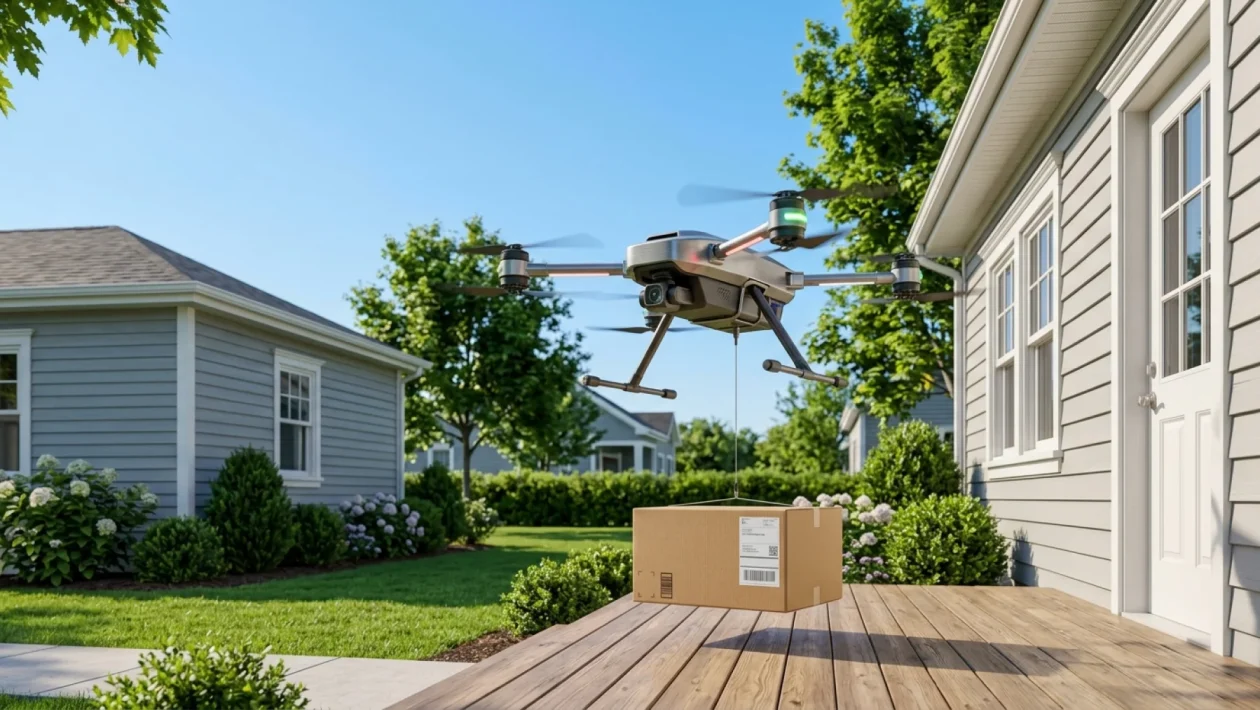
Look up. That faint humming over your roof isn’t a rogue swarm of summer bugs—it’s the reality of autonomous delivery drones finally hitting their stride in our cities.
We’ve been promised flying packages for over a decade, but this summer of 2026, the logistics game has actually changed for good.
From grabbing a forgotten box of deck screws to securing emergency medical supplies, I’m going to show you exactly how these airborne couriers are operating, what’s keeping them from crashing into your chimney, and how your front porch is about to become a miniature airport.
Autonomous Delivery Drones: More Than Just a Sci-Fi Dream
A few years ago, we thought putting heavy robots in the sky over populated areas was a massive liability.
Fast forward to today, and commercial heavyweights like Canadian Tire and Drone Delivery Canada are actively proving the skeptics wrong on a daily basis.
These aren’t the flimsy plastic toys you buy your kid at the mall.
Today’s commercial autonomous delivery drones are heavy-duty, weather-resistant workhorses equipped with collision-avoidance AI that reacts faster than a fighter pilot.
“We are no longer in the testing phase; we are in the scaling phase. The airspace is regulated, the tech is bulletproof, and the consumer demand for instant delivery is off the charts,” says Marcus Vane, Director of Urban Flight Logistics.
Redefining City Airspace: The Invisible Highways Above Us
You can’t just let thousands of drones fly in a free-for-all over our neighbourhoods.
To make this work safely, urban planners and aviation authorities literally had to slice up the sky.
Transport Canada recently rolled out “corridor mapping,” creating invisible, multi-lane highways specifically for uncrewed traffic to keep them away from commercial jets and private helicopters.
In fact, a recent federal aviation report showed a staggering 412% increase in commercial drone flight clearances across major Canadian cities just this past spring.
If you’re wondering how they manage the chaos without gridlock, here is a quick breakdown of what this airborne shift actually looks like for us on the ground.
| The Old Way (Delivery Trucks) | The New Way (Drone Corridors) |
|---|---|
| Gridlock traffic, noise, and tailpipe emissions. | Direct point-to-point zero-emission electric flights. |
| Pothole delays, construction detours, and missed turns. | Unobstructed skyways strictly enforced at 400 feet. |
| 2-day shipping standard or end-of-day guarantees. | 15 to 30-minute rapid micro-fulfillment. |
Doorstep Drop-offs: How Your Packages Actually Land
So, the drone successfully makes it to your property. What happens next?
Nobody wants a twenty-pound flying blender chopping up their prize-winning petunias or taking out the eavestroughs.
The actual doorstep drop-off is a highly choreographed maneuver engineered for maximum safety and minimal noise.
Here is exactly how that new drill battery gets from the sky into your hands:
- The Hover: The drone stops precisely 80 feet above your designated drop zone, staying well clear of trees, power lines, and rooftops.
- The Scan: Onboard LiDAR sensors quickly map your driveway or yard to ensure no kids, dogs, or lawnmowers have wandered into the target area.
- The Tether: Instead of physically landing on your grass, the drone gently lowers your package on a motorized, break-away tether cable.
- The Release: Once the box touches the ground, the tether unhooks automatically, retracts into the belly of the craft, and the drone zips away back to the hub.
Frequently Asked Questions
Are autonomous delivery drones noisy?
Not anymore. While early prototypes sounded like a fleet of flying lawnmowers, the latest 2026 prop-blade designs use advanced acoustic dampening.
From the ground, they blend right into the typical background hum of city traffic and neighbourhood air conditioners.
What happens if a drone breaks down mid-flight?
Modern commercial drones have built-in mechanical redundancies, meaning if one rotor motor fails, the others instantly overcompensate to keep it level.
If a total system failure occurs, they are equipped with emergency ballistic parachutes for a slow, controlled descent.
Can they fly in Canadian winter weather?
Yes, but within reason. They are sealed to handle summer thunderstorms and can push through moderate winter snow just fine.
However, during extreme blizzards, high winds, or severe freezing rain, the fleets are grounded until the skies clear up.
🤝 It’s an exciting time to watch our neighbourhoods evolve and embrace this incredible airborne convenience.
💡 Whether you need a last-minute plumbing fitting to fix a leak or a quick grocery top-up for dinner, the sky is literally the limit.
📱 Share your thoughts with me—would you trust a drone to safely deliver your morning iced coffee without spilling a drop?
👇 Good luck navigating this new tech, and keep looking up!