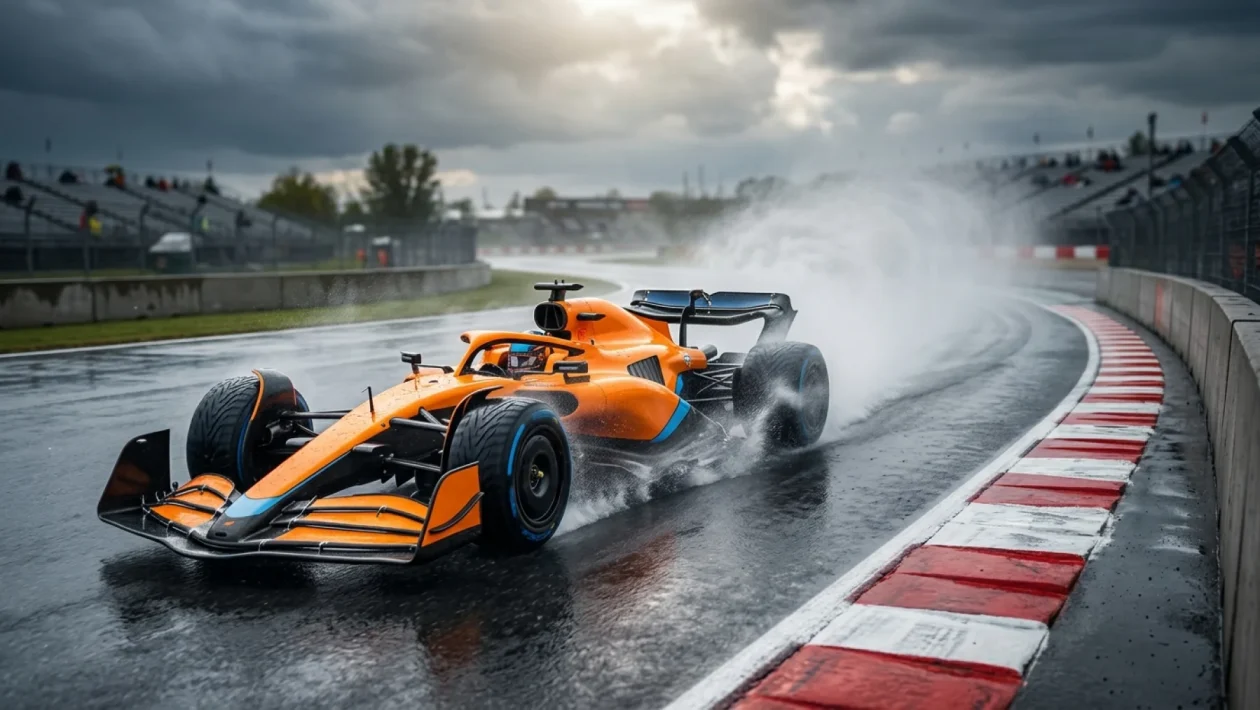
Imagine wrestling a 1,000-horsepower beast on sheer ice while blindfolded. That is exactly what half the Formula 1 grid is facing this weekend at the Circuit Gilles Villeneuve. McLaren boss Andrea Stella just admitted his team is flying totally blind with the new 2026 F1 engines in wet conditions.
The potential for a high-speed disaster is massive. If you want to know why this weekend’s Canadian Grand Prix might turn the established racing hierarchy completely upside down, you need to understand the terrifying learning curve these teams are up against right now.
2026 F1 Engines: The Unpredictable Variable
The new technical regulations rolled out this spring have completely rewritten how these cars deliver speed. Power delivery is no longer just about stomping on the gas pedal. The driver has to seamlessly manage a wildly complex hybrid system.
Here is a surprising hard fact: The 2026 regulations mandated a radical 50/50 power split between the internal combustion engine and the electrical battery. This means drivers are suddenly tasked with balancing nearly 500 horsepower of instant electric torque directly to the rear wheels.
When the track is bone dry, engineers can easily simulate how that power hits the pavement. Add a slick track surface to the mix, and that carefully calibrated predictability flies right out the window.
| Track Factor | The 2026 Problem |
|---|---|
| Ultra-Smooth Asphalt | Incredibly difficult to generate core tire temperature. |
| Lack of High-Speed Corners | Low aerodynamic downforce makes electrical torque snaps violent. |
You wouldn’t slap a set of cheap summer rubber from Canadian Tire on your pickup during a flash freeze and expect miracles, right? That is essentially what these F1 teams are dealing with right now. They simply cannot get the complex Pirelli wet tires into the right temperature window.
Causing McLaren’s Canadian GP Panic
Andrea Stella is a guy who usually keeps his cool, but his recent warnings highlight a massive disadvantage for McLaren. They have exactly zero data on how this new power unit behaves when traction is compromised.
“The power unit remains certainly an element of variability that is concerning, and if you have tested with it in wet conditions, you might know a little bit more,” says Stella.
That “little bit more” is a direct nod to Ferrari and Lewis Hamilton. They are among the very few who ran Pirelli’s wet-weather test at Fiorano back in April. In a sport where thousandths of a second matter, that real-world data is pure gold.
So, how does a team like McLaren survive a weekend where they are essentially guessing the setup? They have to execute a desperate, on-the-fly survival plan during the practice sessions.
- Analyze initial telemetry: Engineers monitor the very first wet laps to see exactly where the rear tires break traction under electric load.
- Tweak power deployment: Software maps are hurriedly rewritten to soften the electrical torque curve coming out of slow corners.
- Rely on driver instinct: Ultimately, they cross their fingers and trust the driver’s throttle control to keep the car out of the infamous Wall of Champions.
Frequently Asked Questions
Why can’t engineers just use computer simulations?
Simulators are incredibly advanced, but they rely on historical data. Because the 2026 F1 engines are fundamentally entirely new, teams don’t have baseline data for how the 50/50 hybrid split behaves on Montreal’s notoriously smooth asphalt in the rain.
Is this an automatic win for Ferrari?
Not necessarily, but it is a massive upper hand. Having actual track time in wet conditions means Ferrari isn’t guessing on their engine mapping. Everyone else is treating the opening laps of the Canadian GP weekend like a dangerous science experiment.
🤝 Share your thoughts in the comments below, because I want to know who you think will survive the chaos in Montreal this weekend.
💡 Expect the unexpected when the lights go out, as these new hybrid systems are guaranteed to catch out at least a few veteran drivers.
📱 Keep your screens locked to the telemetry data during the race, because the battle for rear grip is going to be the absolute defining factor of the afternoon.
👇 Good luck to the mechanics in the garage, because if the predictions hold true, they are going to be working serious overtime rebuilding carbon fiber!