
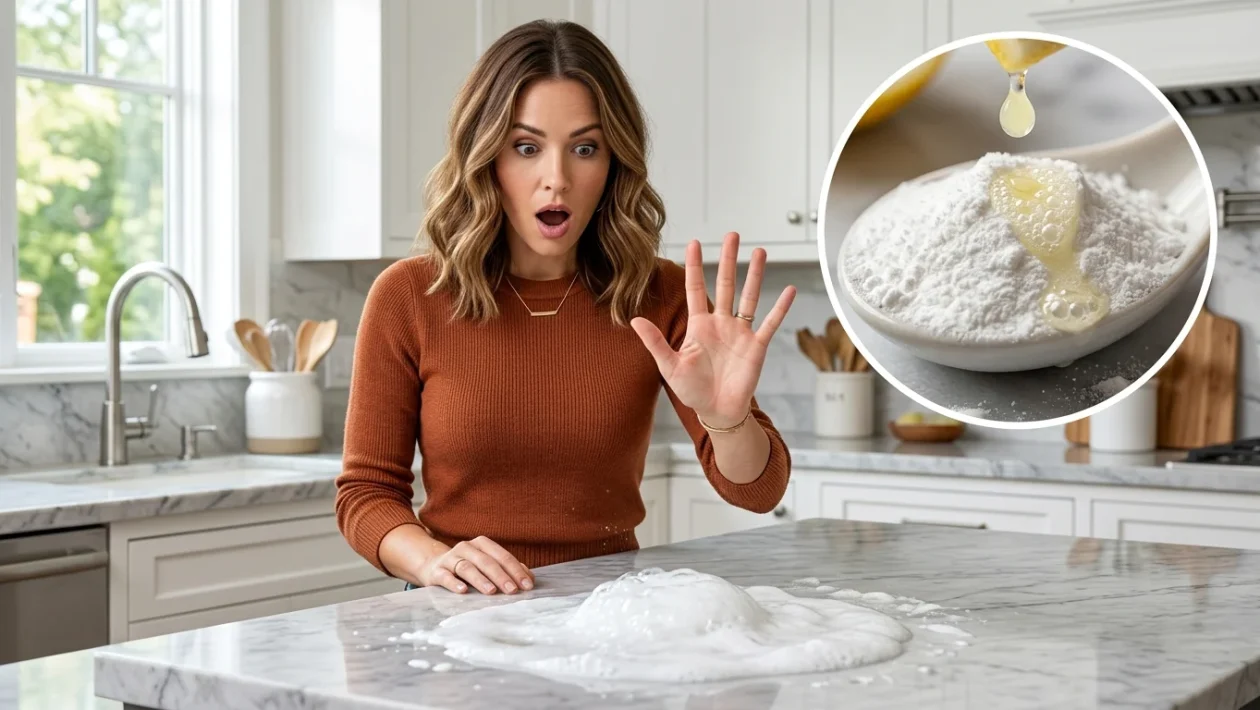
Countless household cleaning hacks claim that mixing baking soda and vinegar creates a miracle solution. You sprinkle the powder, pour the liquid, and watch the chemical reaction bubble away stubborn stains.
The only problem is that the resulting mixture is entirely ineffective.

Woman using a vinegar and baking soda solution.
“I get why people do it. I really do,” says Chem Thug, a PhD student in synthetic organic chemistry who debunked the myth in a TikTok video that garnered over 200,000 likes.
“If you mix vinegar with baking soda, it’s no different than dissolving the same amount of table salt in water and cleaning with that. In other words, it doesn’t do much.”
Why the Ingredients Work Separately
Both ingredients are incredibly effective when used alone. Ruojie Vanessa Zhang, an assistant research professor in food science at the University of Missouri, notes that their popularity stems from their natural properties, low cost, and minimal environmental impact.
Zhang, who also chairs the food chemistry division at the Institute of Food Technologists, explains that baking soda is highly basic. With a pH of around 9, it excels at neutralizing and removing grease.
Vinegar, on the other hand, is a dilute acetic acid with a pH of roughly 2. Its high acidity makes it perfect for dissolving hard water mineral deposits like calcium and magnesium.
The Problem with Mixing Them
When you combine a base and an acid, they neutralize each other. Baking soda and vinegar react to form carbonic acid, which is highly unstable.
This acid immediately breaks down into plain water and carbon dioxide gas.
“Basically, everything turns into carbon dioxide—the gas you see bubbling when you mix the two ingredients,” explains Chem Thug.
“If all you want is bubbles, you would have gotten the same effect if you blew hard over the surface you’re about to clean.”
The One Exception to the Rule
Experts do note one specific scenario where combining the two has a tangible benefit.
“Technically, the mixture can be useful in the household because the bubbles produced can help loosen dirt or unclog drains,” says Zhang.
However, the resulting liquid itself holds no real cleaning power. The solution becomes only slightly alkaline, making it worse at cutting grease than pure baking soda. Simultaneously, the vinegar loses its ability to dissolve minerals because its acidity has been neutralized.
Zhang’s ultimate advice is to stick to using them separately, reserving the mixture strictly for times when you need the physical friction of the bubbles in a tight space, like a blocked pipe.
A Better Chemical Alternative
If you want a chemical reaction that actually leaves behind a powerful cleaning agent, Chem Thug suggests mixing vinegar with potassium bitartrate—commonly known as cream of tartar.
When cream of tartar mixes with vinegar or lemon juice, it creates tartaric acid.
Unlike the useless saltwater left behind by baking soda, this acidic paste is highly effective at polishing and cleaning porcelain, aluminum, copper, and brass.

