The Reality of Post-Travel Paranoia
You land at Pearson after a grueling 14-hour flight. Your joints ache, your throat feels like sandpaper, and by the time you get your bags off the carousel, you are running a fever. If you just got back from Florida, you probably assume it is a standard flu. But if you just returned from regions dealing with more severe outbreaks, your mind—and the minds of the triage nurses at your local ER—goes straight to the worst-case scenario.
This exact situation played out recently in Ontario.
A traveler returning from Ethiopia showed up with symptoms consistent with a whole host of ugly illnesses. The public health machine kicked into high gear, isolating the patient and running a battery of tests, including one for Ebola. The result was negative.
Canada’s top doctor, Joss Reimer, called it a textbook example of how fast precautionary measures are activated, even when the actual statistical likelihood of a pathogen like Ebola hitting Canadian soil remains incredibly low.
We love to panic over headlines with the word “Ebola” in them. It gets clicks, it scares people, and it makes everyone eye the person coughing on their morning commute with extreme suspicion.
But the truth is much more boring, and highly reassuring.
Inside the Playbook
When you show up at a clinic with a fever and a recent passport stamp from a flagged region, the medical staff do not sit around debating probabilities. They trigger a heavily rehearsed protocol.
Honestly, half the time it’s just a nasty stomach bug, or maybe malaria if they were in the wrong region and skipped their pills. But the moment you say ‘fever’ and ‘East Africa’ in the same sentence, the protocol basically runs itself. It’s a massive headache for the hospital logistics team, having to lock down rooms and gown up, yeah, but it keeps everyone else completely out of the blast radius while we figure out what we’re actually looking at.
This is what precautionary testing actually looks like on the ground. It is not an admission of a raging outbreak; it is the system working exactly as designed to prevent one.
If you find yourself feeling wrecked after an international trip this spring, here is how the system handles you:
- The initial triage is aggressive. You will be isolated immediately, long before anyone draws blood.
- Contact tracing prep starts before you even realize what is happening. If a doctor suspects something highly contagious, public health authorities will already be quietly communicating with airlines like Air Canada or WestJet to secure flight manifests. They do not wait for a positive lab result to figure out who was sitting in the three rows around you. If the test comes back negative, they just shred the paperwork and move on.
- You will be tested for the mundane stuff first, even while they run the exotic panels.
Handling Your Own Return
Travel is messy right now. With various regional outbreaks popping up globally, the burden of initial detection often falls on you.
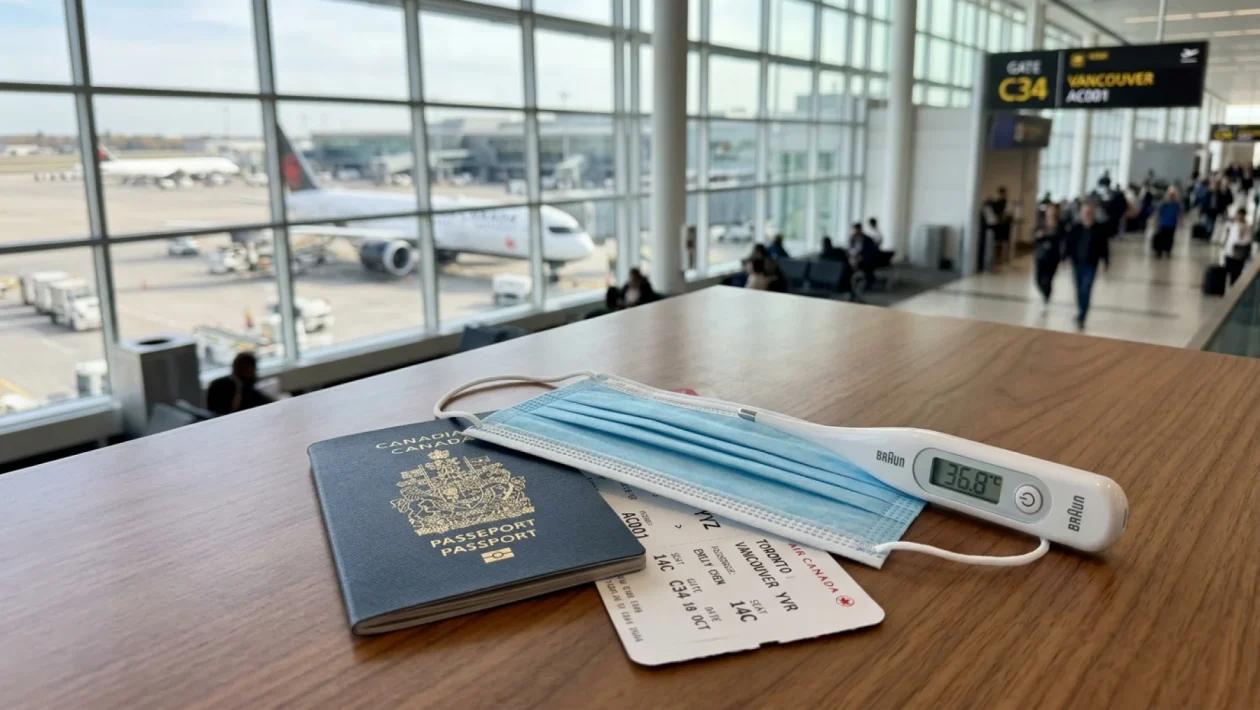
If you develop a fever over 38.0°C within 21 days of returning from a high-risk area, do not just walk into a crowded walk-in clinic and sit next to a toddler. Call ahead. Tell them exactly where you traveled and when you returned. Use a reliable thermometer at home—something like a Braun ThermoScan 7—so you can give the telehealth nurse an exact number rather than just saying you feel hot.
Most of the time, you have picked up a routine respiratory virus recycled through an airplane cabin. But on the off chance you brought back something worse, the system is already primed to catch it. The recent scare in Ontario proves that the safety nets are strung tight, waiting in the background to catch whatever falls through the cracks at the border.