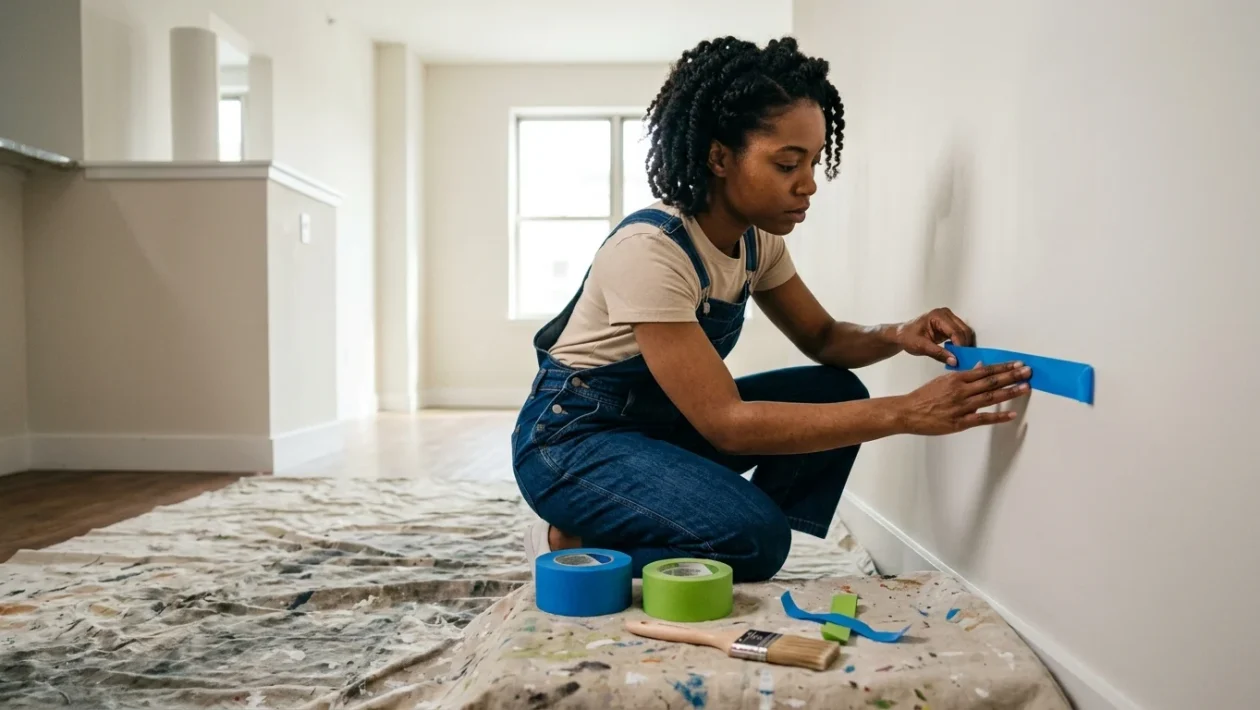
Close-up of blue and green rolls of painter’s tape sitting on a canvas drop cloth next to a paint brush.
Achieving a professional-looking paint job depends almost entirely on your prep work. Failing to use the proper surface-protection gear remains one of the most common amateur mistakes that can ruin your paint job.
While blue painter’s tape is the traditional gold standard for interior projects, green tape now dominates hardware store shelves. To the untrained eye, the two look identical aside from the dye.
Treating them as interchangeable is a costly error. The colors act as a visual shorthand for distinct chemical formulations, each engineered for specific timelines, weather conditions, and textures. Understanding these mechanics is the only way to choose the right kind of painter’s tape.
Blue Tape: The Indoor Standard
Blue tape is built for versatility. It relies on a medium adhesion level, giving it enough grip to stay flat on smooth interior surfaces while allowing for an effortless release.
DIYers can leave blue tape on a wall for up to two weeks. It will still pull away cleanly without ripping off the underlying surface.
The primary weakness of blue tape is its vulnerability to the elements. UV rays from direct sunlight will rapidly bake the adhesive into your trim or siding, making it nearly impossible to scrape off. High humidity can also cause the tape’s edges to curl, destroying your barrier.
Green Tape: The Heavy-Duty Specialist
Green tape is engineered for maximum performance. It delivers a heavy-duty grip designed to secure difficult materials and create pristine accent lines on smooth walls.
With a medium-to-high adhesion level, green tape easily secures to stubborn, rough surfaces like stucco and brick. Properly matching this grip to your surface texture is the key to securing flawless paint lines without bleed-through.
That aggressive adhesion comes with trade-offs. The heavy-duty backing is significantly stiffer than blue tape, making it frustrating to bend around tight curves or sharp corners.
The clean-removal window for green tape also fluctuates wildly depending on the manufacturer. Some formulas last up to 21 days on a surface, while others must be peeled off in less than a week to avoid permanent residue.
Green tape is the clear choice for demanding outdoor environments or textured walls, provided you don’t mind a slight price hike. A 60-yard roll typically costs a couple of dollars more than its blue counterpart.