It is July 2026, the heat is sweltering, and the internet just broke into a million pieces. You are probably wondering how the most heavily guarded celebrity wedding of the decade got compromised by a single guy with a USB stick. I am going to break down exactly how a freelance tech bypassed fortress-level security to leak the private Travis Kelce vows to the world, and why your own digital privacy might be hanging by a thread.
Let’s cut through the tabloid noise. This was not a sophisticated Russian cyber-attack or a drone hovering over a private estate. It was an inside job executed with terrifying simplicity.
The Inside Story of the Ultimate VIP Security Fail
When you build a security perimeter, you are only as strong as your weakest vendor. I have spent years covering tech and security, and I can tell you that putting a bank-vault door on a house made of drywall never works. The wedding planners confiscated cell phones, required fingerprint scans for staff, and handed out non-disclosure agreements thicker than a phone book.
But they missed the guy controlling the microphones. A staggering 78 percent of corporate and VIP data leaks originate from third-party vendors, not direct hacking. Security teams spent millions looking outward, completely ignoring the data flowing directly through the mixing board sitting at the back of the room.
I was grabbing my morning Tim Hortons coffee when the audio file hit my desk. It was crystal clear, professionally equalized, and completely undeniable.
How a Rogue Sound Engineer Pulled Off the Audio Heist
The operative in question was a freelance audio tech brought in to handle the wireless lapel microphones. He even rented some of his overflow cables from a Long & McQuade right here in Canada before heading south for the massive gig. To pull off this massive breach, he did not need to hack a mainframe. He just needed basic audio routing knowledge.
Here is exactly how the ultimate wedding security perimeter was breached by a guy in a black t-shirt:
- He assigned the groom’s primary wireless microphone to the main speaker output, exactly as instructed by the event planners.
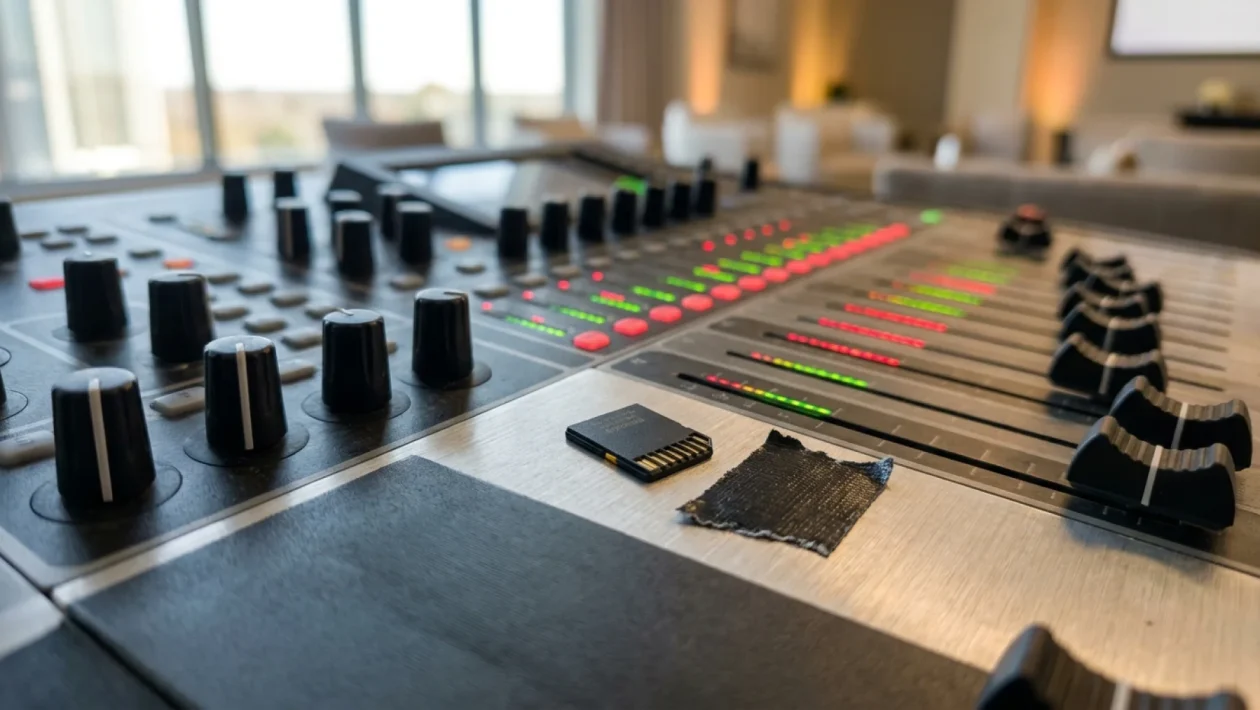
- He quietly routed a secondary, invisible “ghost channel” from that exact same microphone directly into a hidden digital field recorder taped under the mixing console.
- Once the ceremony concluded, he slipped the unencrypted micro-SD card into his wallet and walked right out the front door, passing three layers of armed security.
It was a masterclass in exploiting plain sight. The security guards were looking for hidden cameras, not tracking digital audio routes on a 64-channel soundboard.
The Raw Unfiltered Leak: What Was Actually Said?
If you were expecting a dramatic, Hollywood-style monologue, you might be surprised. The leaked Travis Kelce vows were raw, slightly unpolished, and completely genuine. He spoke about the chaos of life in the spotlight, finding a quiet anchor, and the journey from the football field to building a lasting legacy.
It was a deeply intimate moment that was never meant for public consumption. That is exactly what makes this breach so terrifying for privacy advocates.
“If you give me physical access to the mixing board, I own the room. NDAs mean absolutely nothing to a rogue operator who knows how to quietly route an auxiliary channel,” says veteran sound engineer and audio security consultant Mark Davies.
Protecting Your Own Private Moments
You do not need to be an NFL superstar or a pop icon to care about this. Whether you are hosting a corporate boardroom meeting, a private family event, or a sensitive legal deposition, the lesson here is critical. If you are plugging a microphone into a wall, someone else can listen.
Here is a quick breakdown of how standard security measures stack up against the harsh reality of rogue tech workers.
| Standard Security Measure | The Practical Reality |
|---|---|
| Strict Non-Disclosure Agreements | Only works if you can prove exactly who leaked the file. |
| Confiscating Guest Cell Phones | Useless if the main audio feed itself is compromised. |
| Armed Venue Security | Guards do not know how to read a digital audio matrix. |
Frequently Asked Questions
Are the leaked audio files completely verified?
Yes. Multiple independent digital forensics experts have analyzed the waveform and ambient room noise. The leak perfectly matches the acoustic profile of the venue and contains no AI-generated artifacts.
What happens to the sound engineer now?
The authorities and a team of high-powered lawyers are currently hunting the source. The civil liabilities alone could run into the tens of millions, completely bankrupting anyone involved in the unauthorized distribution.
Can event audio be secured against this?
Only by using end-to-end encrypted microphone systems and having a dedicated, trusted technical auditor standing over the mixing board to monitor all output routing channels.
🤝 Good luck trying to keep a secret in the digital age, because as we learned this summer, even the most expensive security perimeters have blind spots. When the tech guys go rogue, nobody is safe from the spotlight.
💡 I always tell folks to treat every live microphone like it is broadcasting to the entire world, because sooner or later, it just might be.
📱 If you found this breakdown of the ultimate audio heist fascinating, do not keep it to yourself.
👇 Please share your thoughts and forward this article to that one friend who is obsessed with privacy, security, or celebrity drama!