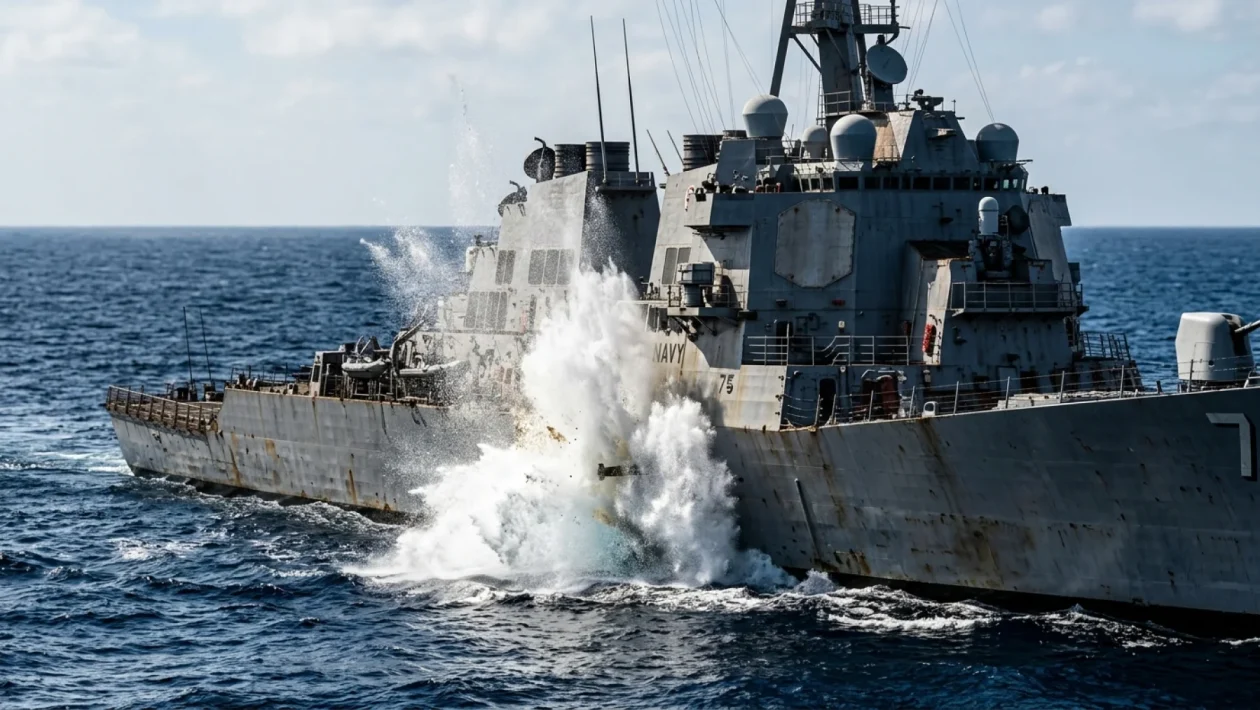
Imagine staring at a radar screen and watching a Japanese submarine lock its crosshairs onto an American warship, fire a live torpedo, and send the massive vessel straight to the bottom of the Pacific. Sounds exactly like a gritty history documentary from 1942, right? But this didn’t happen in the history books—it just went down in the summer of 2026. The target was the USS Juneau. And the absolute craziest part of this whole scenario? The Americans literally asked them to do it.
Welcome to the wild world of modern naval warfare exercises. This isn’t just about blowing things up for the fun of it; it’s about allied survival. Let’s break down exactly why a former enemy just sent millions of pounds of American steel to Davy Jones’ locker.
USS Juneau Sinking: A World War II Ghost Story Repeated
To understand why this event is turning heads, you need to know the heavy history attached to the name painted on the hull. The USS Juneau sinking isn’t a new concept for the US Navy. In fact, it carries a deeply tragic legacy.
Back in November 1942, during the brutal Guadalcanal campaign, the very first USS Juneau (CL-52) was crippled and then completely obliterated by a torpedo from the Japanese submarine I-26. The resulting explosion was so catastrophic that the ship sank in mere minutes.
Here is a hard, staggering fact: 687 crew members lost their lives in that 1942 sinking. Among the fallen were all five Sullivan brothers from Iowa. Their devastating simultaneous deaths rocked North America and directly led the US military to adopt the “Sole Survivor Policy” to protect families from losing all their children in combat.
Now, over 80 years later, a Japanese submarine has once again torpedoed a ship named USS Juneau. But this time, they were cheering together in the command center.
Why Japan Took The Shot
Fast forward to the summer of 2026. The Pacific Ocean is a tense chessboard, and allied nations need to prove they can operate together flawlessly. Enter Valiant Shield 2026, a massive multi-national military drill.
This wasn’t just an American show. The exercise pulled in heavy hitters from Japan, Australia, New Zealand, and our very own Royal Canadian Navy. When Canadian frigates roll into these colossal Pacific exercises, they bring world-class anti-submarine warfare tech to the table, often utilizing state-of-the-art systems integrated by homegrown powerhouses like Halifax’s Irving Shipbuilding.
“When you’re operating in the vastness of the Pacific, interoperability isn’t just a military buzzword—it’s survival. Sinking a real ship together proves that our allied strike capabilities are razor-sharp and instantly lethal.”
By allowing a Japanese submarine to take the kill shot on an American vessel, the allied forces sent a massive message. It proves that their communication systems, targeting data, and weapons platforms can seamlessly talk to one another in the heat of battle.
Torpedoed An American Warship: The 1942 vs. 2026 Breakdown
It’s fascinating to look at how naval warfare—and global alliances—have evolved. The contrast between the two USS Juneau incidents is like night and day.
| The 1942 Tragedy | The 2026 Exercise |
|---|---|
| Sunk by Imperial Japanese Navy sub I-26 during WWII combat. | Sunk by Japanese Maritime Self-Defense Force sub as an ally. |
| USS Juneau (CL-52), a light cruiser. | USS Juneau (LPD-10), an amphibious transport dock. |
| 687 casualties (including the Sullivan brothers). | Zero casualties (unmanned, remote target). |
| Sunk near the Solomon Islands. | Sunk in the Mariana Islands Range Complex. |
On Purpose: Prepping A Giant Ship For The Bottom Of The Pacific
You can’t just tow a massive 16,000-ton warship out into the ocean and blow it up. Environmental regulations (thankfully) don’t allow it. The military calls this a SINKEX (Sinking Exercise), and the preparation is exhausting.
The USS Juneau (LPD-10) had a proud history, hauling troops into Vietnam and serving in Operation Desert Storm before retiring in 2008. To give her a warrior’s death, the Navy had to follow a strict blueprint.
- The Deep Clean: Crews spend months gutting the ship, removing every drop of fuel, oil, asbestos, and hazardous chemicals.
- The Tow: The stripped-down ghost ship is towed out to a specific, highly regulated oceanic zone. By law, it must be at least 200 nautical miles off the coast.
- The Target Practice: Allied forces unleash a coordinated barrage of air, land, sea, and cyber attacks to test modern weapons against real steel armor.
- The Artificial Reef: Once the ship inevitably sinks in thousands of feet of water, the clean hull eventually becomes a habitat for deep-sea marine life.
It is the ultimate stress test. Computer simulations are great, but nothing beats seeing what a live torpedo actually does to a reinforced hull.
Frequently Asked Questions
What kind of ship was the modern USS Juneau?
The USS Juneau (LPD-10) was an Austin-class amphibious transport dock. Designed to haul Marines, helicopters, and landing craft directly into war zones, she was a true workhorse for the US Navy from 1969 until her decommissioning in 2008.
Does blowing up ships harm the ocean environment?
Because of extreme environmental scrubbing protocols, the environmental impact is highly mitigated. The ship is essentially an empty steel shell by the time the torpedo hits, and it sinks into water so deep it doesn’t disrupt coastal ecosystems.
Why don’t they just sell or scrap the old ships?
While many ships are scrapped for recycled metal, the military needs a few real-world targets. You cannot accurately measure the blast radius, armor penetration, or lethality of a new multi-million dollar weapon without firing it at a real, structurally sound warship.
Conclusion
🤝 Seeing former bitter enemies like the United States and Japan execute a highly coordinated, flawlessly timed strike together is a testament to how much the world has changed since 1942.
💡 It’s a fascinating blend of heavy history and modern muscle. The USS Juneau sinking reminds us of the sacrifices of the past, while the Valiant Shield exercise ensures our allied navies are locked, loaded, and ready for whatever the Pacific throws at them next.
📱 Share your thoughts down below—would you want to be on the bridge of that Japanese sub watching the torpedo find its mark, or does the history of the Juneau give you chills?
👇 Good luck out there on the water, stay sharp, and we’ll catch you in the next deep dive!