You are standing on top of a 6,000-degree inferno, and you probably don’t even realize it.
Roughly 5,100 kilometres straight down, there is a glowing ball of iron raging at temperatures that rival the visible surface of the Sun. But here is the kicker that breaks all logical rules: that blistering centrepiece isn’t a sloshing liquid, it is a rock-hard solid.
Today, we are tearing apart the physics of Earth’s inner core to show you exactly how immense, crushing pressure locks this scorching mass into a frozen state. We will also dive into the latest 2026 seismic data proving that this massive planetary engine is actively shifting, moving, and deforming right beneath our boots.
Earth’s inner core exposed
Most of us think we understand digging deep.
You look at a massive Canadian operation like the Kidd Creek mine in Ontario, plunging nearly three kilometres down, and it feels monumental. But in the grand scheme of planetary mechanics, that is barely a scratch on the paint job.
To reach the Earth’s inner core, you would have to drill past 5,100 kilometres of crust, mantle, and molten rock. We obviously cannot physically go there, so every bit of data we have is mathematically inferred.
It was a Danish seismologist named Inge Lehmann who first cracked the code back in 1936. By studying how shockwaves bounced around inside the planet after major earthquakes, she realized there was a dense, fixed centre hidden inside the outer liquid layer.
The 6,000-degree iron sphere
Figuring out the exact temperature of a place we can never visit requires some serious heavy-duty science.
Scientists estimate the core’s temperature sits somewhere between 5,000 and 6,000 degrees Celsius. To put that into perspective, if you dropped a pair of heavy-duty Kamik winter boots down there, they wouldn’t just melt—they would instantly vaporize.
But how do researchers actually pin down that number without melting their thermometers?
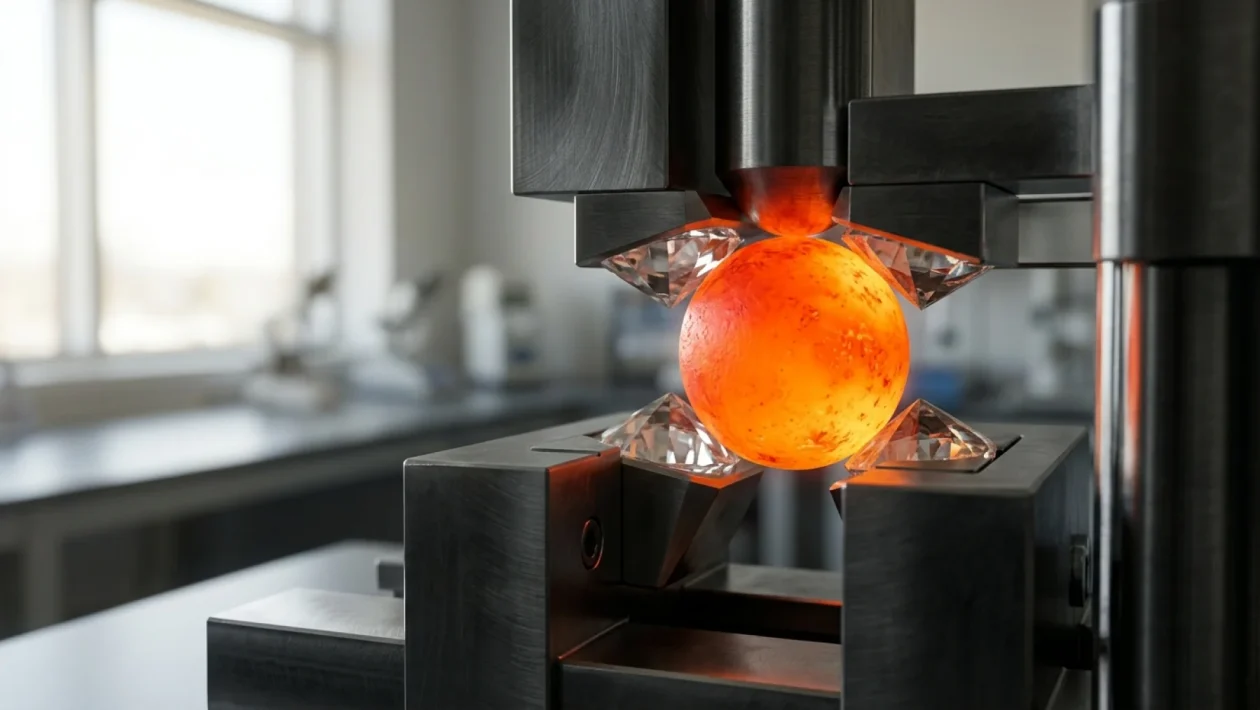
- Simulate the crush: Researchers use specialized tools called diamond-anvil cells to physically compress tiny iron samples between two highly durable diamonds.
- Apply the heat: They hit these highly pressurized samples with powerful lasers or shock-waves to mimic the extreme thermal conditions of the deep earth.
- Read the melting point: By observing exactly when the iron structure collapses into a liquid state under various pressures, they confidently extrapolate the core’s true temperature.
Why it stays completely solid
This is where things get genuinely fascinating.
Common sense tells us that when things get hot, they melt. But pressure is the ultimate equalizer. Down at the boundary of the inner core, the pressure hits roughly 330 gigapascals.
That is an insane metric—more than three million times the atmospheric pressure you feel standing at sea level.
“Heat pushes a material towards melting, but pressure pushes right back. Squeezing atoms together under millions of atmospheres makes it physically impossible for them to break out of their ordered lattice and flow.” — Dr. John Vidale, leading seismologist and Earth sciences researcher.
At these terrifying depths, the melting point of iron skyrockets. Even though the core is thousands of degrees hot, the monumental weight of the entire planet physically crushes those iron atoms into a fixed, solid grid.
| Layer | State & Reason |
|---|---|
| Outer Core | Liquid. The pressure is slightly lower, allowing the intense heat to successfully melt the iron. |
| Inner Core | Solid. The overwhelming pressure forces the atoms into a locked lattice despite the 6,000°C heat. |
Recent shifting discoveries
If you thought this solid iron ball was just sitting quietly in the dark, think again.
Recent seismology papers from 2024 and 2025 have thrown a massive wrench into the static diagrams we saw in high school textbooks. By tracking repeating earthquakes near the South Sandwich Islands, researchers realized the inner core’s rotation is actively changing.
It appears to be slowing down, moving backward relative to the mantle around it. Even wilder, the boundary between the solid and liquid layers is actively deforming, developing physical bulges as liquid iron continuously freezes and melts.
The deepest part of our planet is not a dead, frozen relic. It is an incredibly active, dynamic powerhouse.
Frequently Asked Questions
Why doesn’t the outer core solidify too?
It is entirely a game of pressure limits. As you move outward from the absolute centre, the immense pressure drops just enough that the extreme heat finally wins the tug-of-war. The iron hits its natural melting point and turns into a massive, sloshing liquid shell.
How do we know the inner core is made of iron?
Based on the overall density of the Earth, the speed at which seismic waves travel through the centre, and the known composition of meteorites floating around our solar system, iron (mixed with a bit of nickel) is the only element heavy and abundant enough to fit the math perfectly.
🤝 Thank you for digging deep into the ultimate basement of our planet with me today.
💡 The next time you are standing on seemingly stable ground, take a second to appreciate the absolute chaos of pressure and heat keeping this spinning rock together.
📱 If you found this breakdown mind-blowing, share your thoughts below or send this to someone who loves a good science mystery.
👇 Stay curious out there, and I will catch you in the next deep dive!