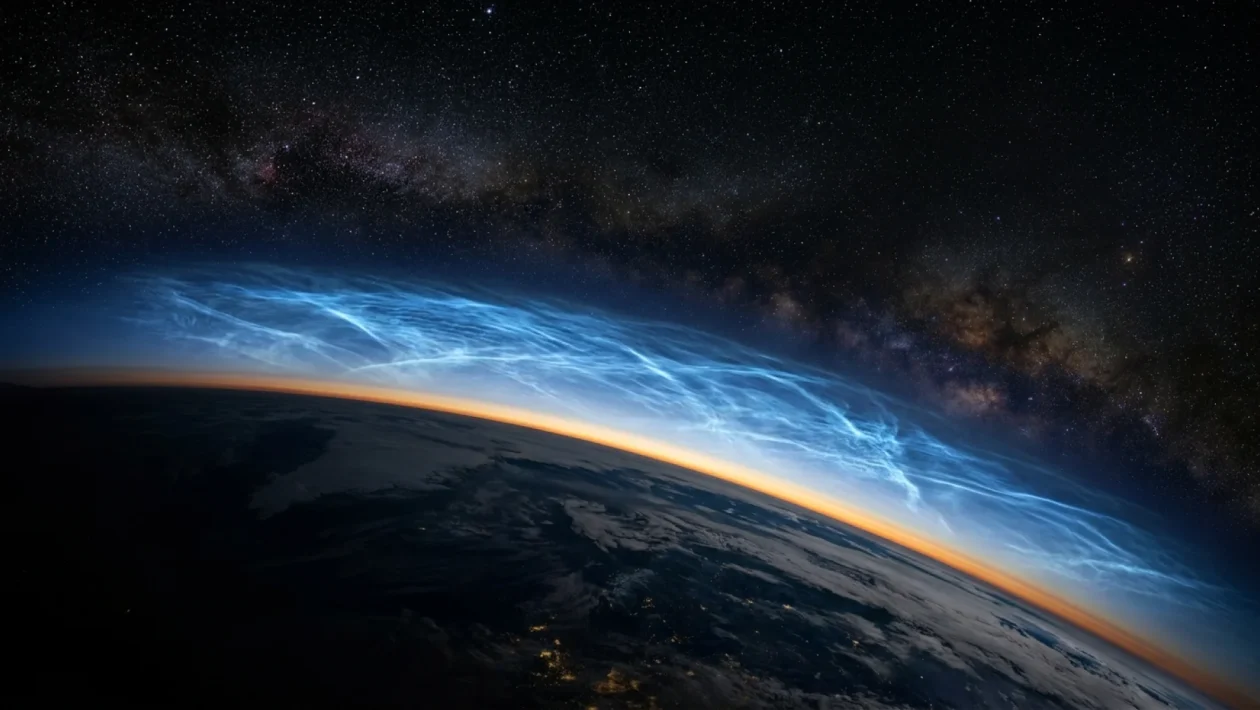
Right now, fifty miles above your head, a hidden ocean of ice is waiting for the sun to go down.
As we transition through May 2026, the Northern Hemisphere is gearing up for one of the most mind-bending optical illusions in the solar system. We are talking about noctilucent clouds (NLCs)—ghostly, electric blue tendrils that literally glow in the dark.
These aren’t your standard rainmakers. They are formed from the vaporized remains of shooting stars, crystallizing at the very edge of space.
If you want to catch this cosmic light show, you can’t just stare aimlessly at the horizon. You need to know exactly when and where the atmosphere is freezing over.
What Exactly Are These Electric Blue Night Sky Phantoms?
To understand why these clouds look like glowing neon veins in the sky, you have to look past our normal weather.
Standard clouds live in the troposphere, just a few miles up. Noctilucent clouds exist in the mesosphere, a staggering 50 miles (80 kilometers) above the Earth’s surface.
At this extreme altitude, temperatures plunge to a bone-chilling minus 220 degrees Fahrenheit. When leftover moisture from the lower atmosphere gets trapped up there, it wraps itself around meteor smoke—microscopic debris left behind when space rocks burn up in our atmosphere.
Because they are so incredibly high, these ice-coated meteor bits catch the sun’s rays long after the sun has dipped below your local horizon. The result? A brilliant, eerie blue glow against a pitch-black sky.
| Atmospheric Feature | The NLC Zone (Mesosphere) |
|---|---|
| Cruising Altitude | 50 miles (80 km) up |
| Core Temperature | -220°F (-140°C) |
| Cloud Composition | Meteor dust wrapped in water ice |
| Illumination Source | Over-the-horizon sunlight |
How to Use a Noctilucent Clouds Map in the USA
Historically, this phenomenon was reserved for folks living in the Arctic Circle or deep into Canada. But the mesosphere is changing.
Thanks to shifting atmospheric conditions and fluctuations in the solar cycle, these glowing clouds are creeping further south. Stargazers in Washington, Michigan, and even as far south as Colorado are now regularly reporting sightings.
To maximize your chances of spotting them without wasting your night, a noctilucent clouds map or tracking tool is your best friend. These digital maps aggregate satellite telemetry and ground-based radar to show exactly where the mesosphere has hit the critical “frost point.”
Here is your foolproof playbook for tracking them down:
- Check the Satellite Feed: Log onto weather mapping sites that utilize data from high-altitude weather satellites. Look for radar maps specifically tracking the mesosphere’s temperature and moisture levels.
- Find the Twilight Zone: NLCs are only visible when the sun is between 6 and 16 degrees below the horizon. The map will help you pinpoint when astronomical twilight hits your specific zip code.
- Look North: No matter where you are in the USA, face the northern horizon about 90 minutes after sunset (or before sunrise).
- Scan for Electric Blue: Look for wispy, glowing ripples that shine with a distinct, unnatural bluish-white light. If the clouds look dark silhouettes against the sky, they are regular clouds. If they are glowing, you have hit the jackpot.
The Science Behind America’s Highest, Coldest Clouds
Atmospheric physicists and aerospace agencies have been obsessed with NLCs for decades.
In fact, NASA’s AIM mission (Aeronomy of Ice in the Mesosphere) spent years staring directly at these clouds, mapping their global spread. Furthermore, scientists at the Canadian Space Agency regularly monitor the upper atmosphere to understand how rocket launches and greenhouse gases might actually be fueling the spread of these night-shining clouds.
Every time a heavy-lift rocket, like a SpaceX Falcon 9, blasts into orbit, it dumps tons of water vapor into the upper atmosphere. That exhaust can drift to the poles, freeze onto meteor dust, and trigger artificial NLCs.
“We are watching the edge of space react to what happens on the ground in real-time. Noctilucent clouds are beautiful, but they are also a high-altitude canary in the coal mine, showing us how interconnected the layers of our atmosphere truly are.”
— Dr. Sarah Collins, Atmospheric Physicist
It is a mind-boggling realization. When you look up at those glowing tendrils, you are watching the intersection of ancient space dust, modern spaceflight, and extreme Earth weather.
Frequently Asked Questions About Noctilucent Clouds
When is the best time to see noctilucent clouds in the US?
The prime viewing season kicks off in late May and runs through August. June and July are the absolute peak months. You want to be looking about 90 minutes to two hours after sunset, or right before dawn.
Do I need a telescope to see them?
Absolutely not! Noctilucent clouds are massive atmospheric structures that stretch for hundreds of miles. They are best viewed with the naked eye. A pair of standard binoculars can help you pick out the delicate, rippling wave structures within the ice, but no heavy-duty telescope is required.
Why are they spreading further south into the USA?
Increased methane in the lower atmosphere breaks down into water vapor when it rises to the mesosphere. Combined with extra water exhaust from frequent rocket launches, there is simply more moisture available at the edge of space to freeze onto meteor smoke, allowing the clouds to form at lower latitudes.
Keep Looking Up
🚀 The edge of space is closer than you think. As we head into the summer of 2026, the night sky is gearing up to offer us a front-row seat to one of the most alien-looking phenomena on Earth.
🔭 Check your local noctilucent clouds map this week. Set an alarm, grab a warm jacket, and head out to a dark-sky spot with a clear view of the northern horizon.
🌌 Share your thoughts and photos with us! Have you ever caught a glimpse of these electric blue phantoms from your backyard? Let us know in the comments, and don’t forget to keep your eyes on the stars.
👇 Happy cloud hunting, America!