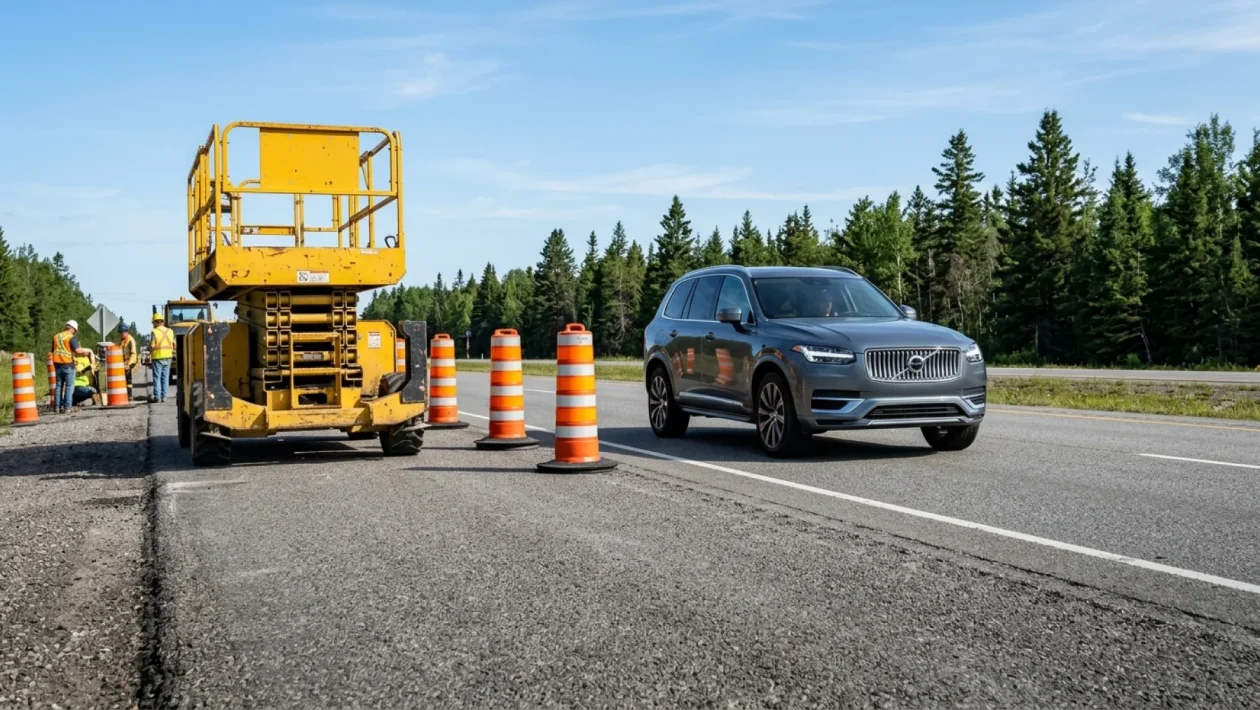
Two people are lying in a hospital bed today because an SUV tangled with a heavy scissor lift. The westbound lanes of the Yellowhead at Highway 60 were completely shut down this May, transformed into a sprawling field of twisted metal and shattered glass. This isn’t just another morning traffic delay to groan about over your coffee. It is a brutal, real-time reminder of exactly what happens when high-speed commutes collide with mobile construction equipment.
We are diving deep into the anatomy of this exact crash to show you how to read the road ahead. I am going to break down how to handle these massive machines so you never end up as a headline on the morning news. The ultimate solution is a shift in driver psychology, and it starts the second you see those orange signs.
Highway 16 collision lessons from the May 2026 wreckage
If you’ve spent any time driving through Alberta, you know the Yellowhead is a major artery pulsating with heavy freight and hurried commuters. The Highway 16 collision that occurred on May 28, 2026, is a textbook example of a mismatched weight class. An SUV squaring off against a steel scissor lift platform is a physics equation where the passenger vehicle always loses.
Emergency crews spent hours clearing the debris scattered across the intersection. These scissor lifts are designed for vertical stability on flat ground, not for surviving a high-speed broadside. When you hit heavy construction equipment, there is absolutely zero crumple zone forgiveness on their end.
Transport Canada data shows that highway collisions in active work areas spike by a terrifying 27% during the spring and summer months. As the ground thaws, the heavy machinery rolls out, and driver complacency becomes deadly.
Navigating construction zones without becoming a statistic
We all hate slowing down. But when you blast through a zone where crews are laying asphalt or upgrading intersections, you are playing Russian roulette. Navigating these areas requires hyper-awareness and a vehicle that actually responds when you slam the pedal.
Before road trip season kicks off, I always recommend folks pull into a trusted Canadian shop like Kal Tire to get their brake pads and tire treads checked. If your stopping distance is compromised, you won’t stand a chance when a front-end loader suddenly pulls into your lane.
Firms like Edmonton-based PCL Construction spend millions annually on site safety protocols and traffic flagging. However, they cannot control the reflexes of a distracted driver barreling toward their job site at 110 km/h.
Spotting heavy equipment before it’s too late
Heavy machinery does not behave like normal traffic. A scissor lift or a skid steer has massive blind spots, terrible acceleration, and a turning radius that takes up two lanes. You have to anticipate their moves before they make them.
Here is my battle-tested protocol for passing heavy equipment safely on the highway:
- Scan the shoulders early: Look half a kilometer ahead for flashing amber lights, not just the brake lights of the car in front of you.
- Identify the pilot vehicle: If you see a pickup truck with a wide-load sign or roof beacons, assume a massive piece of equipment is right behind it.
- Double your following distance: Give yourself at least four to five seconds of buffer room. Heavy machinery can drop debris or stop abruptly.
- Commit to the pass: When it is safe to pass, do it purposefully. Never hover in the blind spot of a grader or an articulating lift.
Protecting your family on Canadian highways
At the end of the day, your priority is getting your family home in one piece. That means adopting a defensive driving mindset the second you merge onto a busy route like Highway 16. It is about expecting the unexpected from both the construction crews and the impatient drivers around you.
“When you see orange cones, your brain needs to instantly downshift into defensive mode. A mobile work platform entering a highway isn’t like another car—it’s a moving brick wall.” — David Reynolds, Industrial Traffic Safety Director.
To put things into perspective, look at the brutal reality of momentum. Here is a quick breakdown of why these crashes are so devastating.
| Vehicle Type | Weight & Hazard Profile |
|---|---|
| Standard Family SUV | Approx. 4,000 lbs (Engineered to crumple and absorb impact) |
| Mobile Scissor Lift | Up to 10,000+ lbs (Solid steel, zero impact absorption) |
Frequently Asked Questions about Work Zone Safety
Who is at fault if I hit construction equipment on the highway?
Fault is determined by law enforcement based on right-of-way, speed, and signage. However, if you rear-end a piece of equipment or fail to yield in a marked construction zone, the liability almost always falls squarely on your shoulders.
How slow do I actually need to go in an Alberta construction zone?
You must obey the posted orange speed limit signs, regardless of whether you actually see workers present. Fines double in these zones, and losing control on milled pavement at high speeds is incredibly common.
Why is equipment like a scissor lift even on the road?
While mostly used on job sites, these machines frequently cross intersections or travel short distances on highway shoulders to move between phased work areas. They are legally allowed to cross if managed safely, which means drivers must stay alert.
🤝 Good luck out there on the roads this season, and keep your head on a swivel.
💡 Remember, arriving at your destination a few minutes late is infinitely better than not arriving at all.
📱 If you’ve ever had a close call near a roadwork site, or have a tip for navigating the Yellowhead, I want to hear about it.
👇 Drop a comment below and share your thoughts on how we can make our Canadian highways safer for everyone.