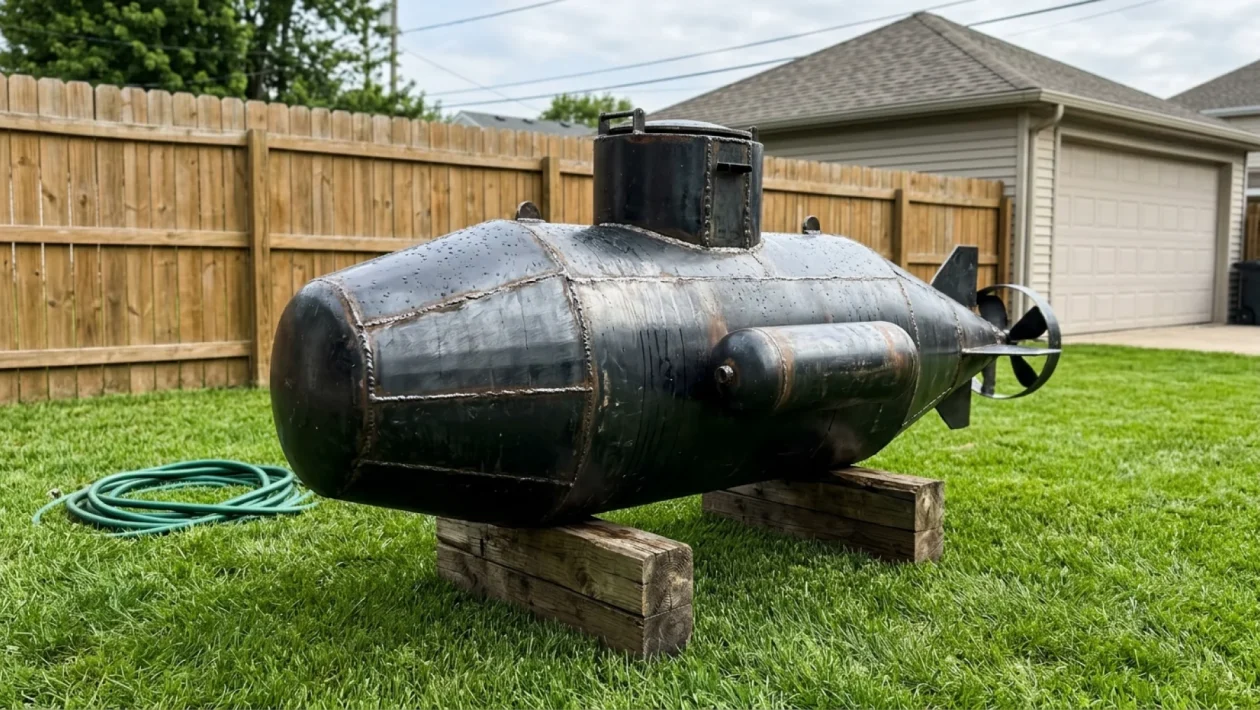
Forget the leaky backyard garden hoses and the flimsy weekend carpentry projects. Imagine sinking your hard-earned cash into a massive pile of scrap steel, firing up a welding torch, and telling your neighbors you are building a submarine. They would absolutely think you had lost your mind. Yet, that is exactly what one 60-year-old former carpenter did, ignoring every skeptic in his village to construct a 100% functional, battery-powered submersible right in his own backyard.
Most of us feel a sense of accomplishment after fixing a squeaky door hinge or surviving a trip to Canadian Tire on a Saturday morning. But this man did not just dream of exploring the depths; he forced the laws of hydrodynamics to bend to his will using pure, unfiltered mechanical grit.
DIY Electric Submarine
The concept of a DIY electric submarine sounds like something ripped straight out of a comic book. For Zhang Shengwu, a farmer residing in China’s mountainous Anhui province, it was a practical engineering challenge. He had spent decades working as a carpenter in busy river shipyards, yet he had never actually laid eyes on a real submarine.
His wild inspiration struck after watching a television documentary about massive, nuclear-powered military subs. While most folks would just change the channel, Zhang looked at the screen and thought, “If they can do it, so can I.”
Of course, his wife tried to talk him out of it. She correctly pointed out that building an underwater death-trap was both highly dangerous and terrible for their household budget. But Zhang pressed forward, proving that when a handyman gets a vision in his head, absolutely nothing can stop him.
How A 60-Year-Old Farmer Built It
You do not just wake up and snap together a five-ton steel tube like it is a set of Lego. Zhang’s journey was paved with massive failures and a steep learning curve. His initial 2016 prototype was a catastrophic flop that suffered from severe water leaks.
Instead of throwing in the towel, he went back to the drawing board. Here is the exact blueprint of how he pulled off this mechanical miracle:
- Scavenging the Hull: He purchased heavy, second-hand steel plates and manually welded them together to form a highly pressurized, watertight exterior shell.
- Balancing the Beast: To stop the vessel from rolling over, he strategically poured exactly two tons of solid concrete into the concave bottom of the ship to act as a permanent counterweight.
- Rigging the Ballast: He engineered and installed two robust, manual air-ballast tanks on the sides to control buoyancy, allowing the ship to sink and rise on command.
- Wiring the Propulsion: He daisy-chained a massive block of heavy-duty batteries to a rear electric motor, creating a silent, fume-free propulsion system.
A Functional Underwater Vessel
The finished product, affectionately dubbed the “Big Black Fish,” is not just a floating tin can. It is a highly capable machine that genuinely works. The interior has enough breathing room to comfortably seat two full-grown adults.
During its initial river trials, the heavy vessel successfully dove to a maximum operational depth of eight meters (about 26 feet). Not a single drop of water breached the hull.
“The hydrostatic pressure even at eight meters is unforgiving. To achieve a perfect watertight seal and master buoyancy using only empirical knowledge and scrap-yard tools is an absolute masterclass in raw mechanical intuition.” — Dr. James Vance, Marine Engineering Consultant.
Powered entirely by its electric motor, the sub cruises underwater at a steady four knots. It can sustain completely submerged, uninterrupted dives for roughly thirty minutes before needing to surface.
From Scrap to Deep Water
Building your own naval fleet on a farmer’s budget requires serious financial sacrifice. Zhang poured his life savings into the project, operating far outside the realm of modern tech hubs or corporate funding.
Here in the spring of 2026, we are surrounded by AI and high-tech gadgets, making raw, hands-on mechanical achievements like this even more impressive. Check out the financial breakdown of his relentless pursuit:
| Project Phase | Estimated Cost (USD) |
|---|---|
| Failed 2016 Prototype | $700 |
| The “Big Black Fish” Redesign | $6,000 |
Surprisingly, Zhang is not alone. Did you know that over the last decade, dozens of rural inventors across Asia have successfully launched homemade aircraft, mechanical walking horses, and watercraft without a single day of formal engineering training?
Zhang is already looking to the future. He recently purchased modern blueprints to build an even larger model, complete with autonomous oxygen purification systems and a periscope boasting a two-kilometer visual range.
Frequently Asked Questions
Is it legal to build and test your own submarine?
It heavily depends on where you live. In North America, agencies like Transport Canada or the US Coast Guard have incredibly strict maritime regulations regarding homemade vessels, especially submersibles. You cannot just drop a homemade steel tube into a public waterway without passing rigorous safety and environmental inspections.
How does a DIY electric submarine supply oxygen?
For short dives, a small cabin holds enough ambient air for a quick 30-minute trip, which is what Zhang currently relies on. For longer excursions, builders must install complex oxygen scrubbers to remove carbon dioxide, similar to the systems used by deep-sea scuba divers.
What happens if the electric motor fails underwater?
This is the ultimate nightmare scenario. A well-designed sub relies on emergency blow systems to forcefully pump compressed air into the ballast tanks. This makes the vessel instantly buoyant, floating it to the surface even if all electrical power is lost.
🤝 We have all tackled crazy weekend projects, but Zhang’s backyard submarine puts our wonky birdhouses and crooked patio decks to absolute shame.
💡 It proves one universal truth: You do not always need a fancy degree or a million-dollar workshop to build something extraordinary. Sometimes, you just need a welder, a vision, and the stubbornness to ignore the people who say it cannot be done.
📱 What is the most ambitious DIY project you have ever attempted? Drop down to the comments and share your thoughts—I would love to hear how you tackle your own backyard engineering challenges!
👇 Good luck on your next build, and remember to measure twice and weld once!