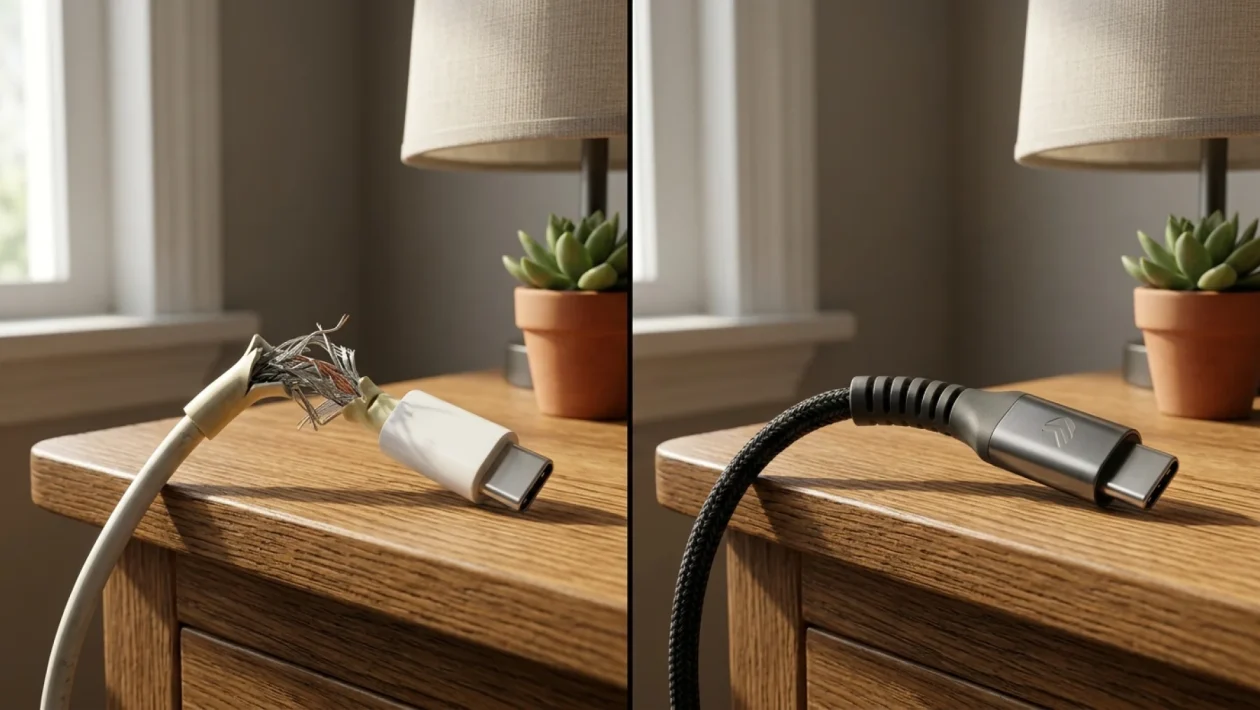
You grab your phone off the nightstand, and there it is—that familiar, frustrating sight. The plastic sleeve on your charging cord has split open right at the neck, exposing a messy nest of frayed silver wires. We’ve all been there, constantly tossing dead cords into the trash and dropping another thirty bucks at Best Buy Canada just to keep our daily devices alive. But that annoying snap isn’t just a random manufacturing flaw; it’s a highly specific mechanical failure you can easily prevent.
Broken USB Cables
Let’s face it, constantly replacing dead cords is a massive drain on your wallet. A staggering industry estimate suggests the average North American burns through three to five charging cables every single year. That isn’t just an annoying recurring expense; it contributes to a massive mountain of avoidable electronic waste.
The real kicker is that we are usually the ones destroying them without even realizing it. Whether you are aggressively pulling the cord from your bed or jamming it vertically into your truck’s cupholder, you are putting lethal stress on the absolute weakest point of the accessory.
The Real Reason They Snap
To stop the madness, you need to understand the basic anatomy of the crime scene. The exact spot where the flexible wire meets the rigid metal plug is a structural nightmare. When you plug it in, that metal connector becomes a fixed anchor point.
Every single yank, twist, or sharp bend transfers brutal mechanical stress directly to that tiny junction. You are physically bending the internal copper wires past their natural elastic limit. Over time, this repetitive bending hardens the metal until it simply gives up and snaps entirely.
“At a microscopic level, bending a wire beyond its elastic limit breaks and reforms the bonds between atoms. It creates a buildup of defects called dislocations, where atoms no longer align—exactly like permanent, damaging folds in a carpet.” — Prof. Robert Hyers, Materials Engineering Expert.
The environment around you accelerates this destruction, too. As we head into the warmer months of 2026, extreme dashboard heat baking inside your car softens the protective polymers, while leftover winter cold makes standard plastic sheathing brittle and prone to cracking.
How To Stop It Forever
You don’t need a degree in materials science to make your gear last. Stopping this cycle of destruction comes down to two simple things: buying the right equipment and changing a few tiny daily habits. First, it is time to ditch the flimsy, standard-issue rubber cables. Brands like Anker make fantastic braided nylon cords that distribute tension evenly across the entire length of the wire, absorbing the shock well before it hits the connector.
Here is a quick breakdown of why the upgrade makes long-term sense:
| Cable Material | Durability & Cost Impact |
|---|---|
| Standard Plastic (PVC) | Prone to tearing, stiffens in cold, requires frequent $20+ replacements. |
| Braided Nylon / Kevlar | Highly flexible, distributes stress gracefully, costs a bit more upfront but lasts for years. |
Now that you have the right gear, you just need to handle it like a pro. Follow this simple process to maximize the lifespan of your charging setup:
- Grip the thick plastic plug head firmly, never grabbing the flexible wire itself.
- Pull the plug straight out from the wall or device without aggressively wiggling it side to side.
- Ensure your cable is long enough (at least 6 to 10 feet) so you never use it stretched tight across a room.
- Never rest the physical weight of your phone directly on the plugged-in connector while sitting on the couch.
Frequently Asked Questions
Does wrapping electrical tape around a frayed cable fix it?
Not really. Tape might temporarily cover the exposed wires, but the internal microscopic damage is already done. Once a cable starts fraying, it becomes a fire hazard and causes incredibly slow charging speeds. Do yourself a favor and throw it in the recycling bin.
Why do cables break so much faster in my vehicle?
Vehicles are absolutely brutal on delicate electronics. When you rest your phone vertically in a cup holder while plugged in, the entire weight of the device—plus all the vibrations from the road—compresses right onto that fragile connector joint. Always lay the phone flat if possible.
Are thicker cables always better?
Thickness doesn’t always equal strength. A thick plastic cable will still break if bent repeatedly. What truly matters is the exterior shielding material—woven nylon or fabric is always superior to standard plastic because of how it flexes.
🤝 We’ve all wasted enough cash on flimsy charging cords over the years. By upgrading to a braided cable and being mindful of how you yank it out of the wall, you’ll instantly stop the endless cycle of frayed wires.
💡 Good luck making your next charging cord last the entire lifespan of your actual smartphone—it is completely possible if you treat the connector with just a little bit of mechanical respect.
📱 Share your thoughts and let me know if you are a habitual cord-wrecker or if you’ve already made the permanent switch to braided nylon.
👇 Drop a comment below with your longest-surviving tech accessory, I’d love to hear what gear is actually holding up for you!