Everyone loves a shiny new toy, especially when it’s strapped to a rocket and branded with Elon Musk’s name. But buying into the upcoming SpaceX IPO without reading the fine print is like buying a used truck without checking the transmission. Wall Street is currently foaming at the mouth over a staggering $1.75 trillion valuation expected this June. I’m here to tell you that looking closely at their S-1 prospectus will instantly kill that buzz.
You don’t need a finance degree to see the cracks in the foundation. We are looking at massive net losses masked by accounting gymnastics, and an AI division that is eating the dust of its competitors. Let’s grab a wrench, pop the hood on this financial engine, and see what’s really leaking.
SpaceX IPO Secrets Revealed
The hype machine for the SpaceX IPO is operating at full throttle. They are aiming to raise $75 billion in what would be the largest public offering in market history. But hype rarely pays the bills long-term.
When you strip away the glamour of space exploration, you are left with cold, hard numbers. And right now, in the spring of 2026, those numbers don’t add up. The company generated $18.67 billion in consolidated sales last year, which sounds massive until you look at the price tag.
Historically, game-changing tech companies max out at a price-to-sales (P/S) ratio of about 30 to 45. At a $1.75 trillion valuation, SpaceX would trade at a ridiculous P/S ratio of 94. For context, even when Canadian darling Shopify went on its legendary, gravity-defying TSX bull run, it didn’t push boundaries this dangerously.
“You can build the greatest rockets in human history, but financial gravity eventually applies to your balance sheet too. A P/S ratio approaching 100 isn’t an investment; it’s a leap of faith.” – Marcus Vance, Senior Equity Strategist
Why Elon’s $1.75 Trillion Mega-Stock Defies History
A massive chunk of this $1.75 trillion valuation is hitched to xAI, Musk’s artificial intelligence startup. The prospectus paints a picture of a limitless $26.5 trillion addressable market for AI infrastructure. But potential doesn’t equal profit.
While rivals are posting explosive revenue, xAI is quietly trailing behind. Anthropic is pacing for roughly $10.9 billion in second-quarter sales right now. Meanwhile, SpaceX’s latest filings show xAI first-quarter sales at just $818 million.
That is a measly 12.5% growth from the previous year. You cannot demand the biggest valuation in stock market history when your flagship tech division is getting its lunch eaten by the competition.
The Accounting Tricks That Are Actually Bleeding Cash
This is where the story gets really interesting. Companies love to use “Adjusted EBITDA” because it’s the corporate equivalent of sucking in your gut for a photo. SpaceX’s prospectus points to a healthy $6.58 billion in positive adjusted EBITDA.
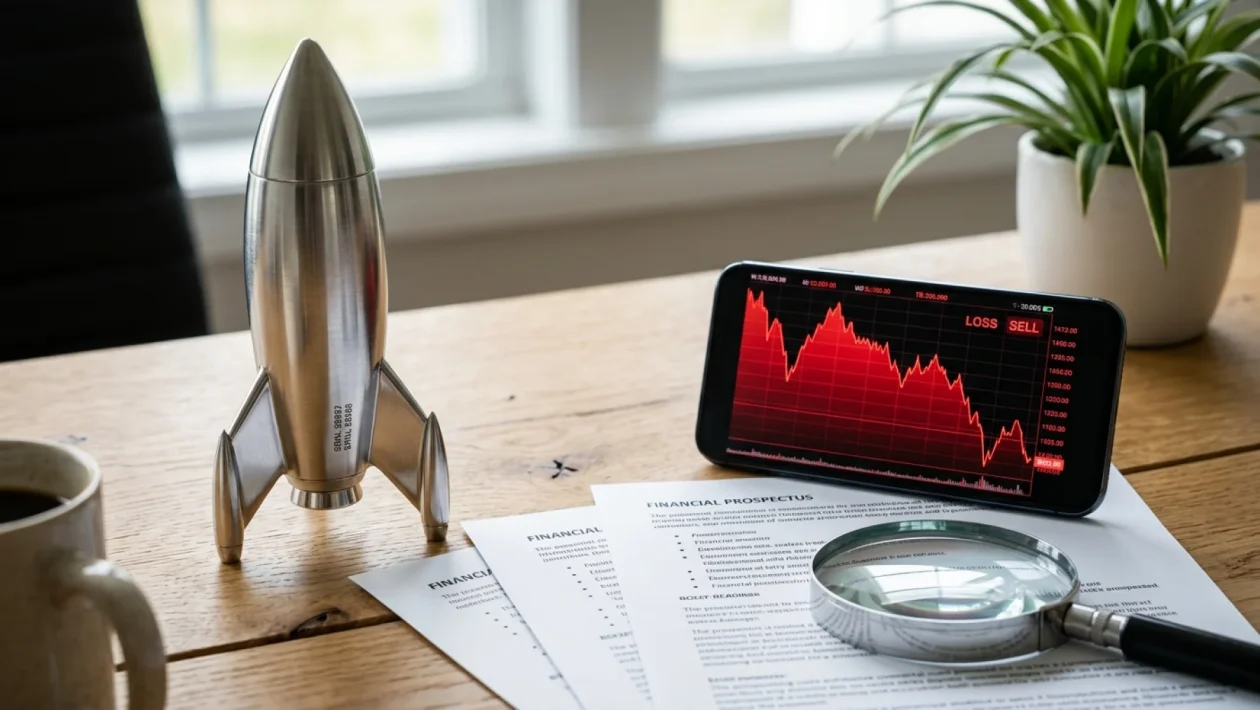
But when you exhale and look at the actual net income, SpaceX recognized an ugly $4.94 billion net loss. They are bridging that massive gap with heavy depreciation, aggressive capital expenditures, and nearly $2 billion in share-based compensation.
Here is a quick breakdown of what the math actually looks like:
| The Corporate Pitch | The Harsh Reality |
|---|---|
| $6.58 Billion (Adjusted EBITDA) | -$4.94 Billion (Actual Net Loss) |
| Rapid xAI Market Dominance | Just 12.5% Q1 Sales Growth |
| Unprecedented IPO Demand | Unsustainable 94x P/S Ratio |
They aren’t close to being profitable. Yet, they want you to pay a premium that assumes they already rule the world.
How to Spot the Flaws in Any Tech IPO
Before you risk your hard-earned cash on the next “sure thing” hitting the market, you need a system. Here is exactly how to protect your portfolio when a mega-stock goes public.
- Skip the press release: Ignore the media fanfare and go straight to the S-1 registration statement.
- Locate the net loss: Hit CTRL+F and search for “Net Loss.” Ignore the “Adjusted” figures entirely.
- Check the stock-based compensation: High insider payouts often mask severe cash burn rates.
- Calculate the P/S ratio: Divide the total valuation by annual sales. If it’s over 40, walk away.
Frequently Asked Questions
Is SpaceX currently a profitable company?
No. Despite highlighting positive adjusted operating earnings, the company’s recent filings reveal a staggering net loss of nearly $5 billion due to massive capital expenses and stock compensation.
When is the SpaceX IPO happening?
The record-breaking IPO is currently expected to debut on June 12, 2026. Thanks to recent exchange rule changes, it could be fast-tracked into major indices like the Nasdaq-100 shortly after.
Should everyday investors buy into the IPO?
With a historically unjustifiable valuation and lagging AI revenue, retail investors should exercise extreme caution. The current asking price leaves zero room for error.
🤝 Thank you for reading! It’s incredibly easy to get swept up in the romance of sending humanity to Mars, but your investment portfolio needs to stay grounded here on Earth.
💡 Do your own homework before jumping into this offering. Always check under the hood, read the ugly numbers, and never pay full price for a company that is still figuring out how to turn a true profit.
📱 Share your thoughts with me below. Are you going to risk it on the SpaceX IPO, or are you sitting this one out? Let’s keep the conversation going.
👇 Good luck out there in the markets this week, and stay sharp!