You just spilled your drink, screaming at the TV because the biggest goal of the tournament was just wiped off the board.
If you are frantically searching for exactly why the referee cancelled the goal after glancing at a completely confusing monitor screen, you certainly aren’t alone.
I am going to break down precisely what the Video Assistant Referee (VAR) saw on that pitch-side monitor that we didn’t, and why the hidden technology inside the ball forced the referee to blow the whistle.
World Cup Replay Angle Analyzed: The Hidden Technology
As we sit right in the thick of the July 2026 tournament, the technology used on the pitch has evolved massively.
If you were watching the main broadcast feed on TSN or streaming it on your Rogers ignite app, you likely saw a standard side-profile camera shot.
From the couch, the attacker looked perfectly onside, and the contact looked completely clean.
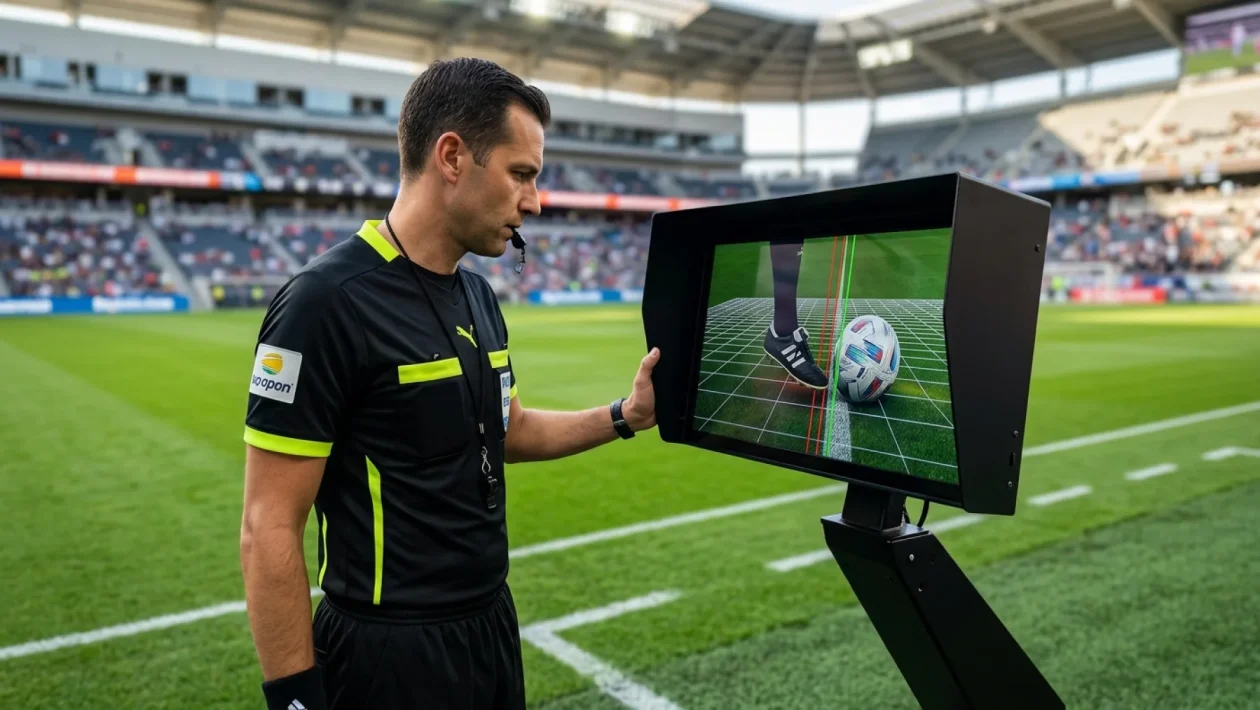
But the referee wasn’t looking at the broadcast feed; they were looking at a specialized World Cup replay generated by Semi-Automated Offside Technology (SAOT).
Here is a crazy hard fact: the official match ball contains an inertial measurement unit (IMU) sensor that sends data to the video operation room an incredible 500 times per second.
This allows the VAR room to pinpoint the exact millisecond the ball was kicked.
Why The Referee Really Cancelled That Goal
When the center referee is called over to the screen, it isn’t just to second-guess themselves.
They are looking for a “clear and obvious error” related to four match-changing situations: goals, penalty decisions, direct red cards, and mistaken identity.
Here is exactly how the review process plays out on the field:
- The VAR team spots an anomaly using the 12 dedicated optical tracking cameras positioned under the stadium roof.
- The VAR alerts the on-field referee through their earpiece, recommending an On-Field Review (OFR).
- The referee approaches the monitor and is shown the point of contact first, followed by the incident at normal speed to judge intent.
- The referee makes the final call, overriding the initial on-field decision if the 3D rendering proves an infraction.
In this specific case, the referee cancelled the goal because the 3D skeletal tracking showed the attacker’s shoulder leaning exactly two millimeters past the last defender.
Comparing The Angles: Broadcast vs. VAR Room
It is incredibly frustrating for fans when the TV replay tells a completely different story than the referee’s final decision.
The confusion usually stems from camera angles and optical illusions caused by the camera’s frame rate.
| The Broadcast Angle (What You Saw) | The VAR Angle (What The Ref Saw) |
|---|---|
| Standard 60 frames-per-second panning camera. | 500Hz sensor data mapped onto 3D player skeletons. |
| Subject to parallax error (distorted depth perception). | Perfectly automated, top-down geometric grid. |
Industry insiders have been warning us about this disconnect between the living room and the referee booth for years.
“The biggest issue with modern VAR isn’t the accuracy of the technology, but the failure to immediately broadcast the definitive 3D angle to the fans in the stadium and at home. It creates an unnecessary vacuum of trust.”
Frequently Asked Questions
Why doesn’t the TV broadcast show the VAR angle immediately?
The 3D rendering takes a few extra seconds to process and verify in the video room. Broadcasters rely on traditional camera feeds to keep the live action moving, which is why there is often a delay before viewers see the definitive, automated angle.
Can a referee refuse to look at the monitor?
Yes. The VAR can only recommend a review. If the on-field referee is completely certain of their initial call and believes the VAR’s description doesn’t constitute a clear error, they can wave off the recommendation, though this is highly unusual.
Does the ball sensor measure fouls?
No. The IMU sensor inside the ball only detects when and where the ball was touched. The referee still has to interpret whether a physical challenge between two players constitutes a foul using traditional video replays.
🤝 Share your thoughts in the comments below—did the ref get it right, or is this new technology ruining the spirit of the game?
💡 Remember this the next time you are screaming at your television: the referee is essentially watching a completely different game constructed of raw data points.
📱 Keep following our coverage as we bring you more insider breakdowns for the rest of this historic summer tournament.
👇 Good luck to your favorite team in the knockout stages, and let’s hope the next big goal actually stays on the scoreboard!