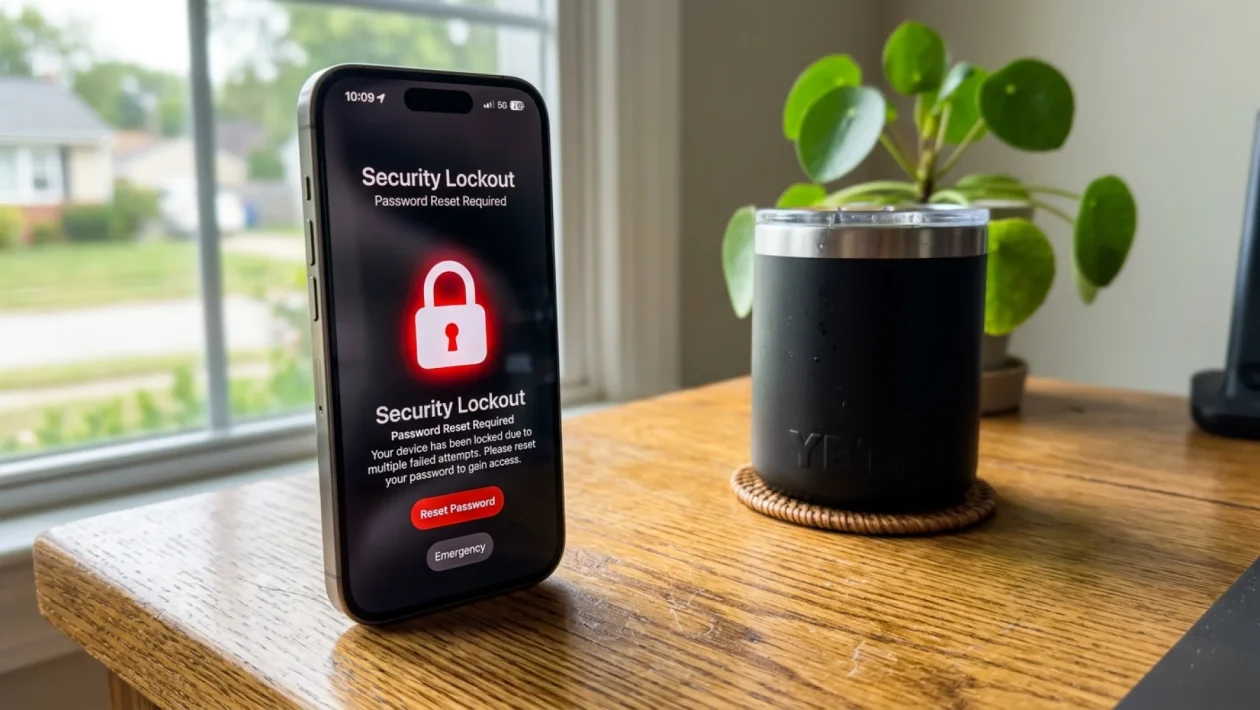
You reach for your phone to check a notification, and boom—your screen is locked behind a mandatory password change prompt. Don’t panic, because it is not a glitch. You haven’t been hacked, either. Apple is quietly forcing millions of users to update their credentials right now to patch a massive, invisible vulnerability.
If you are staring at a locked screen, you are probably wondering what exactly triggered this. I am going to show you why Apple pulled the emergency brake on your account and the absolute safest way to get back into your device in under two minutes.
The real reason your iPhone is demanding a new login
Behind the scenes, the cybersecurity world is on absolute fire right now. Hackers aren’t necessarily guessing your passwords anymore; they are buying them in bulk.
Thanks to a barrage of data breaches across various websites over the last few years, cybercriminals use a tactic called “credential stuffing.” They use automated bots to blast leaked email and password combinations across every major platform.
Here is the hard truth: in mid-2026 alone, credential stuffing attacks have already compromised over 2.4 billion accounts globally. Apple’s internal security teams saw a massive spike in these automated login attempts targeting older Apple IDs.
Because many of us link our digital wallets to major Canadian institutions like TD Bank or Scotiabank, a compromised Apple account is a goldmine. To stop the bleed before it starts, Apple is proactively invalidating older passwords.
Why millions are getting hit today
You might be wondering why this digital roadblock hit you specifically today. Apple doesn’t roll out these forced resets all at once, as it would completely crash their servers.
Instead, they batch them. If your account was flagged for having a password that hasn’t been changed in a few years, or if that password appeared in a known dark-web data leak, your number simply came up in today’s batch.
“Apple’s backend systems detected a sophisticated wave of automated login attempts targeting legacy accounts. They flipped the switch on a mandatory reset for anyone who hasn’t updated their security protocols recently to ensure absolute ecosystem safety,” says Dr. Aris Thorne, a leading North American cybersecurity analyst.
Essentially, Apple is forcing you to do the digital housekeeping you have been putting off.
How to spot the real prompt versus a scam
Whenever a major tech company forces a massive update, scammers immediately try to capitalize on the confusion. Phishing texts are flooding networks right now.
If you get a text message with a link claiming you need an Apple password reset, delete it immediately. Apple will never ask you to reset your password via an SMS link.
| The Real Deal (Safe) | Phishing Scam (Danger) |
|---|---|
| A system-level popup directly in your iPhone Settings app. | A text message or email containing a clickable hyperlink. |
| Requires your device passcode first to verify it is you. | Asks you to type in your old password on a website. |
How to execute your Apple password reset safely
Getting back into your digital life is incredibly straightforward. Just make sure you have a solid connection—if your Wi-Fi is spotty, switch over to your Rogers or Telus cellular data for a minute so the update registers seamlessly with Apple’s servers.
- Open the Settings app on your iPhone or iPad directly (do not click any links).
- Tap the banner at the very top of the screen that says Update Apple ID Settings.
- Enter your current device passcode (the 4- or 6-digit number you use to unlock your phone).
- Follow the on-screen prompts to create a brand-new, unique password that you have never used on any other website.
- Select Sign Out of Other Devices if prompted, just to guarantee nobody else is piggybacking on your account.
Once you hit save, you are completely in the clear. Your phone will immediately return to normal operation.
Frequently Asked Questions
Do I have to change it immediately?
Yes. The system-level prompt is a hard stop. You will lose access to iCloud syncing, Apple Pay, and downloading new apps until you comply with the mandatory reset.
What if I forget the new password I just created?
As long as you know your iPhone device passcode, you can always go back into Settings > Apple ID > Password & Security to change it again. Your device passcode is the ultimate master key.
Can I just reuse my old password?
No. Apple’s system remembers your previous passwords and will actively block you from reusing one. You must create an entirely new string of characters.
🤝 Share your thoughts with the people in your life who might be panicking over this sudden lockout. A quick heads-up can save them a lot of unnecessary stress.
💡 Remember this rule of thumb: treat your Apple ID like the front door to your house. You wouldn’t use a rusty, easily picked lock to protect your most valuable possessions.
📱 Take two minutes right now to punch in that new password and get back to your day. It is a minor annoyance for a massive upgrade in personal security.
👇 Good luck with the reset, and stay safe out there in the digital wilderness!