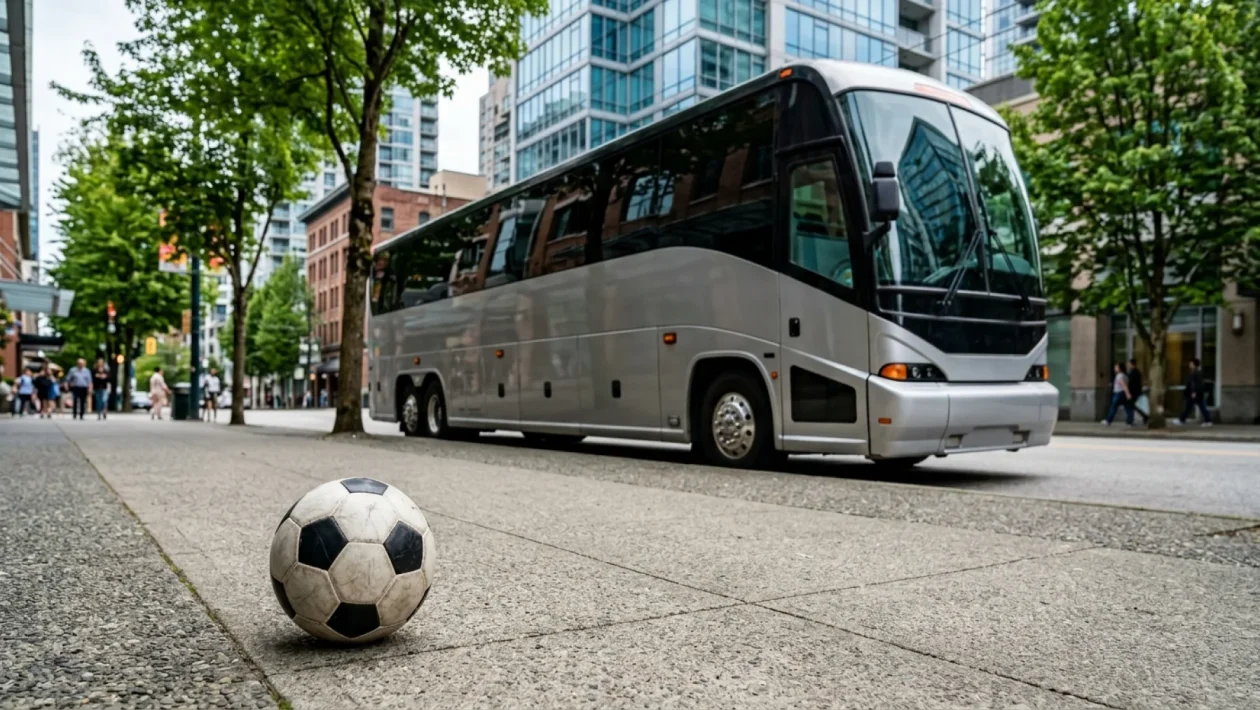
Social media is throwing around a heavy accusation: Vancouver is packing unhoused folks onto midnight buses and shipping them north to “clean up” for the 2026 FIFA World Cup. When a string of fires recently hit downtown Prince George businesses, local community boards instantly pointed fingers at the Lower Mainland. But before we grab our pitchforks, let’s pop the hood on this urban legend. The reality of what’s actually happening on our streets is far more complicated—and hitting much closer to home—than a phantom bus ride.
World Cup Rumours
You’ve probably heard the chatter while grabbing your morning double-double at Tim Hortons. The rumour mill insists that with the global spotlight shining intensely on B.C. this month, officials are trying to sweep our housing crisis under the northern rug.
It makes for a great, cinematic conspiracy theory. An anonymous TikTok video dubbed “The FIFA Pipeline” recently went viral, claiming street-level confirmation of a coordinated relocation effort.
But here is the catch: the video offered zero actual testimony and has since vanished entirely from the internet. Yet, the World Cup rumours caught fire anyway, fueled by our collective frustration.
The Truth About Vancouver’s Secret
Let’s look at the hard data instead of relying on digital gossip. If Vancouver was running a massive, secret relocation program, the numbers would show a massive influx of coastal residents up north.
Spoiler alert: they don’t.
A comprehensive point-in-time homeless count in Prince George completely blows up this narrative. The numbers prove that nearly half of the city’s unhoused population has either lived there their entire lives or for more than a decade.
| Origin of Prince George’s Unhoused | Percentage |
|---|---|
| Local to Northern B.C. / 10+ Years in City | 89% |
| Lower Mainland / Vancouver Island | Only 11% |
Here is a surprising, hard fact that demands our actual attention: 75 percent of the unhoused population in Prince George identifies as Indigenous. This is a staggering local issue, considering they make up just 14 percent of the city’s general population.
Vancouver’s official FIFA Host Committee has actually published a human rights plan strictly prohibiting the displacement of vulnerable people. While critics rightly argue the plan needs tougher measurable targets, the paper trail actively contradicts the secret shipping theory.
“Bussing” Problem
Why do we believe the bussing myth so easily? Because historically, Canadian politicians have pulled stunts like this.
We remember Ralph Klein handing out one-way bus tickets in Alberta, or Toronto’s controversial 1999 “Project Going Home.” Those historical ghosts make today’s rumours feel highly plausible to the average taxpayer.
“It’s a textbook moral panic. People are frustrated, and it’s easier to blame an invisible bus from Vancouver than face the complex local realities of our housing crisis.”
Here is exactly how a modern community myth is manufactured today:
- The Spark: A highly visible local incident occurs, like a fire or a surge in downtown vandalism.
- The Digital Match: Someone posts a baseless theory online, linking the event to a major news topic like the 2026 World Cup.
- The Echo Chamber: Frustrated locals share the post aggressively, treating a lack of official evidence as “proof” of a government cover-up.
- The Outrage: The rumour becomes local lore, forcing city officials to waste valuable resources debunking it.
Northern cities are dealing with very real challenges, from housing inmates released from regional correctional centres to sheltering displaced wildfire evacuees. These are heavy, complex burdens that require real teamwork.
But treating vulnerable citizens as pawns in a nonexistent transit conspiracy only divides us when we need to be working together.
Frequently Asked Questions
Is Vancouver paying unhoused people to leave before the World Cup?
No. Both Vancouver and Prince George officials have firmly denied these claims, citing zero evidence. The City of Vancouver’s public guidelines explicitly forbid relocating people just to meet FIFA hosting requirements.
If they aren’t from Vancouver, where are new unhoused faces coming from?
Many are actually from surrounding northern B.C. communities. People frequently travel to regional hubs to access specialized social services, the regional hospital, or because they were displaced by recent extreme weather events.
Why does this rumour keep coming back every few years?
It is a mix of historical baggage and sociological “moral panic.” Because actual relocation programs happened decades ago in other provinces, it remains a believable, easy scapegoat for communities struggling with highly visible poverty.
🤝 It’s time for some straight talk. We can’t fix our local streets if we’re constantly chasing ghosts on the highway. Let’s focus on real community solutions rather than viral scapegoats.
💡 Good luck navigating the noise out there. Always check the hard data before you hit that share button, because the truth usually lives right in our own neighborhoods.
📱 I want to hear your boots-on-the-ground perspective. Do you think cities are doing enough to manage the visibility of the housing crisis transparently?
👇 Drop a comment below and share your thoughts—let’s keep this conversation grounded in reality!