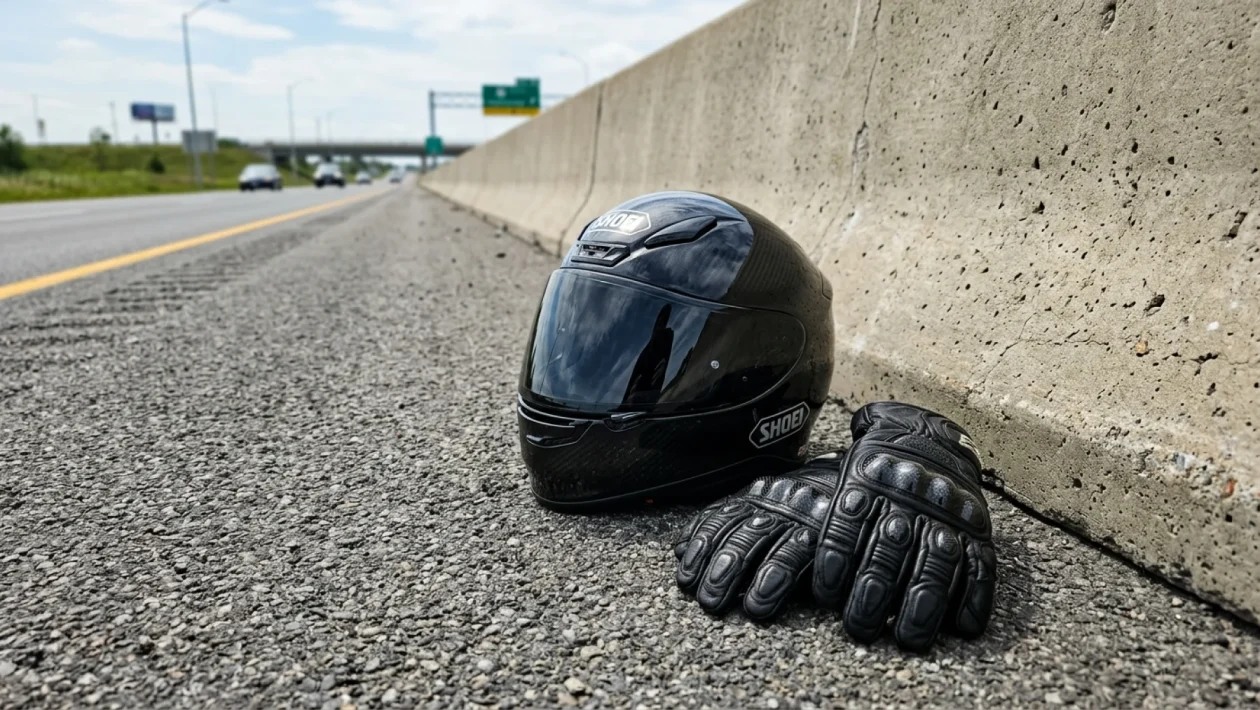
When a 28-year-old Windsor rider slammed into a concrete barrier on Highway 401 at Todd Lane this past Thursday night, the Essex County OPP reported he was rushed to the hospital with serious injuries—but he survived. That survival is not a fluke of luck. When you impact a stationary wall of concrete at 100 km/h, your skin, organs, and skeletal structure are completely at the mercy of kinetic energy. Escaping a high-speed highway collision alive comes down to pure physics, specialized impact gear, and your body’s trajectory in those crucial milliseconds.
Riding season is fully underway this May 2026, and the margin for error on Canada’s busiest traffic corridor is virtually zero. If your bike loses traction and sends you toward the median, your reaction dictates whether you walk away or end up a static highway fatality statistic. Here is the exact mechanical breakdown of how riders survive catastrophic barrier impacts.
Highway 401 Motorcycle Survival: The Reality of Busiest-Corridor Crashes
The Highway 401 corridor presents a uniquely hostile environment for motorcyclists. You are navigating heavy crosswinds, aggressive transport trucks, and deeply grooved pavement.
According to Transport Canada collision data, nearly 70% of single-vehicle motorcycle fatalities involve a rider striking a fixed object like a guardrail or concrete median. These barriers are engineered to redirect 80,000-pound semi-trucks, meaning they have absolutely zero “give” when a 180-pound human body hits them.
Surviving the 401 requires abandoning the illusion that denim and a basic leather jacket will save you. It demands an active safety protocol built around kinetic energy dispersal.
Why Shoei Helmets Save Lives in High-Velocity Impacts
Your skull cannot withstand a direct strike against a Jersey barrier without a premium buffer. This is where high-end engineering from brands like Shoei becomes the line between life and death.
Helmets like the Shoei RF-1400 utilize a multi-ply Matrix AIM+ shell combined with a dual-layer, multi-density EPS (Expanded Polystyrene) liner. When your head strikes concrete, the outer shell prevents penetration while the EPS liner intentionally crushes, slowing the deceleration of your brain inside your skull.
“When a rider strikes a concrete barrier, the localized impact force can easily exceed 250 Gs. A premium Snell-certified helmet compresses internally to stretch that millisecond of impact into a longer time frame, physically preventing catastrophic brain swelling,” says Ryan Kluftinger, senior motorcycle gear analyst at Canadian retailer FortNine.
The ‘Tuck and Slide’ Technique: Your Split-Second Defense
Gear only works if your body is positioned to use it. If you are separated from your motorcycle at highway speeds, flailing your limbs is a death sentence. You must execute the “Tuck and Slide” method to shed speed safely.
- Release the machine: The moment you realize a crash is unavoidable, let go of the handlebars. Never hold onto a bucking 400-pound motorcycle; it will pull you into the barrier or crush your lower extremities.
- Tuck your chin: Instantly lock your chin down tight to your chest. This stabilizes your cervical spine and ensures the reinforced crown of your helmet takes any secondary impacts, rather than your fragile neck or visor.
- Cross your arms over your chest: Pull your elbows in tight against your ribs. Extending your arms to brace for impact guarantees shattered wrists and compound collarbone fractures.
- Slide on your armor: Allow your back or shoulders to take the friction. Do not attempt to stand up or roll. Rolling creates a violent tumbling effect that causes centrifugal bone snaps. Let the slide naturally burn off your kinetic energy.
Concrete Barrier Crashes: Mitigating Blunt-Force Trauma
The friction of the slide will melt through regular clothing in less than two seconds. To survive the initial strike and the subsequent pavement slide, you need armor designed for blunt-force mitigation.
Outfitting yourself with gear from trusted North American suppliers like Joe Rocket Canada ensures you have access to CE-Level 2 armor. This viscoelastic armor stays soft while you ride but instantly hardens upon impact, absorbing the localized shock of a concrete barrier strike.
| Protective Element | Impact Reduction Mechanism |
|---|---|
| CE-Level 2 Back Protector | Reduces transmitted force to below 9 kilonewtons, preventing spinal fracture. |
| Kevlar/Dyneema Denim | Provides 4 to 7 seconds of slide time before road rash reaches the dermis. |
Frequently Asked Questions
How long does it take to stop during a highway slide?
If you come off your bike at 100 km/h, you will slide for roughly 45 to 60 metres. Depending on the pavement’s friction coefficient, it will take approximately 3 to 5 seconds to come to a complete, friction-induced stop. This is why high-denier abrasion resistance is non-negotiable.
Are airbag vests worth the investment for highway riding?
Absolutely. Electronic tethered airbag vests deploy in roughly 25 milliseconds—faster than the blink of an eye. They inflate around your neck, ribs, and collarbones, vastly reducing the blunt-force trauma associated with hitting a stationary concrete barrier.
🤝 Share this guide with every rider in your contact list before they hit the highway this weekend.
💡 Send this to a friend who still thinks a t-shirt and jeans are acceptable riding gear for the 401.
📱 Bookmark this page to review your emergency protocols and gear checklist before your next long-haul trip.
👇 Drop a comment on our social channels with the piece of gear that saved your life during a close call.