Sweat pooling on your forehead while you try to sleep isn’t just miserable—it’s an active drain on your body. When the brutal reality of the July 2026 heat dome hits and you don’t have central air, your living room can quickly transform into a dry sauna. You don’t need a massive renovation budget to drop the thermostat and make your home livable again.
I’m going to walk you through exactly how to manipulate airflow, upgrade your window treatments, and use common household fans to force hot air out. Heatwave home cooling is all about outsmarting the sun and turning your house into a passive cooling machine. Let’s get to work.
Heatwave Home Cooling: Unpacking The 5 Low-Cost Methods
The stakes for keeping your home cool are higher than just avoiding sticky shirts. According to a surprising hard fact from Health Canada, the indoor temperature should never exceed 26°C if you have older adults living with you. Above that threshold, the risk of heat exhaustion and severe strain spikes dramatically.
Tackling this without central AC requires a combination of five distinct strategies: blocking radiant heat, forcing cross-ventilation, upgrading your sleep setup, mastering fan dynamics, and strategically deploying portable air conditioning. You don’t have to tackle all five at once. Even implementing two of these methods will noticeably shift the climate in your home.
“Most folks aim a fan directly at their face to cool down, but that just recirculates stale, warm air in a closed room. True cooling requires exhausting the hot air out while drawing fresh, shaded air in from the other side of the house.” – Mark Tremblay, Independent HVAC Specialist
Strategic Box Fan Placement: You’ve Been Using Fans Wrong
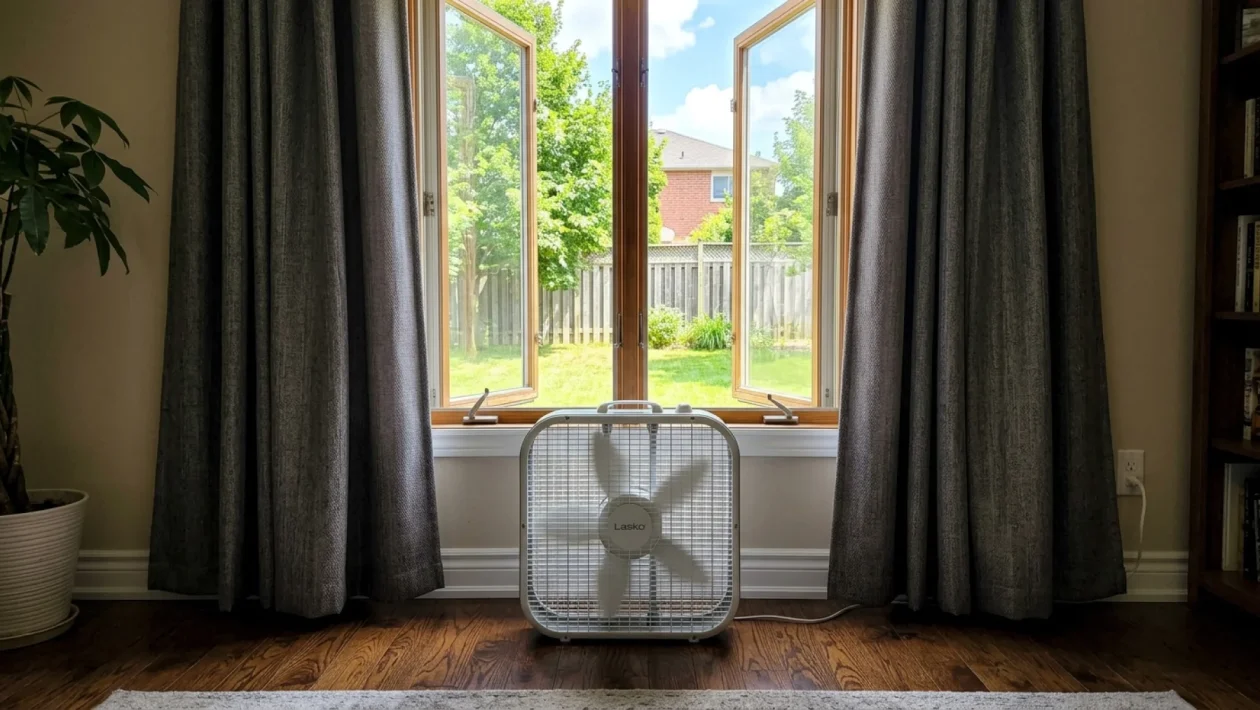
If you have a standard box fan sitting in the corner of your bedroom, you are likely using it incorrectly. Simply blowing hot air around a closed room provides a temporary breeze but does nothing to lower the actual room temperature.
To actively cool a space, you need to create a pressure vacuum that pulls cool air from the shaded side of your property. Here is the exact, counterintuitive method you need to follow tonight:
- Locate a window on the sun-facing (hottest) side of your home and open it wide.
- Place a box fan approximately two feet back from the open window.
- Turn the fan so it faces outward, actively blowing the hot indoor air outside.
- Walk to the opposite, shaded side of your home and open a window to allow cool air to be pulled in.
The Blackout Curtain Rule: Why Your Current Blinds Are Failing
Sunlight pouring through your windows acts like a magnifying glass, rapidly baking your floors and furniture. The single most effective passive cooling method is to kill that radiant heat before it enters the room. This is where the blackout curtain rule comes into play.
Not all heavy curtains are created equal. You need to hit up your local Canadian Tire or browse online for true thermal curtains. Look for a “3-pass” or “4-pass” lining, which is specifically designed to reflect solar radiation.
The secret is in the backing. Ensure the side facing the window is white or highly reflective to bounce the sun’s rays away. Heavyweight cotton or velvet, tightly fitted against the wall, will trap whatever heat does manage to get through, keeping your living space dark and chill.
Beat The Summer Heat: Upgrading Your Bedding And Portable AC Strategy
If you’re still sleeping under heavy synthetic sheets, you are trapping body heat and ruining your sleep cycle. Swap your bedding for 100 percent pure linen or cotton. Brands like the Canadian company Silk & Snow offer excellent naturally porous, moisture-wicking flax linen that allows heat to escape all night long.
When passive methods aren’t enough, renting or buying a portable air conditioner is your final line of defense. They are entirely condo-friendly and don’t require permanent installation. The trick is to buy a unit with high enough BTUs to handle the square footage of your heaviest-use room.
| Cooling Method | Upfront Cost & Effort |
|---|---|
| Thermal Blackout Curtains & Fans | Under $150 total, zero installation |
| Portable AC Unit (10,000+ BTU) | $350 – $500+, requires window venting kit |
Heatwave Survival FAQs
Does pointing a fan out the window actually drop the temperature?
Yes, significantly. By facing a fan outward in a hot room, you force the stagnant, warm air outside. If you open a window on the cooler side of the house, fresh air is naturally siphoned in to replace it.
What is a “3-pass” thermal lining?
A 3-pass lining means the curtain fabric has been coated three times with an opaque, foam-like material. This prevents sunlight from piercing the fabric and heavily insulates the window against radiant summer heat.
Can linen sheets really keep me cooler than cotton?
Absolutely. While cotton is breathable, flax linen has thicker fibers and a looser weave. This creates superior airflow and moisture-wicking properties, keeping your skin dry during muggy summer nights.
Final Thoughts On Staying Cool
🤝 Listen, beating the heat without AC requires a bit of strategy, but taking back control of your home’s temperature is incredibly satisfying. Once you master cross-ventilation, you’ll wonder why you ever suffered through stuffy living rooms in the past.
💡 Treat your windows like the insulation barriers they are meant to be. Drop those thermal curtains the second the sun hits the glass, and let your house do the heavy lifting for you.
📱 If these tips helped you finally get a decent night’s sleep, share your thoughts or send this guide to a buddy sweating it out in a top-floor apartment.
👇 Good luck out there, stay hydrated, and keep those box fans pointing out!