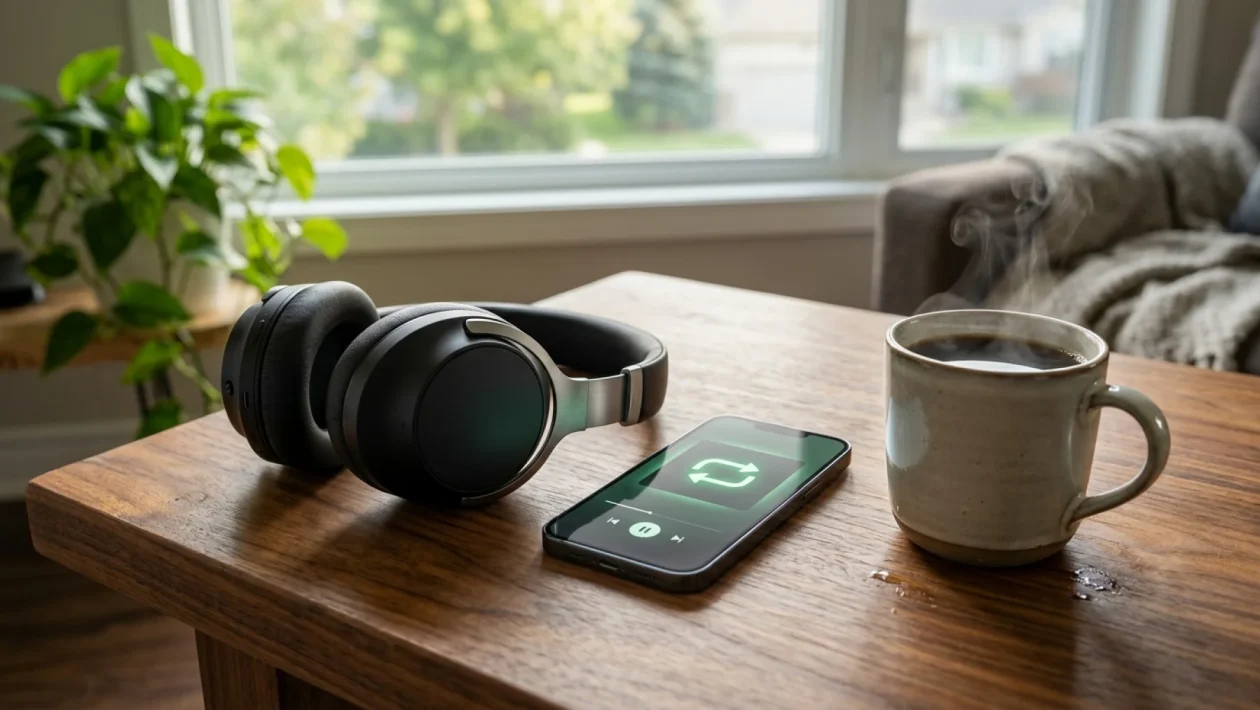
You hit play on that one specific track for the 47th time this week. You know every breath, every guitar slide, and exactly when the drum drops. Your friends probably think you’re stuck in a rut, but science says you are actually performing high-level emotional regulation. Today, we are tearing down exactly why your brain demands that familiar audio loop and how it secretly engineers your daily peace of mind.
Listening On Repeat: The Ultimate Anxiety Killer
We live in an era where our notifications never stop and the world feels incredibly unpredictable. Hitting play on a track you know inside out isn’t just a lazy choice. It is a highly calculated survival tactic.
For many of us, navigating a chaotic summer—maybe battling gridlock on the 401 or dealing with a stressful job site—requires an anchor. Listening on repeat builds an instant emotional fortress around your mind.
Because you already know exactly what is coming next, your brain doesn’t have to work hard to process the incoming information. It just gets to coast, dropping your daily anxiety levels straight through the floor.
The Secret Psychology Of The Familiarity Effect
Psychologists call this the “mere-exposure effect,” but let’s just call it the comfort zone of sound. Human brains are practically hardwired to love the predictable.
When you eliminate the element of surprise, you completely remove mental friction. Think about it like pulling into your own driveway after a brutal ten-hour drive; that deep sigh of relief is exactly what your mind does when the opening chords of your favorite song kick in.
This is especially vital for introverts. Cranking up a highly familiar track creates a reliable shield against overwhelming external noise. It acts as an auditory sanctuary where you can finally recharge your batteries without any unexpected curveballs.
Why We Crave The Same Song: It’s A Biological Dopamine Hit
You aren’t just emotionally attached to your favorite summer anthem. You are biologically hooked on the chemical rush it physically provides to your nervous system.
According to a landmark 2022 report from the Center for Music in the Brain, deeply familiar music directly triggers your brain’s internal reward system. Every time that killer chorus hits, your gray matter pumps out dopamine—the exact same natural chemical that makes eating a great meal feel so incredibly good.
“When we predict a musical sequence correctly, the brain rewards us. But once a song is overplayed, it crosses the neural spectrum, and the brain physically stops absorbing new information from it.” – Peter Vuust, Professor at the Royal Academy of Music.
It is basically a highly legal, completely free mood booster. No wonder you keep smashing that replay button while grabbing your morning coffee at Tim Hortons.
Over And Over: The Hidden Analytics Of Obsessive Listeners
For some folks, looping a track isn’t about chilling out at all. It is an intense, deeply analytical mission.
These listeners use repetition to tear a song apart like an old engine block. They want to hear the hidden bassline, the background harmonies, and the subtle studio tricks that the producer buried deep in the mix.
Every single listen uncovers a brand new mechanical detail. It turns a standard three-minute pop song into a massive logical puzzle that their brain is desperate to solve, note by note.
| The Perks of the Loop | The Pitfalls of the Loop |
|---|---|
| Massive dopamine release and fast stress relief. | Eventual auditory fatigue (the song loses its magic). |
| Creates a predictable, safe mental space to focus. | Limits your exposure to new artists and genres. |
If you have played a track so much that it completely lost its spark, you need an auditory reset. Here is exactly how you get the magic back:
- Take a Hard Detox: Remove the song from all your Spotify or Apple Music playlists for exactly two weeks. Force the withdrawal to let your brain reset.
- Change the Environment: Only allow yourself to listen to it when you are in a completely new setting—like a weekend camping trip or a different driving route.
- Listen to the Live Version: Swap the polished studio track for a raw, live performance. The slightly different tempo and crowd noise will trick your brain into hearing it as a “new” song.
Frequently Asked Questions
Is it normal to listen to one song for hours?
Absolutely. It is a highly common coping mechanism for stress and a fantastic way to maintain deep, unbroken focus while working or studying.
Does listening on repeat mean I have anxiety?
Not necessarily. While it is a proven tool to reduce anxiety, many people do it simply because the song’s specific tempo reliably releases a rush of feel-good chemicals.
Will I eventually ruin my favorite song by overplaying it?
Yes, your brain will eventually reach a state of auditory fatigue. You will stop processing the emotion of the music and only hear the noise, which is exactly why taking strategic breaks is crucial.
🤝 We all have that one track that feels like a perfectly worn-in pair of work boots—dependable, comfortable, and exactly what you need to get through a tough day.
💡 The next time someone gives you a weird look for looping your favorite tune, you can confidently tell them you are just conducting advanced neurochemical maintenance.
📱 If you found this breakdown helpful, share your thoughts below or send this to that one friend who hijacks the aux cord on every single road trip.
👇 Good luck out there, keep your playlists loud, and I’ll catch you in the next one!