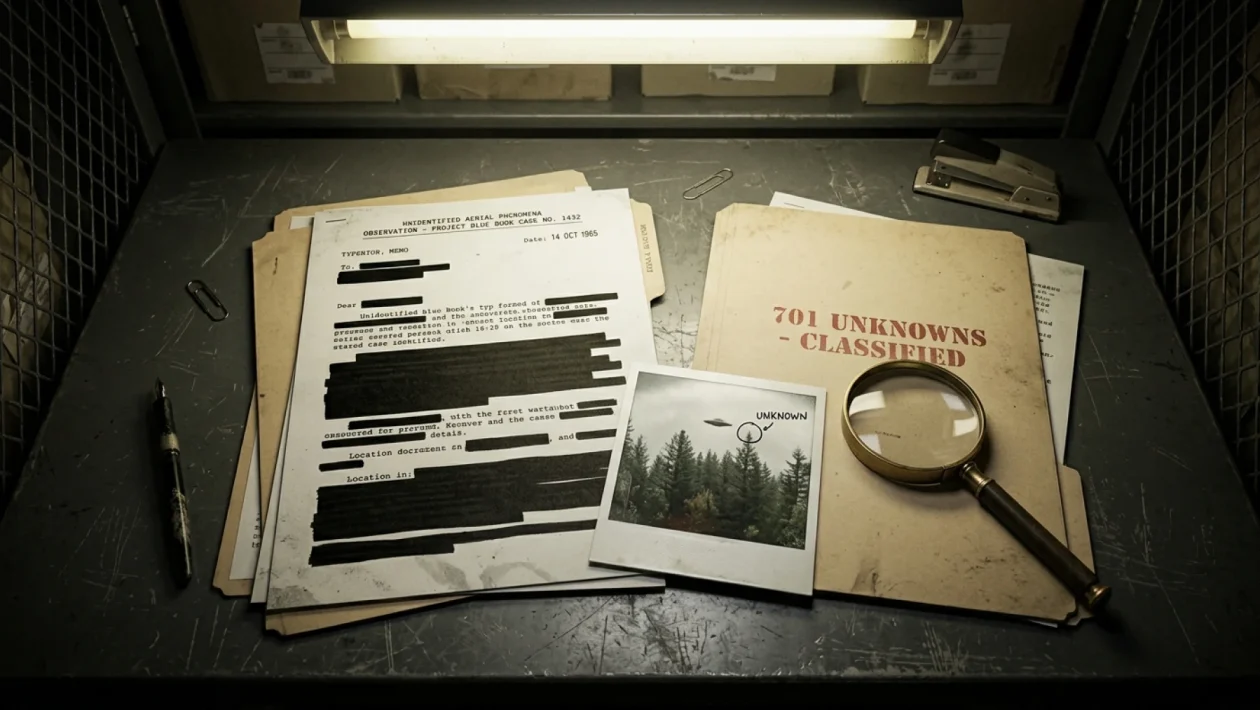
Deep inside the National Archives lies a staggering collection of over 12,000 declassified documents that laid the groundwork for everything we know about government transparency. The Project Blue Book archives aren’t just a dusty relic of the Cold War. They are the literal blueprint for how the modern military handles, categorizes, and occasionally buries reports of Unidentified Anomalous Phenomena (UAP). While the media fixates on the latest high-resolution Navy FLIR videos this Spring of 2026, the real key to understanding the Pentagon’s current disclosure playbook is hiding in these historical files. Out of those thousands of reports, exactly 701 remain genuinely unexplained by any conventional science.
Project Blue Book Archives: Inside The 12,000-File Vault
Between 1952 and 1969, the United States Air Force ran a systematic study to determine if anomalous objects in the sky were a national security threat. The resulting massive intelligence sweep generated what we now call the Project Blue Book archives.
These files are packed with field reports, grainy photographs, and frantic transcripts from commercial pilots and military personnel. We are talking about highly trained observers who tracked metallic discs and glowing orbs pulling impossible G-forces.
Today, the Pentagon’s All-domain Anomaly Resolution Office (AARO) and the Canadian Department of National Defence still reference these historical baselines when evaluating modern airspace incursions.
Unlocking The Pentagon’s Cold War Playbook
The primary goal of the initiative wasn’t necessarily scientific discovery. According to heavily redacted memos from the era, the objective was often public pacification.
The Air Force aggressively tried to explain away sightings as weather balloons, swamp gas, or astronomical anomalies. This is where understanding older aerospace technology becomes crucial to the mystery.
Early primary radar systems were highly susceptible to temperature inversions. This is a real aviation phenomenon where radar beams bend along thermal atmospheric layers, painting false solid targets on the radar screen.
Investigators weaponized this fact to dismiss hundreds of credible reports, even when visual confirmations from fighter pilots directly accompanied the radar returns.
“The military’s approach during the Cold War was to shoot down the narrative before shooting down the object. We were told to find a conventional explanation, no matter how much we had to bend the physics to make it fit.” – Former USAF Intelligence Officer
Despite the aggressive debunking campaign, the archives left us with a clear dividing line between simple misidentifications and true anomalies.
| Case Status | Historical Details |
|---|---|
| The Debunked | Venus, weather balloons, and thermal inversion radar ghosts accounted for roughly 90% of the declassified files. |
| The 701 Unknowns | Cases featuring multiple sensor confirmations and credible military witnesses that entirely defied 1960s physics. |
Modern UAP Secrets: Why These Old Files Matter Today
Fast forward to May 2026, and the echoes of the Cold War are deafening in the halls of Washington. Recent Congressional hearings have proven that the bureaucratic stigma heavily manufactured decades ago directly harmed aviation safety.
For generations, commercial pilots were terrified to report near-misses with anomalous objects for fear of losing their flight status and pensions.
Even NORAD, tasked with defending North American airspace, had to recently recalibrate its radar gate filters to catch slow-moving, high-altitude anomalies. The old criteria would have simply ignored these targets as background noise.
You don’t need a top-secret clearance to investigate aerospace anomalies like a pro. If you spot something unusual in the sky today, apply the same rigorous data-matching that modern investigative journalists use:
- Check Commercial Traffic: Immediately open an app like Flightradar24 to rule out conventional aircraft, drones, or high-altitude balloons in your specific grid.
- Log The Met-Data: Note the exact time, GPS coordinates, and weather conditions. Dense cloud cover and temperature shifts can create wild optical illusions.
- Cross-Reference Satellites: Use satellite tracking websites to ensure you aren’t just witnessing a Starlink train catching the evening sun.
- Submit to the Pros: File a detailed report with civilian research groups or national aviation safety boards to get your data on the record.
Frequently Asked Questions
Are the Project Blue Book archives fully declassified?
Yes, the vast majority of the files were declassified and made available to the public through the National Archives. However, some names and specific identifying details of witnesses remain redacted for privacy reasons.
Did the Canadian government have a similar program?
Absolutely. Canada ran its own parallel investigations, most notably Project Magnet. This initiative closely mirrored the US Air Force’s efforts to categorize and analyze anomalous sightings over North American airspace.
Why did the Air Force shut down the original study?
The program was officially terminated in 1969 after the controversial Condon Committee concluded that further study of these phenomena could not be justified on the grounds of scientific advancement or national defense.
🛸 Stay vigilant, because the sky above us is far more crowded and mysterious than the official historical narratives suggest.
📁 The ghosts of the old government archives remind us that true scientific inquiry requires looking at the raw data without institutional bias.
👁️ If you happen to look up tonight and see something that defies all explanation, remember that you are stepping into an ongoing, decades-long mystery.
👇 Share your sightings and keep demanding transparency, because the real truth isn’t just out there—it’s waiting to be fully declassified.