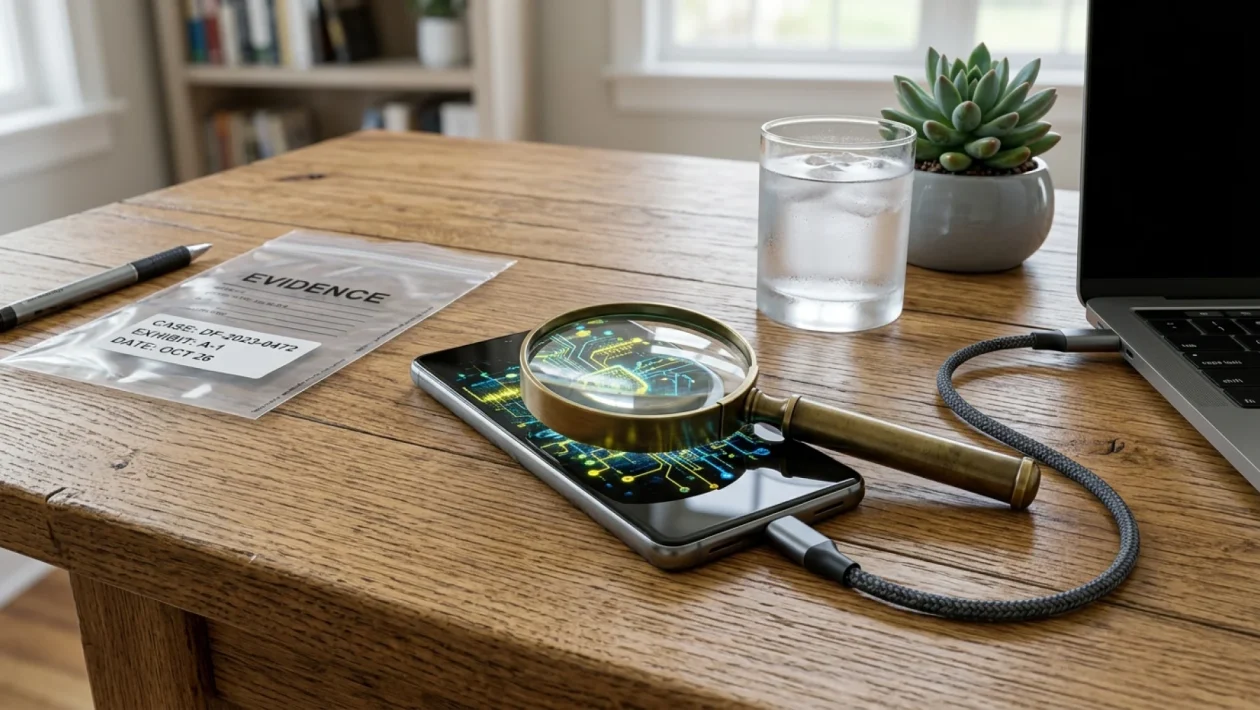
We’ve all bought into the tech industry’s slickest marketing pitch: hit send, and poof, your message vanishes into the digital ether. But when a tragic mystery unfolds and lives are on the line, that illusion of absolute privacy shatters fast. Today, we are tearing the lid off the myth of the disappearing message. If you think deleting an app clears your history, you are dead wrong. We are diving deep into the grim and highly contested July 2026 investigation of Mississippi teen Nolan Wells, showing you exactly how federal authorities rip apart mobile devices to find the truth.
Let’s get one thing straight right out of the gate. Snapchat forensic evidence isn’t just some Hollywood buzzword; it is a very real, very aggressive science. When timelines don’t add up and stories clash, investigators don’t just take a witness’s word for it anymore. They go straight to the servers.
Snapchat Forensic Evidence
Think of your phone as a hyper-active snitch in your pocket. Every single time you open an app, send a photo, or even just walk down the street with your device turned on, a handshake happens between your phone and a remote server. In modern criminal investigations, capturing this data is the ultimate game-changer.
When an 18-year-old community college football player goes missing, like in the Nolan Wells case, the first thing law enforcement looks for is the digital trail. The FBI and local authorities don’t just dust for fingerprints; they dust for data packets.
Here is a hard fact that surprises most people: according to digital forensic experts, a staggering 94% of a user’s geolocation history can still be triangulated even if they manually disable their device’s GPS. The system relies entirely on background cell tower handshakes.
Major North American telecom giants, from AT&T in the States to Rogers up here in Canada, constantly log these background network pings. If a crime is suspected, that data gets handed over fast.
Recovering Deleted Messages
Nolan Wells’ mother rightly suspected that crucial messages from the day her son disappeared were wiped clean. His friends had his phone, and mysteriously, his Snapchat history from that fateful Fourth of July was a ghost town.
But deleting a message on your screen does not wipe it from existence. It simply removes the local pathway to that file on your specific device. The actual data often sits comfortably on the company’s server farm until it is overwritten.
“I think they’re going to be looking at a lot of that … because you have a timeline that has a lot of contradictions.”
That is retired FBI agent Kieran Ramsey laying out the harsh reality of digital forensics. Law enforcement relies on a specific sequence to drag those “deleted” files back into the light of day.
- The Preservation Letter: Authorities fire off a legally binding document to the social media company, forcing them to freeze the user’s server data immediately.
- The Subpoena: Investigators secure a grand jury subpoena or a search warrant to legally compel the platform to hand over the frozen archive.
- The Device Extraction: Using advanced forensic software, technicians rip a physical copy of the phone’s hard drive, digging through unallocated space for hidden fragments.
Exposing Digital Footprints
Messages only tell half the story. The other half is location, location, location. Exposing a digital footprint means mapping out exactly where a device was at any given second, and more importantly, whose device was traveling right next to it.
When Wells’ friends claimed they took a boat home without him around 3 p.m., leaving him on the remote Horn Island, their digital footprints either back up that claim or expose a lie.
Investigators cross-reference different types of data to build a bulletproof timeline. It is incredibly hard to outsmart.
| Evidence Source | What It Reveals To Investigators |
|---|---|
| App Servers (Snapchat, IG) | Recovered chat logs, exact login timestamps, IP addresses, and shared media. |
| Mobile Carriers (Cell Towers) | Broad geographic movement, SMS logs, and proximity to other known devices. |
The Nolan Wells Case
The tragedy of Nolan Wells isn’t just about data; it’s about a family demanding answers. Wells, a young Black man, was out with three white friends who ultimately returned without him, yet somehow ended up with his phone and his keys.
Civil rights attorney Ben Crump and Rev. Al Sharpton have stepped in, pointing out the glaring red flags. They aren’t explicitly calling it a racially motivated crime, but they refuse to ignore the suspicious circumstances.
With the FBI now assisting the Jackson County Sheriff’s office, the investigation is barrelling toward a grand jury. A mutual inspection of the recovered cellphone is underway.
Every deleted snap, every GPS ping, and every cell tower handshake will be laid bare. The truth is trapped inside that circuitry, waiting to be read.
Frequently Asked Questions
Can police always recover deleted Snapchat messages?
Not always, but the odds are much higher than you think. If law enforcement issues a data preservation letter before the platform’s servers permanently overwrite the data, they can usually retrieve the underlying content and metadata.
How long do telecom companies store location data?
It varies by carrier, but most major North American network providers retain detailed cell tower ping logs and location data for anywhere from one to five years.
What exactly is a data preservation letter?
It is an urgent legal request sent by authorities to a tech company. It legally mandates the company to lock down and save a specific user’s account data, preventing routine automated deletion while investigators work on getting a formal search warrant.
🤝 It’s a tough reality to face, but in the modern age, our secrets are rarely as secure as we hope. The technology that keeps us connected is the exact same technology that will testify against us in a court of law.
💡 Digital forensics has fundamentally changed the landscape of missing persons cases. While the Wells family is enduring an unimaginable nightmare, the sheer power of modern data recovery offers a glimmer of hope that justice will prevail.
📱 What do you think about the illusion of digital privacy? We trust these apps with our lives, but maybe we shouldn’t.
👇 Drop into the comments and share your thoughts on the Nolan Wells investigation. Do you think the tech companies should have to hand over data even faster? Stay sharp, stay safe, and I’ll catch you in the next breakdown.